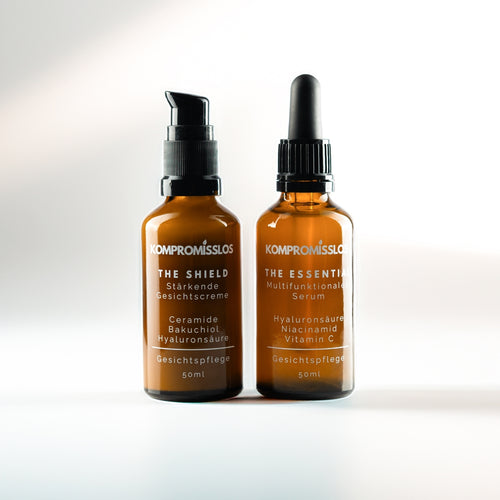
Vegan day cream for sensitive skin: what it needs to do – and what it doesn’t
VEGAN DAYTIME SKINCARE
A vegan day cream contains no raw material of animal origin and is designed for the demands of the day: a light texture under make-up, antioxidant active ingredients against environmental stressors, and care that supports the skin barrier. For sensitive skin, what matters most is a short, fragrance-free formula. It does not replace sun protection.
What is the difference between a day cream and a night cream?
A day cream is meant to shield your skin through the day; a night cream accompanies its regeneration while you sleep. That leads to three practical differences. First, texture: during the day there is often sunscreen or make-up on top, so a light, fast-absorbing consistency makes sense. Second, the choice of active ingredients: in the morning, antioxidants such as vitamin C are the obvious choice, because they neutralise free radicals generated during the day by light and the environment. Ingredients that can make your skin more sensitive to light fit better into an evening routine. Third, richness: a heavy night cream can look shiny or pill under make-up. With sensitive skin there is a fourth point: the shorter the ingredients list, the fewer potential triggers. Whether you need two separate products for this is another question. With The Duo of serum and cream, the answer is deliberately no, because both steps work the same way morning and evening.
| Criterion | Morning | Evening |
|---|---|---|
| Main job | Shielding against environmental stressors | Supporting regeneration during sleep |
| Texture | Light, absorbs quickly | Can be richer |
| Typical active ingredients | Vitamin C, niacinamide, humectants | Lipids, ceramides, bakuchiol |
| Sun protection | Needed separately | Not needed |
What makes a day cream vegan?
For a day cream, vegan means that not a single ingredient comes from an animal – not even a by-product. In daytime skincare, animal-derived raw materials turn up in different places from night creams. The most common case is carmine, declared as CI 75470, which is obtained from scale insects and provides the colour in tinted day creams and BB creams. Then there is lanolin from sheep’s wool as an emollient, beeswax under the name Cera Alba, silk proteins as Serica or Hydrolyzed Silk in products with a silky finish, and collagen and elastin in anti-ageing claims. The only way to spot them is the ingredients list on the packaging, not the word natural. A raw material can be completely natural and still of animal origin. Nor is the packaging proof: a leaf symbol or a green lid is not a verified claim. At Kompromisslos, the full ingredients list is openly available.
Which active ingredients belong in a vegan day cream for sensitive skin?
For sensitive skin in the morning, three groups of active ingredients count: humectants, barrier building blocks and a well-tolerated antioxidant. The Duo covers all three. Hyaluronic acid at 2 per cent binds water in the upper layers of the skin. Ceramides, squalane and panthenol are among the barrier building blocks and support the skin barrier. As the antioxidant, it contains vitamin C in the form of 3-O-Ethyl Ascorbic Acid at 2 per cent – a water-soluble derivative that, according to a study in the International Journal of Pharmaceutics: X, is considerably more stable than pure ascorbic acid and therefore oxidises more slowly. Then there is niacinamide at 5 per cent. A paper in the British Journal of Dermatology showed that nicotinamide stimulates the skin’s own ceramide production in the stratum corneum and reduces water loss through the skin. All percentages apply to The Duo as a whole, not to a single product. You can read how the two actives differ in the comparison vitamin C or niacinamide.
Added to that are edelweiss extract and gentian root extract at 2 per cent each. Just as important is what is left out: perfume, essential oils used for scent and high acid concentrations.
Does a vegan day cream replace sunscreen?
No. A day cream without declared UV filters offers no measurable sun protection, however caring it is. The Federal Food Safety and Veterinary Office (FSVO) states that sunscreens must protect against both UVB and UVA radiation and contain approved UV filters for this purpose, which must be declared on the packaging. If no SPF is stated, there isn’t one in the product. Check the information on the packaging, not the product description in the online shop. The same goes for tinted day creams: coverage is not sun protection. The FSVO names clothing, a hat, sunglasses and shade as the best protection, with sunscreen as an addition for uncovered areas. For your morning routine, that means skincare and sun protection are two steps, not one. The Shield cream is a skincare cream without UV filters and does not replace your sunscreen.
How do you apply a vegan day cream correctly in the morning?
The order in the morning is always the same: from the lightest texture to the heaviest. In practice, there are four steps. First: cleanse your face with lukewarm water and just pat it dry, don’t rub. Second: apply 3 to 6 drops of serum to skin that is still slightly damp and let it absorb briefly. Humectants such as hyaluronic acid work better when there is water available for them to bind. Third: 3 to 6 pumps of cream on top, gently patted in rather than massaged. Fourth: apply sunscreen, and only then reach for your make-up. Waiting one to two minutes between layers is important; otherwise make-up can pill. More product is no substitute for waiting, and in the morning fewer layers are almost always better than more. A bottle lasts 2 to 4 months, depending on how often you use it. The detailed how-to-use guide shows you both steps in detail.
When don’t you need a separate day cream?
You don’t need a separate day cream if your cream is light enough to work under sunscreen in the morning and nourishing enough for the evening. That is exactly what The Shield cream as daytime skincare is designed for. Two separate products are worthwhile mainly if your skin genuinely has different needs in the morning and evening – for example very oily skin that needs a matte texture during the day, or if you want a noticeably richer cream for very dry skin in the evening. With very sensitive skin, there is even little to be said for two formulas, because every additional product is an additional potential trigger. If your skin is prone to blemishes, texture matters more than the number of products; you will find more on this under skincare for blemish-prone skin. And if your skin is happy with its current cream, there is no reason to switch.
When should you see a specialist instead of reaching for a day cream?
Cosmetics care; they don’t treat. If your skin persistently burns, weeps or flakes, or if redness doesn’t settle for weeks, that calls for a dermatological assessment, not a new cream. The same applies to skin changes that alter in shape, colour or size, to severe itching and to reactions that appear shortly after applying a product. Make a note of such a reaction even if it fades on its own after a few hours, because the pattern is the more important information. A short note with the date, product and reaction is all you need. A day cream can soften the look of dryness and tightness and support the skin barrier. It is no substitute for a diagnosis. What others have experienced when using it can be found in the feedback from more than 125 reviews.
I am often asked why we don’t have a separate day and night cream. The honest answer: I couldn’t find a reason I could justify. The differences between most day and night versions on the market lie in texture and fragrance, not in the logic of the active ingredients. So I developed one cream that is light enough for the morning and nourishing enough for the evening, and I deliberately didn’t mix sun protection into it. An SPF in a skincare cream is rarely applied in the amount it needs to work. I would rather have two honest products than three half-hearted ones.
Frequently asked questions
What is a vegan day cream?
A vegan day cream is a daytime facial skincare product that contains no raw material of animal origin – no lanolin, beeswax, honey, carmine, silk protein or collagen. It is usually formulated to be lighter than a night cream, so that sunscreen and make-up sit well on top.
Does sensitive skin need a special day cream?
Above all, sensitive skin needs a short, fragrance-free formula, not necessarily a dedicated day product. What matters are barrier building blocks such as ceramides, squalane and panthenol, and leaving out perfume and high acid concentrations. A light texture also helps, because it works better with sunscreen.
Does a day cream replace sunscreen?
No. Only products with declared UV filters and a stated SPF offer sun protection. The FSVO requires sunscreens to protect against UVA and UVB radiation and the filters to be listed on the packaging. If there is no SPF on your day cream, you also need a separate sunscreen.
How can you tell whether a day cream is really vegan?
From the ingredients list on the packaging. Look out for Lanolin, Cera Alba, Mel, CI 75470, Serica, Hydrolyzed Silk, Collagen and Elastin. These names stand for animal-derived raw materials. Terms such as natural, gentle or dermatologically tested say nothing about whether a product is vegan.
Can you use a day cream in the evening too?
Yes, as long as it is nourishing enough. A light day cream works just as well in the evening, provided your skin doesn’t feel tight with it. The other way round is trickier: a very rich night cream can look shiny or pill under make-up. The Shield cream is deliberately made for both times of day.
Which texture works best under make-up?
A light cream that absorbs within one to two minutes and leaves no oily film. Apply 3 to 6 pumps, pat them in gently and wait briefly before sunscreen and make-up follow. Not waiting long enough is the most common reason for pilling.
How much does vegan daytime skincare from Switzerland cost?
At Kompromisslos, The Duo of The Essential serum and The Shield cream costs CHF 109.90. A bottle lasts 2 to 4 months, depending on how often you use it. Delivery within Switzerland costs CHF 3.70 and is free on orders over CHF 60; delivery takes 1 to 3 working days.
Sources
- Iliopoulos F., Sil B.C., Moore D.J., Lucas R.A., Lane M.E., 3-O-ethyl-l-ascorbic acid: Characterisation and investigation of single solvent systems for delivery to the skin, International Journal of Pharmaceutics: X, 2019. Source
- Tanno O., Ota Y., Kitamura N., Katsube T., Inoue S., Nicotinamide increases biosynthesis of ceramides as well as other stratum corneum lipids to improve the epidermal permeability barrier, British Journal of Dermatology, 2000. Source
- Federal Food Safety and Veterinary Office FSVO, Sonnenschutzmittel (sunscreens). Source