Neck and décolleté care: do you need a neck cream or is your face cream enough?
SKIN OVER 40
In most cases, you do not need a separate neck cream to look after your neck and décolleté. A well-tolerated face cream that you take down to the base of your neck every day covers the essentials: moisture and lipids for skin that produces less oil of its own than the centre of your face. What your décolleté really lacks is rarely a special cream, but consistent sun protection. In the long run, that does more to determine spots, redness and crêpey lines than any jar.
Do you need a separate neck cream, or is your face cream enough?
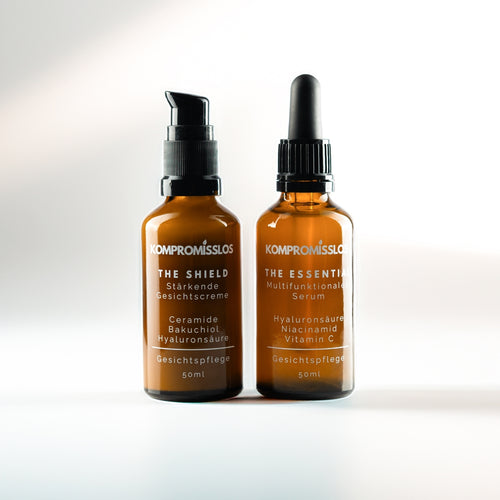
Your face cream is enough for your neck, as long as your skin tolerates it well and you actually apply it all the way down. A common mistake is not choosing the wrong cream, but stopping at the chin. For years, the neck then gets nothing while the face receives serum, cream and sunscreen. A neck cream only solves this problem because it reminds you to put cream on your neck in the first place. In terms of what they contain, many neck creams differ very little from face creams: they work with the same humectants, lipids and active ingredients, often in a slightly richer texture. A separate product is therefore only worth it if your face cream is noticeably not enough on your neck or irritates the skin there. In every other case, you simply use a few more drops or pumps. That is exactly how The Duo with its serum and face cream is meant to be used: both products are massaged in from the centre of the face outwards and down over the neck, with no extra jar. In her review on Judge.me, Gabriela K. writes: “I really appreciate not having to use umpteen creams” (review translated from German).
How is the skin on your neck and décolleté different from your face?
The skin on your neck and décolleté gets less of its own oil from within and, at the same time, a lot of sun and movement from outside. Sebaceous glands are particularly dense on the face, especially on the forehead, nose and chin, whereas the neck and décolleté have far fewer of them. What they secrete is more than just “oil”: it also carries protective substances to the skin’s surface. A study with eight volunteers in the Journal of Investigative Dermatology found a 20 to 1 ratio of vitamin E between cheek and upper arm in the uppermost layer of the stratum corneum, and showed that sebaceous glands are an important delivery route for this antioxidant. The further you move away from the centre of your face, the more your skin depends on what you give it from the outside. On top of that, the skin on the neck is fairly thin and constantly in motion: every downward glance folds it, every turn of the head stretches it.
For your skincare, this means three things. First, your neck tends to need more lipids rather than fewer, so cream rather than serum alone. Second, thin skin reacts more sensitively to high doses of acids or retinoids. Third, the décolleté is often uncovered in summer without anyone giving sunscreen a thought. Where horizontal neck lines and sagging neck skin come from – phone posture, sun and declining firmness – is a topic in its own right.
How do you apply cream to your neck properly, and in which direction?
Apply cream to your neck gently and evenly, without pulling the skin – the direction is secondary. The often-repeated rule of “always from the bottom up” is a beauty tradition, not a proven effect: a few seconds of stroking in one direction or the other does not change how firm your skin is. What matters is that you do not tug hard downwards and that the cream actually reaches the base of your neck. Many women spread what is left of their face cream downwards with their fingertips, and by the time it gets to the neck there is hardly anything left.
- Carry straight on after your face: what is left on your fingers is rarely enough, so take a little extra.
- Apply with the flat of your hand: stroke from the collarbone towards the chin or from the neck outwards, using light pressure.
- Do not forget the sides and the back of your neck: the sides of the neck get a particularly large amount of sun.
- Keep your head relaxed and level: that way, the cream also reaches the fine horizontal lines that are pulled smooth when you tilt your head back.
- Finish with sunscreen in the morning: your neck and décolleté are part of the same area as your face.
What is the difference between a neck cream and a face cream?
The main difference between a neck cream and a face cream is usually the label, and only rarely the formula. There is no protected definition of what a neck cream has to be. Some products are richer, and some contain active ingredients such as peptides or retinoids that are found in face creams just as often. The sensible question is therefore not whether the packaging says “neck”, but whether the cream meets three criteria: it provides moisture, it supplies lipids for skin with fewer sebaceous glands, and it is mild enough for thin skin to tolerate every day. The same logic applies around the eyes: there, too, tolerability matters more than the name, and you can answer the question of whether you need an eye cream using the same criteria.
| Criterion | Typical neck cream | Good face cream | What to look for |
|---|---|---|---|
| Texture | Often richer | Light to rich | On the neck, cream rather than serum alone |
| Active ingredients | Humectants, lipids, sometimes peptides or retinoids | The same groups of active ingredients | Disclosed concentrations instead of promises |
| Tolerability | Sometimes fragranced | Depends on the product | Fragrance-free is the calmer choice for thin neck skin |
| Sun protection | Usually no SPF | Usually no SPF | Plan for a separate sunscreen |
What does your neck need after 50?
After 50, your neck mainly needs more lipids, more consistency and less irritation – not more products. With the menopause, many women find that their skin becomes drier and thinner, and on the neck, which produces little oil of its own anyway, this shows early: the skin feels tight, looks crêpey and reacts more quickly to fragrance or strong active ingredients. A specialist article in CosmoDerma lists dryness, loss of firmness, wrinkles, pigmented spots, visible thread veins and a rough surface among the typical signs of an ageing neck. Some of this comes down to skincare, a large part to the sun, and some to connective tissue and muscles that no cream can reach.
In practice, this means using a slightly larger amount of cream on your neck and, in the evening, adding a second layer if your skin feels tight. Keep the routine the same as for your face so that you do not forget it. What this looks like for the face is described in the skincare routine for mature skin. If it is the softening contours of your face that bother you more, you will find an honest assessment in the article on sagging skin on the face, and lines that are still visible on your décolleté in the morning are explained in the article on sleep wrinkles on the face and chest.
Why is sunscreen on your décolleté more important than any neck cream?
Sunscreen on your décolleté is more important than any neck cream because much of the visible ageing there is caused by UV light, and no cream without SPF can slow down that part. A randomised trial in the Annals of Internal Medicine with 903 adults under the age of 55 shows how large the effect can be: in the group that applied sunscreen daily, there was no detectable increase in skin ageing after 4.5 years, and skin ageing was 24 per cent lower than in the group that only applied sunscreen at their own discretion.
The influence of the sun is particularly easy to see on the neck. A clinical study of 50 patients in the Journal of the European Academy of Dermatology and Venereology describes poikiloderma of Civatte, a reddish-brown, net-like discolouration, as mainly affecting the V of the neck, the sides of the neck and the upper chest, while the shaded area under the chin typically stays clear. So if you notice a difference between the sun-exposed base of your neck and the paler shadow under your chin, you are more likely looking at the effects of light than at a lack of cream. Which sunscreen suits you is covered in the article on sunscreen when your skincare has no SPF. The same principle applies to dark spots that are already visible: without UV protection, they tend to get darker rather than lighter.
Reddish-brown, net-like discolouration on the neck and spots that change, itch or bleed should be seen by a dermatologist. Skincare can play a supporting role, but it cannot replace a diagnosis.
I deliberately did not make a separate product for the neck. Two products instead of eight also means no extra jar for an area that is well looked after by the same skincare. That is why our page on how to use the serum and cream says to massage both in from the centre of your face outwards and over your neck. What I cannot do for you is the sun protection. The cream has no SPF, and I do not sell sunscreen either. For the décolleté, which is often uncovered in summer, a separate sunscreen is therefore a more important step than any additional cream. To be honest, that one step will do more for your décolleté than anything I could put into a neck cream.
Frequently asked questions
Can I use my face cream on my neck?
Yes, your face cream is suitable for your neck if your face tolerates it well. Use a little more than what is left on your fingers and apply it down to the base of your neck. If the skin on your neck still feels tight, a second thin layer in the evening will help more than a new product.
Does neck cream help with wrinkles?
A neck cream can make dry skin look smoother, but it will not make deep horizontal lines disappear, as the article on neck wrinkles and what really helps explains in more detail.
Is retinol suitable for the neck?
Retinol can irritate the thin skin of the neck more quickly than the face and needs a particularly slow introduction there, as you can read in the article on active ingredients for neck wrinkles.
How often should I moisturise my neck?
Moisturise your neck as often as your face, ideally morning and evening. If you build it into the same routine, you will not forget it. In the morning, finish with sunscreen, especially if your neck and décolleté are not covered by clothing.
Does massage help with a sagging neck?
Massage makes applying cream more pleasant, but according to current knowledge it does not firm up a sagging neck – more on this in the article on neck exercises and sagging neck skin.
What can I do about brown spots on my décolleté?
For brown spots on your décolleté, daily sunscreen comes first, because without it they keep darkening again. What skincare can soften cosmetically beyond that is covered in the article on dark spots. Have new or changing spots checked by a dermatologist.
Can I use The Duo on my neck too?
Yes, the instructions explicitly include the neck: the serum and cream are massaged in from the centre of the face outwards and over the neck. That means you do not need an additional neck cream. Because The Duo contains no SPF, add a separate sunscreen for your neck and décolleté in the morning.
Sources
- Thiele JJ, Weber SU, Packer L. Sebaceous gland secretion is a major physiologic route of vitamin E delivery to skin. Journal of Investigative Dermatology, 1999. Source
- Vedamurthy M, Hande M. Characteristic features of neck aging. CosmoDerma, 2022. Source
- Hughes MC, Williams GM, Baker P, Green AC. Sunscreen and prevention of skin aging: a randomized trial. Annals of Internal Medicine, 2013. Source
- Katoulis AC, Stavrianeas NG, Georgala S, Bozi E, Kalogeromitros D, Koumantaki E, et al. Poikiloderma of Civatte: a clinical and epidemiological study. Journal of the European Academy of Dermatology and Venereology, 2005. Source