Neck wrinkles: where they come from and what really helps
SKIN OVER 40
What you can do about neck wrinkles depends on which kind of wrinkle you are looking at. Fine crêpey lines caused by dryness look visibly softer with daily skincare, and consistent sun protection slows down the arrival of new ones. Deep horizontal lines, vertical neck bands and what is known as a turkey neck, on the other hand, will not be smoothed away by any cream, not even an expensive specialist one. For those, only treatments from a medical professional are an option. Keeping these two levels apart saves you a lot of money and even more disappointment.
What causes wrinkles on the neck?
Neck wrinkles come from three overlapping sources: movement, sun and the natural remodelling of connective tissue with age. The neck is one of the most mobile areas of the body. Every nod and every downward glance folds the skin along the same lines. As long as the skin is elastic, it springs back afterwards. Over the years, this ability to recover fades, and the movement line turns into a wrinkle that stays even when the neck is at rest. The sun speeds this up, because UV radiation damages the skin’s elastic fibres. Later on, a third factor comes in that has little to do with the skin itself: beneath the skin lies a thin, flat muscle, the platysma, which can show up with age as vertical cords. At the same time, fatty tissue under the chin shifts, and the contour between chin and neck becomes less defined. This results in four distinct appearances, each of which needs a different answer. Once you can tell them apart, you know straight away where skincare makes a difference and where it does not.
| Appearance | Typical cause | What skincare can do | What helps beyond that |
|---|---|---|---|
| Fine crêpey lines | Dryness, sun | Skin looks visibly plumper and smoother | Daily sun protection |
| Horizontal lines, known as necklace lines | Movement, predisposition, declining elasticity | Skin becomes suppler, the line remains | Fillers or skin boosters from a medical professional |
| Vertical neck bands | Platysma muscle | No change | Botulinum toxin from a medical professional |
| Sagging neck skin, turkey neck | Age, loss of tissue, changes in weight | No change to the contour | Device-based treatment or a neck lift |
At what age do neck wrinkles appear?
Neck wrinkles have no fixed starting age: fine horizontal lines can appear even in young people, whereas sagging neck skin and neck bands typically only develop in the second half of life. A systematic review and meta-analysis in Aesthetic Surgery Journal Open Forum explicitly describes horizontal neck lines as a common concern among both older and younger people. So horizontal lines on their own are not a sign of age. Firmness is a different matter. A study in Clinical, Cosmetic and Investigational Dermatology of women aged between 30 and 78 found that sagging of the facial tissue is mainly linked to chronological age and did not differ between women who sought out the sun and women who avoided it. For the neck, that is a plausible parallel: when it comes to the lines, whether you have a wrinkly neck at 50 depends largely on sun and predisposition; when it comes to the contour, it depends mainly on the years. During the menopause, the skin also loses moisture and elasticity, which is why many women around 50 start paying serious attention to their neck for the first time. You can read about how the skin changes as a whole during this phase in the article on skincare for mature skin.
Why do horizontal neck lines form so early?
Horizontal lines on the neck form early because they are largely lines of movement and predisposition rather than primarily signs of ageing. In certain places, the skin on the neck is more firmly attached to the tissue underneath. That is exactly where it creases again and again when you tilt your head. In some people, these lines are already faintly visible in childhood; in others, they stay invisible for a long time. The shape of the neck, skin type and predisposition all play a part. Tilting your head forward for hours on end also folds the skin in the same place over and over. Sleeping position can play a role too: if you lie on your side with your chin tucked towards your chest, the skin is compressed all night, much like with sleep wrinkles on the chest. Dry skin also makes early horizontal lines more noticeable, because a dehydrated surface shows every crease more clearly. It is important to see this in context: an early neck line is not a sign that you have done something wrong. Above all, it shows where your skin has been folding for years.
What can skincare realistically do for neck wrinkles?
Skincare can improve the surface of the skin on the neck, but it cannot reverse an etched-in line or a sagging contour. Humectant active ingredients such as hyaluronic acid make the outermost layer of skin look plumper, while lipids such as ceramides and squalane support the skin barrier and help keep moisture in the skin. As a result, fine dryness lines look visibly softer and the skin feels suppler. A deep horizontal line nevertheless remains a horizontal line, because its cause lies in the connective tissue and in movement, not on the surface. Nicole B. puts a realistic expectation into words in her review on Judge.me: ‘The fine lines don’t go away, which isn’t really the idea anyway […], but the overall look becomes softer’ (review translated from German). That is the yardstick you can apply to any neck or face care.
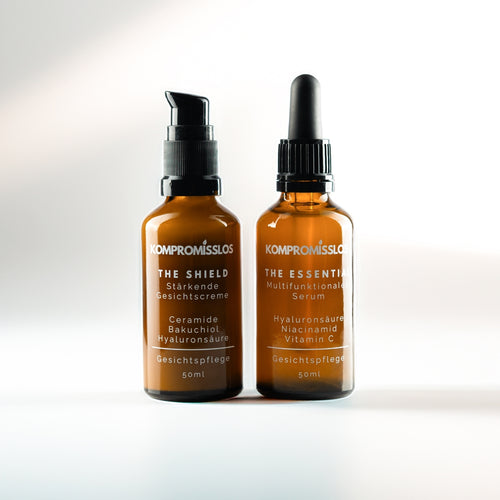
The most important skincare step for the neck is therefore an unspectacular one: include it every time you apply your skincare. With The Duo of Essential serum and Shield cream, this is part of the routine, as both products are massaged in from the centre of the face outwards and down over the neck. The same limits apply when firmness fades on the face, as the article on sagging skin on the face shows.
What role do the sun and looking down at your phone play?
The sun is the best-documented factor in skin ageing that you can influence, on the neck too, while phone posture is a plausible but barely studied additional factor. For the face, the study in Clinical, Cosmetic and Investigational Dermatology concluded that UV radiation appears to be responsible for 80 per cent of visible signs of ageing. In everyday life, the neck is about as exposed to the sun as the face, yet it is often forgotten when you apply cream. A study of identical twins in Plastic and Reconstructive Surgery showed that more sun exposure was associated with an older appearance, as were spending a lot of time outdoors and not using sun protection. Because the twins are genetically identical, differences like these clearly point to the environment rather than to predisposition alone. You can find out how large the sun’s share in skin ageing is overall in the article on how to slow down skin ageing.
When it comes to phones, the evidence is thinner. So far, there are hardly any robust studies directly linking screen time to more neck wrinkles. The mechanism, however, is the same as with expression lines: the longer your head is tilted forward, the longer the skin stays in the same fold. Small habits cost nothing:
- Hold your phone closer to eye level rather than lowering your head towards it.
- Raise your laptop and screen so that you look straight ahead.
- During long reading sessions, straighten your head and lift your gaze every now and then.
When do only professional treatments help?
Treatments from a medical professional become the realistic option when horizontal lines stay deep even with your neck stretched, when neck bands become visible or when the skin between chin and neck visibly hangs. For horizontal neck lines, the meta-analysis in Aesthetic Surgery Journal Open Forum mentioned above evaluated eleven studies with a total of 379 people on hyaluronic acid fillers. It found clear improvements, but also a re-treatment rate of 50 per cent within twelve months. Complications occurred in 14 per cent of cases and were described as mild and temporary. In other words, the result does not last forever. For vertical neck bands, an anatomical review in Archives of Plastic Surgery describes botulinum toxin as a treatment that requires precise knowledge of the neck muscles. Depending on the findings, the options include:
- Hyaluronic acid fillers or skin boosters for etched-in horizontal lines
- Botulinum toxin for vertical neck bands
- Laser, radiofrequency or microneedling for skin quality
- A surgical neck lift where there is significant excess skin
Your first port of call is a dermatologist or a specialist in plastic surgery. Ask them to explain which of the four types you have before you discuss any method.
Try this simple test in front of the mirror: tilt your head slightly back to stretch your neck. If the line almost disappears, it is mainly a movement line. If it stays as a groove, it is etched in, and that is where the influence of any cream ends.
I have not added a neck cream to our range, even though it would be easy to sell. The reason is in the instructions for using The Duo: you massage the serum and cream in from the centre of your face outwards and down over your neck. So your neck is included in every application, morning and evening, without a third product. At the same time, I want to be honest: no cream smooths away deep neck wrinkles, ours included. What skincare can do is keep the skin on your neck supple and make fine dryness lines less visible. And because the Shield cream deliberately contains no SPF, a separate sunscreen belongs in your daytime routine, on your neck just as on your face. Two products and a sunscreen are less spectacular than a specialist cream, but more honest.
Frequently asked questions
Can neck wrinkles go away?
Fine dryness lines can visibly diminish, but etched-in horizontal lines usually do not go away on their own. When the skin gets enough moisture and lipids, superficial lines look softer within a few weeks. A line that remains even when your neck is stretched sits deeper in the connective tissue. It can be softened with treatments from a medical professional, but not creamed away.
Does retinol help with neck wrinkles?
Retinol can visibly soften fine wrinkles, but its effect on deep neck wrinkles is limited. In a study in the Archives of Dermatology, a 0.4% retinol lotion improved fine wrinkles on the arms of older people over 24 weeks. There is hardly any data specific to the neck. Because the skin on the neck is thin, it becomes irritated more quickly: start with a low concentration two to three times a week, and only increase it if your skin tolerates it well.
Do neck exercises help?
So far, there are no robust studies showing that neck exercises reduce neck wrinkles. Training strengthens muscles, but horizontal lines form in the skin and through repeated folding. Exercises in which you keep pulling your chin towards your chest actually fold the skin in exactly the places that matter. Exercises can be useful for posture and for your neck muscles, but they are no remedy for wrinkles.
What is a turkey neck?
A turkey neck is a hanging fold of skin and tissue between the chin and the neck. It usually results from a combination of slack skin, visible neck bands of the platysma muscle and shifted fat under the chin. This is a question of tissue structure, not of the skin’s surface. That is why no cream changes the contour; the options lie with a medical professional.
Are neck wrinkles hereditary?
Neck wrinkles are partly hereditary, but the environment also has a strong say. The shape of your neck, your skin type and predisposed horizontal lines are things you are born with. However, the twin study in Plastic and Reconstructive Surgery showed that identical twins with more sun exposure and a longer history of smoking looked older than their genetically identical counterparts. Predisposition sets the framework; sun and smoking determine how much of it becomes visible.
Does weight loss make neck wrinkles more visible?
Significant weight loss can make neck wrinkles and loose skin more visible, especially in the second half of life. You can read what rapid weight loss changes in the face in the article on Ozempic face. When volume beneath the skin disappears, the skin does not retract to the same extent. In the twin study in Plastic and Reconstructive Surgery, a body mass index four points higher made twins under 40 look older, but from 40 onwards it made them look younger. This fits with the idea that volume in the face and neck plays a different role as the years go by.
Do I need anything else for neck wrinkles if I use The Duo?
Yes, a sunscreen during the day, on your neck as well, because The Duo contains no SPF. Apply it in the morning as the last step, down to the base of your neck. You can read how else to look after your neck and décolleté in the article on neck and décolleté care. For the neck itself, it is enough to massage in The Duo as well every time you use it.
Sources
- Wong ZY, Limbu S, Karanasios G, Monks F, Faderani R, Kanapathy M, et al. Efficacy and Safety of Hyaluronic Acid Fillers for Horizontal Neck Lines: A Systematic Review and Meta-Analysis. Aesthetic Surgery Journal Open Forum, 2025. Source
- Flament F, Bazin R, Laquieze S, Rubert V, Simonpietri E, Piot B. Effect of the sun on visible clinical signs of aging in Caucasian skin. Clinical, Cosmetic and Investigational Dermatology, 2013. Source
- Guyuron B, Rowe DJ, Weinfeld AB, Eshraghi Y, Fathi A, Iamphongsai S. Factors contributing to the facial aging of identical twins. Plastic and Reconstructive Surgery, 2009. Source
- Hu H, Kim SB, Wan J, Chan LKW, Lee AKW, Sydorchuk O, et al. Anatomical Guidelines and Technical Tips for Neck Aesthetics with Botulinum Toxin. Archives of Plastic Surgery, 2024. Source
- Kafi R, Kwak HS, Schumacher WE, Cho S, Hanft VN, Hamilton TA, et al. Improvement of naturally aged skin with vitamin A (retinol). Archives of Dermatology, 2007. Source