Does double chin cream work? What firming creams can and can’t do
SKIN OVER 40
A double chin cream does not work on the fat itself: it cannot dissolve the fatty tissue beneath your chin, even if the packaging advertises caffeine, peptides or ‘chin firming’. What a cream achieves happens in the top layers of the skin. The skin on your chin and neck looks plumper, smoother and suppler, and some film formers tighten the surface for a few hours. Whether your double chin comes from fat, loss of firmness or the shape of your jaw determines what can make any difference at all. The only proven way to reduce fat beneath the chin in a targeted way is medical treatment.
Can a cream get rid of a double chin?
No, an ordinary off-the-shelf cream will not get rid of a double chin, because it does not reach the pad of fat beneath the chin. This fat sits under the skin, and some of it even lies behind the thin neck muscle known as the platysma. A cream first has to get through the stratum corneum, the skin’s outermost layer, and most active ingredients stay in the epidermis or the upper dermis. What you see after applying it is therefore almost always a surface effect: moisture makes the skin look plumper, while film formers contract as they dry and smooth the surface for a short time. If you want to know what so-called botox creams can really do and where their instant effect comes from, these are exactly the ingredients to look at. The effect is gone as soon as you wash your face, and it does nothing to the contour beneath your chin.
One possible exception comes from research. A study in Skin Research and Technology tested a topical formulation containing 1.0% sodium deoxycholate – the active ingredient in fat-dissolving injections – on 21 women. After eight weeks of once-daily use, the volume beneath the chin, measured with 3D imaging, fell from 10.0 to 8.5 millilitres. The paper does not describe a control group, and all of the authors work for the company that developed the formulation. That is an indication, not proof. And this formulation has nothing to do with the chin creams on the chemist’s shelf.
What is a double chin made of: fat, loose skin or jaw shape?
A double chin is usually a mix of three components: fat beneath the chin, skin that is losing its firmness, and a jaw and chin shape that gives the tissue little support. When it comes to fat, specialists distinguish between two layers. The fat directly under the skin, in front of the platysma, can be pinched between two fingers. The deeper fat behind the muscle cannot be grasped from the outside. A review in the Journal of Drugs in Dermatology describes how the skin becomes looser with age and how the deep fat pad can sink downwards. When you gain weight, the fat compartments beneath the chin also get bigger, and the angle between chin and neck becomes more obtuse. The third component is the skeleton: a relatively short lower jaw or a receding chin offers less of a frame for the skin and soft tissue to stretch over. The tissue beneath then looks fuller, even when there is little fat.
This distinction matters in practice, because it determines what can make any difference at all. The table gives you a rough guide, but it is no substitute for a diagnosis.
| Component | How to recognise it | What realistically makes a difference |
|---|---|---|
| Fat in front of the neck muscle | A soft pad you can pinch between your thumb and index finger | Medical fat reduction; if you are overweight, losing weight too |
| Deeper fat behind the muscle | Fullness you cannot pinch | Only surgical procedures, after assessment by a specialist |
| Loss of firmness | Thin, loose skin, a softer jawline | Sun protection, skincare for the appearance of the skin, medical tightening |
| Jaw and chin shape | A double chin even at a young age and with a slim build | Posture, advice from a jaw surgeon or aesthetic specialist |
Horizontal creases, vertical bands and loose skin on the front of the neck are a separate topic. What does and does not help there is covered in the article on neck wrinkles, turkey neck and what really helps.
Why do slim people get a double chin too?
Slim people get a double chin too, because fat distribution, jaw shape and posture are only loosely linked to body weight. Where the body stores fat first is partly down to your genes: some people put on weight around the stomach first, others early on in the face and neck. Then there is anatomy. A receding chin or a flat jaw angle can make even a small amount of tissue look like a double chin, especially in photos taken from below or when you look down at your phone. Over the years, loss of firmness adds to this impression. The review in the Journal of Drugs in Dermatology notes that this area is very difficult to change through diet and exercise. Losing weight from one specific part of the body does not work anyway. So if you have a double chin at a normal weight, you have usually done nothing wrong. Rather than hunting for the next specialist cream, it makes more sense to work out what lies behind your own. That saves money and disappointment, because you then know whether skincare, posture or a medical consultation is the right approach.
What is in double chin and chin-firming creams, and what is backed by evidence?
Double chin creams mostly contain the same groups of active ingredients as anti-cellulite and firming products, and there is little evidence for any of them on the chin. Caffeine is the most common. A review in Skin Pharmacology and Physiology describes how caffeine penetrates the skin barrier well and stimulates fat breakdown in cells by inhibiting an enzyme called phosphodiesterase. According to this review, commercial formulations usually contain 3% caffeine. Between the mechanism in the cell and a measurably smaller double chin, however, there is no evidence in humans. The other typical ingredients can be assessed as follows:
- Green tea or guarana extract: also supply caffeine, and the same evidence gap applies to the contour of the chin.
- Peptides: meant to send the skin signals to rebuild itself, but they do not reach the fat beneath the skin.
- Film formers and polymers: tighten the surface as they dry; the effect is visible and gone once you wash it off.
- Collagen and hyaluronic acid: bind water at the surface and make the skin look plumper. Whether collagen from a cream can actually get into your skin is a separate question.
- Retinoids: can improve skin texture over several months, but they do not break down fat.
The honest way to read such a pack is therefore this: what it contains can smooth the skin on your chin and make it look plumper. Wherever it talks about ‘fat reduction’, ‘contouring’ or ‘a new chin line’, the advertising promises more than a cream can achieve in the skin.
What can skincare realistically improve on the chin and jawline?
Skincare can make the skin on your chin, jawline and neck look suppler, plumper and more even, but it does nothing to the amount of fat underneath. That is less than chin creams promise, but it is not nothing: well-hydrated skin reflects light more evenly, fine dryness lines look softer, and an intact skin barrier holds on to moisture for longer. The biggest long-term lever lies elsewhere, though. UV light speeds up the breakdown of collagen and elastic fibres, and it is precisely these fibres that keep the skin over the chin in shape. Consistent sunscreen for your face, applied down beneath your chin and over your neck, protects firmness more than any specialist cream. How far this goes for the cheeks and jawline is explained in the article on what skincare can and can’t do when firmness fades.
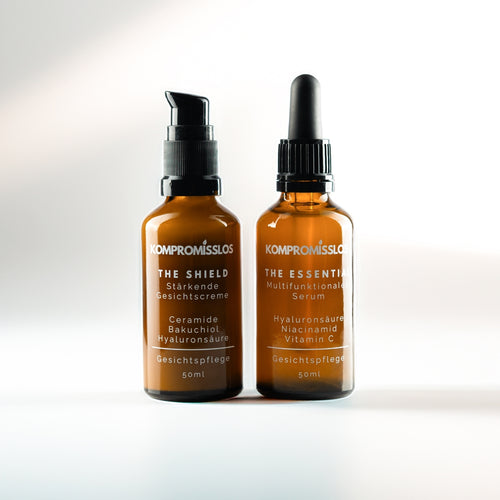
In practice, this means that the skincare you use on your face belongs under your chin as well. You do not need a separate chin or neck cream for that, and neck and décolleté care is covered in detail in its own article. With The Duo of Essential serum and Shield cream, the area beneath the chin is already part of the routine, because both are massaged in from the centre of the face outwards and down over the neck. The serum brings hyaluronic acid in three molecular sizes and niacinamide, the cream bakuchiol, ceramide NP and squalane. The result is skin that feels plumper and suppler, not a new contour. Because neither product contains SPF, you add a separate sunscreen during the day.
You can get a rough idea yourself of whether your double chin is mainly fat or mainly skin: keep your head straight, look ahead and gently take the tissue beneath your chin between your thumb and index finger. A thick, soft pad points more towards fat, a thin, loose fold of skin more towards loss of firmness.
Which treatments work for a double chin, and when should you see a specialist?
The only proven way to reduce fat beneath the chin in a targeted way is with medical procedures: deoxycholic acid injections, cooling (cryolipolysis), liposuction or, if loose skin and muscle bands are the main issue, a surgical neck lift. The best-studied option is injection lipolysis with deoxycholic acid. In the pivotal REFINE-1 trial, published in Dermatologic Surgery, 70.0 per cent of those treated achieved an improvement of at least one grade, as rated by both the clinicians and the participants. With placebo, the figure was 18.6 per cent. Side effects mainly affected the injection site and were mostly mild to moderate and temporary. In 4.3 per cent of those treated, a usually mild, temporary weakness of a nerve along the edge of the lower jaw occurred. Devices such as HIFU are also on offer, but how they compare is a topic in its own right.
Which method suits you depends on which component dominates in your case, and only an examination can establish that. The people to see are dermatologists or specialists in plastic surgery. If the fullness beneath your chin is new, appears quickly or on one side only, is painful or feels hard, it is not a cosmetic matter. In that case, have it checked by a doctor, because the thyroid, lymph nodes or salivary glands may be behind it.
I do not sell a chin or neck cream, and that is a deliberate decision. The skin beneath your chin does not need different care from your face, which is why, according to our instructions for use, the serum and cream go down over the neck anyway. A third product with a name of its own would change nothing there except the length of the routine. Nor do I promise that a cream melts fat away, because no cream can do that. The Shield contains bakuchiol instead of retinol. That is a decision in favour of tolerability, not contours. For me, two products instead of eight and disclosed concentrations also mean saying openly where skincare stops. With a double chin, it stops at the surface of the skin.
Frequently asked questions
Does caffeine in a cream help with a double chin?
There is no evidence that it makes a double chin visibly smaller. According to a review in Skin Pharmacology and Physiology, caffeine penetrates the skin well and stimulates fat breakdown in cells. But so far, no robust studies in humans have shown that a caffeine cream measurably shrinks the fat pad beneath the chin. What you feel after applying it is more of a fresh, smooth sensation on the skin.
Does a chin strap or chin band help overnight?
No, a chin strap does not permanently change either the fat or the structure of the skin. It presses the tissue into shape for a few hours, after which it returns to its usual position. Worn tightly and for long periods, it can leave pressure marks and irritation. Your money is better spent on a good sunscreen.
Does a double chin go away when you lose weight?
Partly, if excess weight is the main cause. As your body fat drops, the pads beneath the chin get smaller too, but you cannot lose weight from that spot alone. If your double chin is mainly down to the shape of your jaw or to loose skin, losing weight changes little. After major weight loss, the skin on the neck can even look looser.
Does a double chin get bigger with age?
Often, yes, even without weight gain. With age, the skin becomes looser, the deep fat pad beneath the chin can sink, and the jawline loses its definition. A review in the Journal of Drugs in Dermatology describes it in the same way. Sunscreen slows down the loss of firmness, but the process itself cannot be stopped.
Can looking down at your phone cause a double chin?
It does not create fat, but it makes an existing double chin much more noticeable. When you lower your head, the tissue beneath your chin bunches up, and in video calls or selfies you then see yourself from exactly this unflattering angle. Putting the screen at eye level and sitting up straight changes the impression immediately, though not the tissue itself.
Is there a fat-dissolving injection for a double chin?
Yes, deoxycholic acid injections are well studied for fat beneath the chin and are approved in the USA and Canada, among other countries. In the REFINE-1 trial, the double chin improved by at least one grade in 70.0 per cent of those treated, compared with 18.6 per cent on placebo. Several sessions are usually needed. A dermatologist can tell you whether the method is right for you.
Does The Duo help with a double chin?
No, The Duo does not dissolve fat beneath the chin – no cream can. The serum and cream care for the skin on your chin, jawline and neck: they provide moisture, support the skin barrier and make the skin look plumper and suppler. Because you massage both over your neck anyway, you do not need an extra chin cream. You can see what is in them on the page for The Duo of serum and cream.
Sources
- Thomas WW, Bloom JD. Neck Contouring and Treatment of Submental Adiposity. Journal of Drugs in Dermatology, 2017. Source
- Jones DH, Carruthers J, Joseph JH, Callender VD, Walker P, Lee DR, et al. REFINE-1, a Multicenter, Randomized, Double-Blind, Placebo-Controlled, Phase 3 Trial With ATX-101, an Injectable Drug for Submental Fat Reduction. Dermatologic Surgery, 2016. Source
- Park HJ, Jang JS, Kim CH, Kim KH, Nam G. Topical formulation of sodium deoxycholate for submental lipolysis. Skin Research and Technology, 2023. Source
- Herman A, Herman AP. Caffeine's mechanisms of action and its cosmetic use. Skin Pharmacology and Physiology, 2013. Source