Does collagen cream work? What it really does and whether collagen gets into your skin
ACTIVE INGREDIENTS
A collagen cream works on the surface of your skin: the collagen binds water and leaves a fine film that makes skin feel softer and look smoother for a while. It does not reach the collagen network in the deeper layers. A native collagen molecule weighs around 300,000 daltons, while an intact stratum corneum essentially only lets through substances under 500 daltons. So what you are buying with a collagen cream is a moisturiser, not a collagen treatment. That is not worthless, but it is not more than that either.
What does collagen cream actually do?
A collagen cream hydrates and temporarily smooths the surface of your skin – that is all the collagen in it can do. Collagen is a protein that can bind a lot of water. On the skin, it therefore behaves like other humectants: it holds water in the uppermost cell layers, the stratum corneum swells slightly and fine dryness lines look less pronounced. Native collagen also forms a thin film that feels smooth. A review in the journal Antioxidants describes hydrolysed collagen as a safe ingredient for creams with good moisturising properties in the stratum corneum. Some of the authors work for a collagen manufacturer, and even this paper places the moisturising effect in the stratum corneum, not deeper down. The effect is real, but it only lasts as long as the moisture: it is gone once you wash your face and comes back the next time you apply the cream.
What a collagen cream cannot do is firm the connective tissue, replace lost collagen or change the contours of your face. Whether a derma roller can stimulate your skin’s own collagen production, and where the risk lies, is covered in our article on at-home microneedling. If loss of firmness is your main concern, it is worth reading what skincare can and can’t do for sagging skin on the face and where its limits lie.
Can collagen from a cream penetrate the skin?
No, intact collagen cannot get through a healthy stratum corneum – the molecule is simply too large. The stratum corneum is the skin’s outermost protective layer and reliably keeps large molecules out. The dermatologists Bos and Meinardi described this in Experimental Dermatology as the ‘500 Dalton rule’: for a substance to be absorbed through the skin, its molecular weight must be below 500 daltons. According to the review in Antioxidants, native collagen weighs around 300,000 daltons – roughly 600 times more. An older laboratory experiment in the Journal of the Society of Cosmetic Chemists shows that this is more than a calculation on paper: labelled collagen was applied to the skin of hairless mice. None of it got through skin with an intact stratum corneum. Only once the stratum corneum had been stripped off with adhesive tape did 60 to 70 per cent of the label get into the skin – and then as fragments under 8,000 daltons, not as whole collagen.
Hydrolysed collagen, which has already been broken down, is a slightly different story. The fragments are smaller, and in animal studies some of them did get into the skin. The review in Antioxidants cites an experiment in which around 8 per cent of a hydrolysate of 5 to 13 kilodaltons passed through mouse skin. These fragments are still far above 500 daltons, and that does not show they do anything in human skin. One more thing is clear: a fragment applied to the skin is not simply built into the collagen network. Your skin makes collagen itself, in the fibroblasts of the dermis.
Why does skin lose collagen with age?
Skin loses collagen with age because the cells that make it produce less and, at the same time, receive less stimulation to do so. A study in the American Journal of Pathology compared fibroblasts from the skin of young people aged 18 to 29 with those of people over 80. In the laboratory, the young cells produced 82 nanograms of type I procollagen per millilitre, the old cells 56. A second mechanism comes on top of this: in young skin, fibroblasts attach over a large area to intact collagen fibres and are therefore under mechanical tension, which keeps production going. In old skin, there is less of this contact and the cells are less spread out. The research team concludes that at least two mechanisms are at work together: ageing cells and less mechanical stimulation. From the outside, it is mainly UV light that speeds up skin ageing, which is why sun protection does more to slow down skin ageing than any collagen cream.
Whether your skin’s own collagen production can be stimulated from the outside is a separate question. The studies on this mostly concern retinoids and pure vitamin C in the form of L-ascorbic acid, not its more stable derivatives such as 3-O-ethyl ascorbic acid. Which active ingredients have evidence behind them is covered in our guide on whether anti-wrinkle creams actually work.
What do hydrolysed collagen, soluble collagen and collagen peptides mean on an ingredient list?
Soluble collagen, hydrolysed collagen and collagen peptides are different forms of the same protein; they differ in how far the molecule has been broken down. In conventional creams, all three come from animals. Collagen is typically obtained from the skin, bones and connective tissue of cattle and pigs, or from fish skin and fish scales, because plants do not produce collagen. The INCI name tells you the form, but almost never the origin. If one of the following names appears on the list and the manufacturer does not state explicitly that it was made biotechnologically, it is safest to assume it is of animal origin.
| Name on the INCI list | What it is | Origin | What it does on the skin |
|---|---|---|---|
| Collagen, Soluble Collagen | Whole, native collagen dissolved in water | Usually animal | Forms a smoothing film and binds water on the surface |
| Atelocollagen | Native collagen with the ends of the molecule removed enzymatically | Usually animal | Like soluble collagen: film and moisture |
| Hydrolyzed Collagen | Collagen broken down into fragments, often marketed as collagen peptides | Usually animal | Acts as a humectant, holding water in the stratum corneum |
| Collagen Amino Acids | Collagen split completely into individual amino acids | Usually animal | Binds water on the surface |
| Palmitoyl Tripeptide-5, Palmitoyl Pentapeptide-4 and similar | Synthetically built signal peptides, not collagen | Synthetic | Meant to send a signal to skin cells; the evidence is thin |
The word ‘peptides’ often causes confusion here: collagen peptides are broken-down collagen, whereas signal peptides are short, purpose-built chains of amino acids that share little with collagen beyond the marketing message. What they can do, and how thin the research is, is explained in the article on peptides in skincare. Position on the list also tells you something: if collagen is near the end, there is usually only a small amount of it. For the basics, see our guide on how to read an ingredient list.
‘With collagen’ in large letters on the front and ‘Hydrolyzed Collagen’ near the end of the INCI list is not an unusual combination. So judge a collagen cream the way you would any other moisturiser: by how well your skin tolerates it, its texture and what else is on the list.
Hyaluronic acid or collagen: which makes more sense in a cream?
For moisture, hyaluronic acid is the more obvious choice in a cream, because it does the same job without any animal-derived raw materials. Both substances are humectants: they bind water in the upper layers of the skin and make it look smoother and plumper. As whole molecules, both are too large to get deep into the skin. The difference lies in origin and choice. Hyaluronic acid for cosmetics is mostly made by fermentation today and is available in different molecular sizes that are absorbed at different speeds. Collagen in conventional creams comes from animals. More important than choosing between the two is whether the moisture is then held in. Without a nourishing layer on top, the bound water evaporates again more quickly. You can read more about what hyaluronic acid really does for skin, and when a higher percentage adds nothing, in our hyaluronic acid guide.
Four questions can help you decide in the shop:
- Do you want vegan skincare? Then go for hyaluronic acid, because conventional collagen is animal-derived.
- Is your skin dry and tight? Then, alongside the humectant, what matters most is a cream with lipids such as ceramides or squalane.
- Are you looking for firming? Neither hyaluronic acid nor collagen in a cream firms the connective tissue. Daily sun protection, which helps prevent further breakdown, and active ingredients with better evidence do more.
- Do you already use a hyaluronic acid serum? Then an extra collagen cream adds very little.
Are there vegan alternatives to collagen in creams?
Yes, there are vegan alternatives to collagen, because collagen in a cream mainly provides moisture, and ingredients that are not of animal origin can do that job too. Well-established humectants include hyaluronic acid, glycerin and polysaccharides, which are complex sugars from plants or from fermentation. To keep the water in the skin, you also need lipids for the skin barrier, such as ceramides and squalane. Be wary of the label ‘vegan collagen’: since plants do not produce collagen, it means either biotechnologically produced collagen or a blend of amino acids and plant proteins sold as a substitute. Which other animal-derived ingredients turn up in face creams is covered in the guide to vegan face cream.
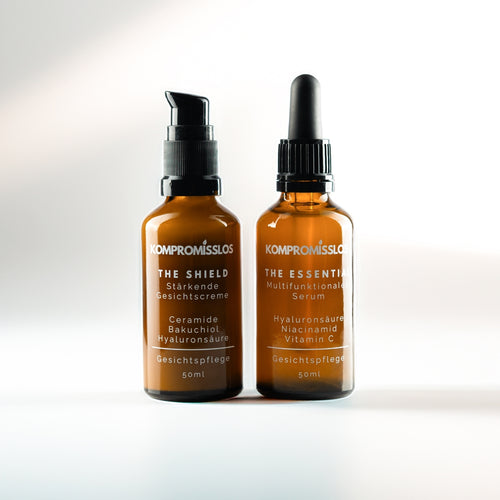
The Duo is vegan and contains no collagen. In the Duo, moisture comes from hyaluronic acid in three molecular sizes, tamarind seed polysaccharide and Biosaccharide Gum-1, and the cream adds ceramide NP and squalane for the skin barrier. The result is skincare that hydrates and supports the barrier, not skincare that replaces collagen. In her review on Judge.me, Nicole B. writes: ‘The fine lines don’t go away, which isn’t the idea anyway […], but my overall expression looks softer!’ (review translated from German). You should not expect more than that from any cream, including one with collagen. You can see how the serum and cream work together in the Duo of serum and face cream.
Collagen was never up for discussion for The Duo, and the reason is simple: both products are vegan, and conventional collagen comes from animals. I have not missed it, because in a cream it mainly does one thing: bind water. In our products, hyaluronic acid in three molecular sizes takes on that job. The cream adds ceramide NP and squalane, which support the skin barrier so that the moisture does not evaporate straight away. What I am not promising you is that your skin will make new collagen or that lost collagen will be replaced. No cream can honestly promise that, ours included. You can read which active ingredient is in there for what on our page about the active ingredients in the Duo.
Frequently asked questions
Is the collagen in creams from animals?
Usually, yes. Collagen for cosmetics is traditionally obtained from the skin, bones or connective tissue of cattle and pigs, or from fish skin, because plants do not produce collagen. Biotechnologically produced versions now exist, but the INCI name usually does not distinguish between sources. If there is no clear vegan label or statement of origin from the manufacturer, it is safer to assume the collagen is animal-derived.
Is drinking collagen better than using a cream?
The two cannot be compared directly: collagen you drink is absorbed through the gut rather than through the stratum corneum, and the research on it is a separate topic. For your skin from the outside, the rule is this: the best way to protect your own collagen is daily sun protection. You can read more in the guide on how to slow down skin ageing, according to the evidence.
At what age does a collagen cream make sense?
There is no age at which a collagen cream becomes necessary, because at no age does it replace your skin’s own collagen. What it provides is moisture, and dry skin needs that just as much at 30 as at 60. If you are choosing a cream because of your age, look at barrier care, how well your skin tolerates it and daily sun protection rather than the word collagen on the packaging.
What is the difference between collagen and peptides?
Collagen is a large structural protein made of three long amino acid chains wound around each other; peptides are short chains of just a few amino acids. Collagen peptides are produced when collagen is broken down, which makes them hydrolysed collagen. Signal peptides in anti-ageing creams, by contrast, are built synthetically for a specific purpose and do not come from collagen, even if they are marketed as boosting its production.
Does vitamin C help with collagen?
Your body needs vitamin C to make collagen, and healthy skin contains high concentrations of it. A review in Nutrients notes, however, that how well vitamin C works when applied to the skin, compared with a good supply from your diet, is poorly understood. The studies on collagen production also mostly concern L-ascorbic acid. There is more on this in the overview of vitamins in skincare.
Is collagen cream bad for your skin?
As a rule, no. Collagen is considered a well-tolerated cosmetic ingredient, and the review in Antioxidants describes hydrolysed collagen as safe for creams. If a collagen cream irritates your skin, the rest of the formula, such as fragrance, is the more likely cause. The bigger problem is the price: if you pay extra for the promise of collagen building, you are paying for something the cream cannot deliver.
Does The Duo contain collagen?
No. The Duo is vegan and contains no collagen, no collagen peptides and no other peptides. Moisture comes from hyaluronic acid in three molecular sizes and complex sugars such as tamarind seed polysaccharide, and the cream supports the skin barrier with ceramide NP and squalane. If you mainly use a collagen cream for moisture, The Duo with serum and cream does that job without any animal-derived raw materials.
Sources
- Bos JD, Meinardi MM. The 500 Dalton rule for the skin penetration of chemical compounds and drugs. Experimental Dermatology, 2000. Source
- Coapman SD, Lichtin JL, Sakr A, Schiltz JR. Studies of the penetration of native collagen, collagen alpha chains, and collagen cyanogen bromide peptides through hairless mouse skin in vitro. Journal of the Society of Cosmetic Chemists, 1988. Source
- Aguirre-Cruz G, León-López A, Cruz-Gómez V, Jiménez-Alvarado R, Aguirre-Álvarez G. Collagen Hydrolysates for Skin Protection: Oral Administration and Topical Formulation. Antioxidants, 2020. Source
- Varani J, Dame MK, Rittie L, Fligiel SE, Kang S, Fisher GJ, et al. Decreased collagen production in chronologically aged skin: roles of age-dependent alteration in fibroblast function and defective mechanical stimulation. American Journal of Pathology, 2006. Source
- Pullar JM, Carr AC, Vissers MCM. The Roles of Vitamin C in Skin Health. Nutrients, 2017. Source