Derma roller at home: what microneedling can do and where the risks lie
ROUTINE
Using a derma roller at home does less than the before-and-after pictures promise and carries more risk than the packaging admits. Home rollers use very short needles that only reach the surface layers of the skin. The well-studied effects on scars and wrinkles, by contrast, come from in-clinic treatments with longer, sterile needles. If you do roll at home, use a short needle length and a clean device, leave plenty of time between sessions and do not apply active serums straight afterwards.
What does a derma roller at home actually do?
A derma roller used at home works mainly on the surface of the skin – it is no substitute for an in-clinic treatment for scars or deeper wrinkles. The reason is needle length. A review in the Indian Dermatology Online Journal describes home rollers as having needles shorter than 0.15 mm. They are marketed for finer-looking pores, fine lines, less sebum and better absorption of skincare products. For ageing skin and wrinkles, the same review gives treatment needle lengths of 0.5 or 1.0 mm, and usually 1.5 to 2 mm for acne scars.
The idea behind microneedling is a controlled micro-injury: the skin responds with a healing process that also involves forming new collagen. But that requires needles long enough to reach the right depth – and therefore a procedure in professional hands. Whether collagen can get into the skin the other way round, from the outside via a cream, is a different question that we answer separately: whether collagen from a cream can actually get into your skin. And the impressive before-and-after pictures you come across when you search for “derma roller before and after” mostly show exactly these in-clinic treatments, not a home roller bought online.
How does at-home microneedling differ from microneedling in a clinic?
Microneedling in a clinic differs from home use in needle length, hygiene and control – and it is precisely these three factors that determine both the effect and the risk. In a clinic, a professional works with sterile single-use needles or pre-sterilised rollers, checks beforehand whether your skin can be needled at all and decides on the intervals between sessions. The review in the Indian Dermatology Online Journal gives intervals of three to eight weeks for in-clinic treatments, over several sessions. With a 1.5 mm roller, at least three weeks should pass between two treatments.
How well microneedling performs in this setting was examined in a systematic review in the Journal of Plastic, Reconstructive & Aesthetic Surgery. It rates the procedure as a safe and effective option for scars and wrinkles, but points out methodological weaknesses in the studies carried out so far. For home rollers with very short needles, there is no comparable body of evidence.
| Criterion | Derma roller at home | Microneedling in a clinic |
|---|---|---|
| Needle length | Very short, within the cosmetic range | 0.5 to 2 mm or more, depending on the goal |
| Hygiene | The device is reused | Sterile single-use needles or a pre-sterilised instrument |
| Assessment beforehand | Up to you | A professional checks your skin and any reasons not to treat |
| Goal | The surface, how the skin feels | Scars, wrinkles, skin texture |
| Aftercare | At your own discretion | The professional’s instructions, including sun protection |
Which needle length makes sense for a derma roller on the face?
For a derma roller on your face at home, the shortest needle length is the sensible one – anything from 0.5 mm upwards belongs in professional hands. The review in the Indian Dermatology Online Journal classifies the common types of roller: a cosmetic type with 0.13 mm needles is used to improve the absorption of skincare products, while a 0.2 mm version is intended for the scalp. A 0.5 mm roller is already listed there as a medical type for collagen induction, and a 1.5 mm roller creates deeper channels that reach into the dermis.
That gives a clear answer to the common question “derma roller 0.25 or 0.5 mm”: if you roll at home, choose 0.25 mm rather than 0.5 mm – and the home rollers described in the review are even shorter than 0.15 mm. One trap lies in how little it hurts. According to the same review, treatment with needles up to 0.5 mm long is essentially painless. But painless does not mean harmless, because how deep the needles actually go also depends on how hard you press. If you press harder to achieve “more”, you leave the cosmetic range without noticing.
Where do the risks of at-home microneedling lie?
The risks of microneedling at home lie less in the rolling itself than in hygiene, pressure, frequency and what goes on your skin afterwards. A systematic review in the Journal of Clinical and Aesthetic Dermatology analysed 51 articles covering a total of 1,029 patients. Overall, the procedure proved relatively safe; the most common side effects were the expected redness, pain, swelling and temporary irritation. The review covered clinical trials, retrospective studies and case reports. It says only so much about how safe it is to roll in your own bathroom without a professional.
The review in the Indian Dermatology Online Journal also lists rarer but more serious complications:
- Local infections after a non-sterile instrument has been used.
- Dark patches following inflammation (post-inflammatory hyperpigmentation).
- Acne getting worse and cold sores flaring up again.
- Allergic reactions, up to and including granulomas – small, nodular areas of inflammation.
- Linear scars over bony areas (“tram-track” scarring), which can be avoided with less pressure and shorter needles.
The granulomas in particular show how closely device and product are linked. A case report in JAMA Dermatology describes three women in their forties to sixties who developed granulomas on the face after microneedling. Two of them had had the same vitamin C serum worked into their skin during treatment. The authors conclude that products applied before needling can carry immunogenic particles into the dermis, and they explicitly point to home use.
What should go on your skin after a derma roller – and what should not?
Straight after using a derma roller, no active serums should go on your skin – instead, give it a break or follow whatever the professional tells you. The fresh puncture channels let ingredients reach layers that cosmetics are not designed for. This applies equally to vitamin C in any form, niacinamide, acids, retinol and fragrance. You can see how sensitively skin can react to an active that is too strong even without needles, in retinol side effects such as redness and stinging. After needling, that threshold is considerably lower.
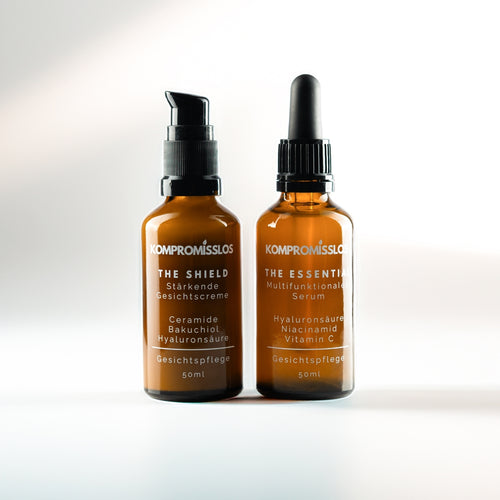
Two things apply in every case. First, sun protection: the review in the Indian Dermatology Online Journal recommends regular sun protection after treatment, because dark patches following inflammation are one of the known complications. Second, patience: only once redness and tightness have subsided do you go back to your normal routine. For that everyday routine, you do not need a derma roller. Moisture and barrier care work without needles too, through serum and cream – for example with The Duo of serum and cream: The Essential with niacinamide and hyaluronic acid in three molecular sizes, The Shield with Ceramide NP, squalane and jojoba oil. If too much irritation has thrown your skin off balance, it is worth looking at what a damaged skin barrier really needs.
If you do roll at home, only do so on freshly cleansed, intact skin and with your own device that you share with no one. Bent or blunt needles are a reason to replace the roller, not to press it down harder.
When is it better to leave the derma roller in the cupboard?
Leave the derma roller in the cupboard whenever your skin is inflamed, broken or affected by a skin condition – and also when your goal is easier to reach with skincare. The review in the Indian Dermatology Online Journal lists the following contraindications: active acne, cold sores or other local infections such as warts, moderate to severe chronic skin conditions such as eczema and psoriasis, blood disorders and blood-thinning medication, a marked tendency to form keloids, and ongoing chemotherapy or radiotherapy. With rosacea, during pregnancy, with sunburn or freshly irritated skin, the decision likewise belongs with a dermatologist or doctor, not in the bathroom cabinet.
It is also often worth asking what you actually want to achieve. If it is fine lines, an overview of which anti-wrinkle ingredients are actually proven will help you more than a device. If it is how your pores look, the article on enlarged pores with age explains why pores look bigger over the years and what skincare can do about it. A derma roller does not replace skincare, and a good routine does not need a derma roller.
I do not sell a derma roller or an exfoliant, and that is a deliberate decision. For me, two products instead of eight means that the basics – moisture and barrier – can be looked after without needles. The Duo does not stimulate collagen and does not replace an in-clinic treatment; I would rather say that up front. Our active ingredients also have a clear limit: vitamin C in its stable 3-O-ethyl form and 5% niacinamide are meant for intact skin, not freshly needled skin. And because the cream contains no SPF, you need a separate sunscreen after microneedling anyway. How the two products work together day to day is explained in how to use the serum and cream.
Frequently asked questions
How often can you use a derma roller?
The longer the needles, the longer the gap between sessions. The review in the Indian Dermatology Online Journal gives two to three times a week for very short home rollers under 0.15 mm and intervals of three to eight weeks for in-clinic treatments – at least three weeks with 1.5 mm. At home, less often is the safer choice, and as long as your skin is still red, you do not roll.
How do I clean a derma roller properly?
Clean a home roller after every use – according to the review in the Indian Dermatology Online Journal, with hot tap water – then shake it dry and keep it in its protective case. That does not make it sterile, so it is never a clinical instrument. The same review gives up to 100 uses per roller. Do not share it with anyone, and replace it sooner if the needles look bent or blunt, because infections from non-sterile instruments are a known complication.
Is a derma pen better than a derma roller?
A derma pen is not automatically better, mainly just different. It works automatically with single-use needles and an adjustable needle length, which, according to the review in the Indian Dermatology Online Journal, is meant to make up for the uneven pressure of rolling. At home, though, the adjustable depth tempts you to set the needles too long. For deeper treatments, the pen belongs in a clinic too.
Does a derma roller help with acne scars?
In-clinic microneedling helps with depressed acne scars; a home roller with short needles is not enough for that. In a randomised trial in JAMA Facial Plastic Surgery, a derma roller with 1.5 mm needles was used in four sessions over three months, under clinical conditions. Flat red or brown spots, on the other hand, are usually acne marks. How to get rid of acne marks is a separate topic, and one that needs no needles.
Can I use retinol or vitamin C after a derma roller?
Not straight afterwards. Freshly needled skin lets ingredients penetrate deeper than intended, and a case report in JAMA Dermatology documents granulomas after a vitamin C serum was worked into the skin during microneedling. Only bring retinol and vitamin C back once your skin has fully calmed down – and after an in-clinic treatment, follow the professional’s instructions.
When do you see results from microneedling?
With in-clinic microneedling, results only show after weeks to months. According to the review in the Indian Dermatology Online Journal, new collagen continues to be laid down for around three to six months after the last session, and several sessions are needed. A fresh look right after using a home roller, by contrast, is mostly mild redness and swelling, not a remodelling of the skin.
Can I use The Duo after a derma roller?
Not straight afterwards. The serum and cream contain active ingredients such as niacinamide, vitamin C as 3-O-Ethyl Ascorbic Acid and bakuchiol, which are meant for intact skin. Once redness and tightness have subsided, you can use The Duo morning and evening as usual. After an in-clinic treatment, follow the professional’s instructions, and you will need sun protection separately.
Sources
- Singh A, Yadav S. Microneedling: Advances and widening horizons. Indian Dermatology Online Journal, 2016. Source
- Ramaut L, Hoeksema H, Pirayesh A, Stillaert F, Monstrey S. Microneedling: Where do we stand now? A systematic review of the literature. Journal of Plastic, Reconstructive & Aesthetic Surgery, 2018. Source
- Gowda A, Healey B, Ezaldein H, Merati M. A Systematic Review Examining the Potential Adverse Effects of Microneedling. Journal of Clinical and Aesthetic Dermatology, 2021. Source
- Soltani-Arabshahi R, Wong JW, Duffy KL, Powell DL. Facial allergic granulomatous reaction and systemic hypersensitivity associated with microneedle therapy for skin rejuvenation. JAMA Dermatology, 2014. Source
- Afra TP, Razmi T M, Narang T, Dogra S, Kumar A. Topical Tazarotene Gel, 0.1%, as a Novel Treatment Approach for Atrophic Postacne Scars: A Randomized Active-Controlled Clinical Trial. JAMA Facial Plastic Surgery, 2019. Source