How to get rid of acne marks: what actually fades and what you can skip
SKIN CONDITION
Strictly speaking, you cannot get rid of acne marks – they fade. Red marks come from dilated blood vessels under the skin; brown ones from excess melanin produced after the inflammation. Both usually fade on their own over a period of months. Daily sun protection, keeping your hands off fresh spots and active ingredients such as niacinamide support a more even complexion.
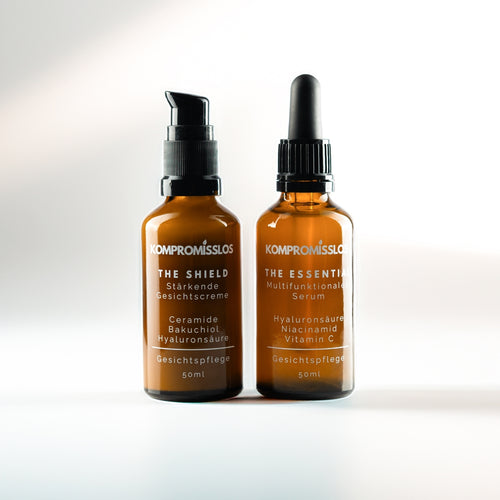
You will find niacinamide and a stable vitamin C derivative in the serum of The Duo – Serum & Face Cream, fragrance-free and from Switzerland.
What exactly are acne marks, and why aren’t they scars?
Acne marks are flat discolourations that remain after an inflamed spot has healed. They are not scars, because the structure of the skin has not changed: the area is smooth, neither sunken nor raised; it is simply a different colour from the skin around it. Dermatologists distinguish between two forms. Red to pink marks are caused by blood vessels that dilated during the inflammation and only slowly return to normal afterwards. Brown marks develop when the inflammation has stimulated the pigment cells and more melanin has reached the upper layers of the skin. Both forms are temporary; they are not true scars. How pronounced the marks become also depends on how much the area was squeezed and picked, which is why it pays not to squeeze spots yourself. Raking light will show you whether an area is a mark or a scar: anything that only stands out in colour is a mark; anything that casts a shadow in light from the side is a scar.
The distinction is not academic; it determines what you can expect. Red marks respond to anything that calms the skin and keeps the barrier stable. Brown marks respond above all to consistent UV protection and to active ingredients that interfere with pigment formation. If you try to tackle both with the same product and see no change after two weeks, the problem is usually not the wrong product but the wrong time frame.
How long do acne marks last?
Acne marks usually last months, not weeks. For the brown type, which specialists call post-inflammatory hyperpigmentation, a review in the Journal of Clinical and Aesthetic Dermatology gives a typical course of six to twelve months when the pigment sits in the epidermis. If it sits deeper, it can take years. Red marks are harder to pin down in figures, but they too disappear over weeks to months as long as no new inflammation follows. What matters most, therefore, is less the individual product than whether the skin settles down. As long as a new inflamed spot appears every few days, your face never looks clearer, because fresh marks keep coming and the older ones barely stand out by comparison. To judge progress realistically, compare photos taken eight to twelve weeks apart rather than checking the mirror from day to day. The most effective lever against acne marks is therefore one step earlier, in the causes of blemish-prone skin.
| What you see | What is behind it | Typical course | What skincare can do |
|---|---|---|---|
| Red or pink area | Blood vessels that stay dilated after the inflammation | Weeks to months | Gentle skincare that keeps the barrier stable |
| Brown area | More melanin in the epidermis after the inflammation | Six to twelve months, years if deeper | UV protection plus active ingredients for a more even complexion |
| Dent or raised area | Altered connective tissue, i.e. a true scar | Remains without treatment | Skincare does not change the structure |
What helps acne marks fade faster?
Consistent UV protection makes the biggest difference, because sunlight darkens brown marks and delays their fading. Second, it matters that you leave the area alone: every bit of squeezing and every aggressive exfoliation prolongs the inflammation and with it the discolouration. Third, there are active ingredients with evidence behind them. For niacinamide, a study in the British Journal of Dermatology showed that it inhibits the transfer of melanin to skin cells by 35 to 68 per cent and visibly reduced facial pigmentation after four weeks. Vitamin C is used in a stable form as 3-O-Ethyl Ascorbic Acid and has the same aim, namely a more even complexion. The Duo contains 5 per cent niacinamide, 2 per cent vitamin C and 1 per cent zinc, relative to serum and cream together. These figures are no proof that the marks will disappear faster; they simply show that the active ingredients are present in amounts of the kind that have actually been studied.
The order of these levers still matters. Without daily sun protection for your face, every active ingredient is working against the sun, and that is a battle it loses. Only then is it worth looking at what niacinamide does for your skin and how long it takes. All the concentrations in the Duo are openly documented; you will find them in the full ingredient list.
One customer wrote to me that since switching to a calmer routine she hardly gets any new spots, but can still see the red marks from before, and asked whether the Duo would remove them. My answer was: not remove them, no. What she can expect is skin that no longer keeps producing new marks, and a complexion that looks more even over time. That is less spectacular than any advertising promise, but it is true.
What you can skip when trying to get rid of acne marks
Skip home remedies that rely on acid or abrasion. Lemon juice, baking soda, apple cider vinegar and toothpaste come up in every search about acne marks, and all four have the same problem: they irritate the skin instead of letting the inflammation die down. Every additional irritation is exactly the trigger that causes pigment and redness in the first place, which is why these remedies tend to prolong the marks rather than shorten them. It is worth being similarly cautious about harsh scrubs with grains and daily acid treatments that are too strong for your skin. A second serum on top is rarely the answer either. If you are unsure how much product a routine really needs, the overview of how to use our products will help more than another purchase. You can also skip checking your skin in a magnifying mirror every day, because it almost always ends in picking and so creates exactly the irritation you are trying to get rid of.
Nor do you need a special product just for marks. If your skincare already contains niacinamide and vitamin C in a sensible concentration and you use UV protection every day, you have reached the point where additional products mainly cost money. That is exactly why our whole routine consists of two products rather than five. What is still missing then is time.
When skincare is no longer enough and it’s time to see a professional
Skincare works on the surface and on appearance; it is no substitute for a dermatological assessment. It makes sense to see a dermatologist if the areas are sunken or raised, because then they are true scars that skincare cannot change. The same applies if the acne remains active and new inflamed nodules keep appearing, if a discolouration looks bluish or grey, if it formed without a spot first, or if it does not get any lighter at all over many months. For these cases, there are medical options ranging from prescription active ingredients to peels and lasers, and deciding which of them is suitable belongs in professional hands. Skincare still makes sense alongside this, taking on the part that means calm and protection. Seeking an assessment is also no contradiction to a simple routine: most dermatological treatments actually require the skin to be cared for gently and kept well supplied alongside them.
I am often asked why we do not offer a separate serum for acne marks. The honest answer: it would not need new active ingredients, just the same ones that are already in it. For vitamin C, I deliberately chose 3-O-Ethyl Ascorbic Acid, because this form is considerably more stable than pure ascorbic acid and the skin tolerates it better. And I put the 5 per cent niacinamide on the page instead of talking about a miracle, because it lets you do the maths yourself. Selling a third product that does the same job would be convenient for us and expensive for you.
Frequently asked questions
Can you really get rid of acne marks?
Getting rid of acne marks in the sense of making them vanish instantly is not possible. They fade over time as the dilated blood vessels return to normal and the excess pigment is broken down. Skincare can support this process and make your complexion look more even, but it cannot skip it.
How long does it take for acne marks to go away?
Brown acne marks typically take six to twelve months when the pigment sits in the epidermis, and can persist for years if it sits deeper. Red marks usually fade over weeks to months. The time frame gets longer whenever new inflammation develops in the same place.
What is the difference between red and brown acne marks?
Red marks are a vascular reaction: the blood vessels under the area stay dilated after the inflammation. Brown marks are a pigment reaction in which the inflammation has triggered the production of more melanin. Red marks are more common on lighter skin, brown ones on darker skin tones.
Does sunscreen help with acne marks?
For brown acne marks, sun protection is the single most important factor. UV radiation further stimulates pigment formation, darkens existing marks and so delays their fading. Protection used every day does not remove marks, but it stops them from being refreshed again and again.
Do home remedies like lemon or baking soda help with acne marks?
Lemon juice, baking soda, apple cider vinegar and toothpaste do not belong on acne marks. They shift the skin’s pH, irritate the area and can therefore prolong exactly the inflammation that caused the mark in the first place. At best they have no effect; at worst they cause additional discolouration.
Which active ingredients make sense for acne marks?
For niacinamide, there is evidence that it inhibits the transfer of melanin to skin cells and can visibly reduce pigmentation. Vitamin C in a stable form supports a more even complexion. The Duo contains 5 per cent niacinamide and 2 per cent vitamin C, relative to serum and cream together.
Are acne marks the same as dark spots?
No. Acne marks develop after inflammation in exactly the place where a spot was, and fade on their own. Classic dark spots develop over years as a result of UV radiation or hormonal influences and usually persist. The trigger is different, and so is how you deal with them.
Sources
- Sangha AM, Managing Post-inflammatory Hyperpigmentation in Patients with Acne, Journal of Clinical and Aesthetic Dermatology, 2021. Source
- Bae-Harboe YSC and Graber EM, Easy as PIE (Postinflammatory Erythema), Journal of Clinical and Aesthetic Dermatology, 2013. Source
- Hakozaki T et al., The effect of niacinamide on reducing cutaneous pigmentation and suppression of melanosome transfer, British Journal of Dermatology, 2002. Source