Home remedies for dark spots on the face: what lemon, potato and co. really do
ROUTINE
Home remedies for dark spots on the face almost never live up to what the lists online promise. Combined with sunlight, lemon juice can even make spots darker, and there is no evidence that potato, yoghurt, apple cider vinegar or turmeric lighten dark spots in humans. What really counts at home is unspectacular: daily UV protection, not irritating your skin and patience over months. The active-ingredient idea behind some home remedies only works in a stable, declared form, not fresh from the kitchen.
Which home remedies actually work for dark spots?
None of the classic kitchen remedies has solid evidence that it lightens existing dark spots in humans. Most recommendations start from a correct observation that is then applied in the wrong way: lemon contains vitamin C, aloe contains a substance that slows pigment production in experiments, and green tea contains polyphenols. From this, people conclude that the whole fruit or plant does the same on the skin as a precisely dosed active ingredient. That leap is not backed by evidence. On top of this, dark spots consist of excess melanin that sits deep in the epidermis and breaks down only slowly. A remedy that stays on your skin for ten minutes and is then washed off simply has too little time and too little active ingredient to make a difference. If you want to know more about how dark spots on the face develop, you will find the background there.
| Home remedy | What is claimed | What the evidence shows | Verdict |
|---|---|---|---|
| Lemon juice | Vitamin C and acid bleach spots | Furocoumarins plus sun can trigger phototoxic reactions that leave darker skin | Skip it |
| Raw potato | An enzyme lightens pigment | No human study found | Harmless, but no effect to expect |
| Yoghurt, buttermilk | Lactic acid peels spots away | Lactic acid in food amounts has not been studied for dark spots | At best a skincare mask |
| Apple cider vinegar | Acid dissolves discoloured layers of skin | No evidence of lightening | More likely to irritate, skip it |
| Aloe vera gel | Aloe inhibits pigment production | Only the isolated compound aloesin has been tested in humans | Soothing, not a lightener |
| Green tea, turmeric | Antioxidants lighten spots | Mainly lab findings on isolated plant compounds | No substitute for skincare |
| Hydrogen peroxide | Bleaches skin the way it bleaches hair | No sensible use on the face | Irritating, skip it |
Does lemon juice lighten dark spots, or make them darker?
Lemon juice does not reliably lighten dark spots, and in the worst case it makes them darker. The reason lies in the fruit itself: citrus fruits contain furocoumarins, plant compounds that make the skin sensitive to light. If UVA radiation follows contact, a phototoxic reaction known as phytophotodermatitis can develop. A case report from the Arizona Burn Center, published in the journal Wounds, describes a seven-year-old girl who had squeezed lemon juice onto her skin while playing in the sun and developed burn-like blisters within 24 hours. The authors describe the sequence of redness, then blisters, then hyperpigmentation as a well-documented clinical pattern. That is the opposite of what you are hoping for from a lemon mask.
Even without sun, lemon juice is not a good idea. It is highly acidic and irritates the skin, especially when applied undiluted or several times a day. A review on post-inflammatory hyperpigmentation in the Journal of Clinical and Aesthetic Dermatology stresses that caution is needed even with established lightening ingredients, to avoid irritation and with it a worsening of the discolouration. What holds for dosed active ingredients holds all the more for fruit acid from the kitchen. And the vitamin C in the juice, as ascorbic acid, breaks down quickly in air and light anyway.
What is behind potato, yoghurt and buttermilk as skin lighteners?
Behind potato, yoghurt and buttermilk lies a plausible story, but no evidence for dark spots. With raw potato, the usual claim is that it contains a ‘lightening enzyme’. We have not found a single study in the medical literature in which potato slices or potato juice visibly lightened dark spots on human skin. Ironically, the best-known enzyme in potatoes is the one that turns cut tubers brown – in other words, it produces pigment rather than breaking it down. Potatoes do contain some vitamin C and vitamin B3, but in amounts and in a form that have nothing in common with a skincare product.
Yoghurt and buttermilk contain lactic acid, which is indeed used in peels as an alpha hydroxy acid. In food, however, its concentration is low, its pH is not adjusted to the skin, and after ten minutes you wash everything off again. A cooling yoghurt mask does most people no harm, but it is more of a skincare ritual than a measure against dark spots. If you already use quark or yoghurt as a mask, they belong more in the context of home remedies for dry facial skin, where the focus is on moisture and comfort, not pigment.
Do aloe vera, green tea or turmeric help with dark spots?
Aloe vera, green tea and turmeric do little for existing dark spots as long as you use them as gel straight from the plant, tea bags or spice paste. With aloe, there is an interesting lead, but it is often misquoted. A study in Clinical and Experimental Dermatology tested aloesin, an isolated compound from aloe, on volunteers whose forearm skin had been deliberately exposed to UV light. Aloesin was applied four times a day for 15 days and suppressed pigmentation by 34 per cent compared with the control. That concerns a tan freshly triggered by UV, not spots on the face that are years old, and it concerns a pure compound, not the gel from the leaf.
It is a similar story with green tea and turmeric, which are recommended mainly for their polyphenols. A review in the Journal of Investigative Dermatology Symposium Proceedings describes how isolated plant compounds such as aloesin, flavonoids or polyphenols can inhibit melanin production in various ways. It draws on laboratory experiments and individual clinical studies with processed extracts, not on tea bags or spice paste. Turmeric also stains the skin yellow and can irritate sensitive skin. Incidentally, aloe vera juice is the base of both our products – as a moisture carrier, not as a lightener.
Why is an active ingredient in food not the same as in a serum?
An active ingredient in food is not the same as in a serum because the amount, stability and contact time are completely different. In a serum, an active ingredient is dissolved at a known concentration, stabilised against breakdown and stays on the skin for hours after you apply it. A wedge of lemon or a slice of potato delivers an unknown, variable amount that degrades in the air and is washed off again after a few minutes. A study in the British Journal of Dermatology shows how much difference this makes: 18 people with hyperpigmentation applied a moisturiser with 5% niacinamide, compared with the same moisturiser without the active ingredient. After four weeks, the hyperpigmentation was measurably reduced. That is a defined formulation used every day, not a kitchen recipe.
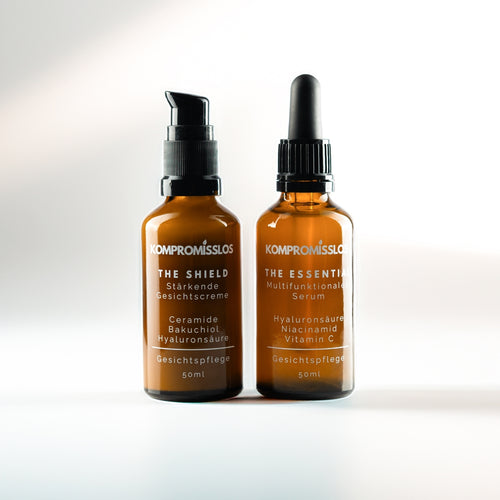
So the idea behind lemon and potato is not wrong – only the way it is put into practice. The Duo contains 2% vitamin C as stable 3-O-Ethyl Ascorbic Acid and 5% niacinamide. This can soften the appearance of dark spots and give you a more even-looking complexion if you use it morning and evening over months. It does not remove spots, though, and it contains no sun protection factor. If you are comparing products at the moment, the article on what to check before you buy a cream for dark spots sets out the criteria that really matter.
What can you do at home about dark spots that really makes a difference?
What really makes a difference at home is a handful of unexciting habits that together achieve more than any home remedy. The most important is UV protection, because without it spots darken again every summer, no matter what else you apply. The second is not to irritate your skin further, because any inflammation can trigger new pigment.
- Sunscreen every day: a daily sunscreen for your face with UVA protection is the step without which everything else goes to waste, cloudy days included.
- Avoid irritation: no scrubbing, no acid experiments from the kitchen, no picking at spots. The article on how to get rid of dark acne marks explains what this looks like for discolouration after breakouts.
- Test new products first: before a new product goes on your whole face, try it on a small area. How to patch test skincare properly is covered in a separate guide.
- Be patient and take comparison photos: photograph the area every four weeks in the same light. Changes in pigment show up over months, not days.
- Get changes checked: spots that newly appear, grow or change colour should be seen by a dermatologist. Knowing where age spots come from helps you put them in context.
Melasma and pregnancy-related pigmentation are a special case. They react strongly to hormones and light, and well-meant home remedies can make them worse. Here, treatment belongs in a dermatologist’s hands, with skincare playing only a supporting role.
When I chose the active ingredients for the Duo, vitamin C was a given – but not in just any form. Pure ascorbic acid, the kind also found in lemons, breaks down quickly in air and light. That is why I opted for 3-O-Ethyl Ascorbic Acid, a stable form of vitamin C, and declared the concentrations openly: 2% vitamin C and 5% niacinamide. To be honest, even that cannot remove dark spots; it can soften their appearance. And because the cream deliberately has no sun protection factor, you need a separate sunscreen during the day. No home remedy and no serum makes up for missing UV protection. I have set out the role each ingredient plays on the page about our active ingredients and their concentrations.
Frequently asked questions
How long does it take for a home remedy to lighten dark spots?
There is no serious answer to that, because no lightening effect has been shown for the common home remedies. If you notice a difference after a few weeks, you may be seeing spots fade naturally over the winter, or different lighting in your photos. With dosed skincare ingredients and consistent sun protection, allow several months before you take honest stock.
Can apple cider vinegar remove dark spots?
No, there is no evidence that apple cider vinegar removes or lightens dark spots. It is acidic, but its strength is not adjusted to the skin, and applied undiluted or under a plaster it can irritate the skin considerably. Because irritation tends to make dark spots darker rather than lighter, you can spare your face the vinegar.
Does hydrogen peroxide help with dark spots?
No, hydrogen peroxide is not a suitable remedy for dark spots on the face. The fact that it bleaches hair does not mean it selectively breaks down melanin in the skin. On the skin, its main effect is irritation, which can make discolouration worse. Leave the bottle in the bathroom cabinet and put your energy into daily sun protection instead.
Can I combine home remedies for dark spots with vitamin C?
It achieves nothing and can do harm. If you already use a product with vitamin C, lemon juice adds no extra benefit – only more acid and the risk of a phototoxic reaction. Vinegar or yoghurt masks on top also tend to increase irritation. Stick to one dosed product, use it regularly and combine it with sun protection.
Are home remedies for dark spots safe during pregnancy?
During pregnancy, you should be particularly cautious with dark spots. Pregnancy-related pigmentation is usually hormonal and reacts sensitively to light and irritation, and lemon and acids can make it worse. Talk to your gynaecologist or a dermatologist about new spots, protect your skin consistently from the sun and skip the kitchen experiments.
When should a spot be checked by a doctor rather than treated with home remedies?
A spot should be seen by a dermatologist as soon as it newly appears and looks different from your other spots, grows, changes colour, has blurred edges, itches or bleeds. Large, symmetrical areas of discolouration on the face should also be checked. In the worst case, home remedies on an unclear spot delay an important diagnosis.
Do I need home remedies for dark spots if I use The Duo?
No. The active ingredients that lemon and potato are really about are in The Duo in a stable, declared form: 2% vitamin C as 3-O-Ethyl Ascorbic Acid and 5% niacinamide, morning and evening after cleansing with water. This can soften the appearance of spots, but it does not remove them. More important than any additional home remedy is a separate sunscreen in the morning, because the Duo contains no sun protection factor.
Sources
- Matthews MR, VanderVelde JC, Caruso DM, Foster KN. Lemons in the Arizona Sunshine: The Effects of Furocoumarins Leading to Phytophotodermatitis and Burn-like Injuries. Wounds, 2017. Source
- Davis EC, Callender VD. Postinflammatory hyperpigmentation: a review of the epidemiology, clinical features, and treatment options in skin of color. Journal of Clinical and Aesthetic Dermatology, 2010. Source
- Choi S, Lee SK, Kim JE, Chung MH, Park YI. Aloesin inhibits hyperpigmentation induced by UV radiation. Clinical and Experimental Dermatology, 2002. Source
- Zhu W, Gao J. The use of botanical extracts as topical skin-lightening agents for the improvement of skin pigmentation disorders. Journal of Investigative Dermatology Symposium Proceedings, 2008. Source
- Hakozaki T, Minwalla L, Zhuang J, Chhoa M, Matsubara A, Miyamoto K et al. The effect of niacinamide on reducing cutaneous pigmentation and suppression of melanosome transfer. British Journal of Dermatology, 2002. Source