Cream for dark spots: five things to check before you buy
SKIN CONDITION
A cream for dark spots is worth buying if it passes five checks: an evidence-backed active ingredient such as niacinamide or vitamin C, an openly stated concentration, a clear reference to daily UV protection, a realistic time frame of weeks to months, and a transparent price per month of use. Skincare can soften the look of dark spots, but it cannot remove them permanently.
Check 1: Which active ingredients for dark spots are backed by evidence?
Two active ingredients in particular are backed by evidence: niacinamide and vitamin C. Niacinamide does not interfere with melanin production itself; instead, it slows the transfer of finished pigment packages from the pigment cells to the upper skin cells. According to a study in the British Journal of Dermatology, niacinamide inhibited this transfer by 35 to 68 per cent in a cell model, and skincare with 5% niacinamide measurably reduced hyperpigmentation after four weeks. What else niacinamide does in the skin goes well beyond the subject of pigment. Vitamin C works at a different point, influencing the enzymes that produce melanin in the first place. Our main article explains in detail how dark spots on the face develop. When it comes to buying, only one thing counts in the end: if one of these active ingredients is clearly declared on the pack, you have a basis you can check. If all it says is a flowery-sounding plant complex with no specific ingredient named, you have nothing to base a comparison on.
Check 2: Why the concentration needs to be on the pack
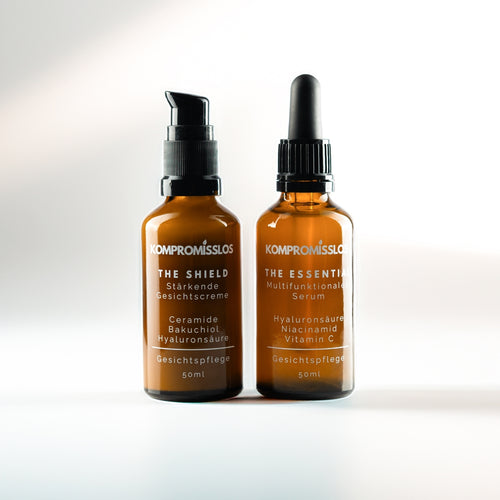
Without a percentage, two creams cannot be compared. A product can feature niacinamide prominently on the front and still contain so little of it that the mention is pure decoration. The ingredient list only helps to a limited extent. The list is sorted by weight, but under Article 19 of the EU Cosmetics Regulation, which most products sold here follow for their labelling, ingredients below one per cent may be listed in any order. Many active ingredients fall into exactly this range, which is why their position on the list says little. A voluntary percentage is therefore the more honest signal. In the Duo of serum and cream, it is 5% niacinamide and 2% vitamin C as 3-O-Ethyl Ascorbic Acid, each relative to the Duo as a whole, and the figures are openly listed in the overview of all ingredients. Whether a brand states the figure tells you more about its attitude to transparency than any promise on the front of the pack.
One customer once wrote to me that over the years she had bought several creams for dark spots, each with a slightly different promise on the front, and that not one of them made it clear how much of the named active ingredient it actually contained. The question behind this was simply why hardly any brand writes it down. There is no good answer to that.
Check 3: Without daily sun protection, any cream is working against itself
UV radiation is the strongest driver of dark spots, which is why sun protection belongs in any skincare routine meant to even out your complexion. If you buy the active ingredient but leave out UV protection, you are evening out in the morning what forms again in the afternoon. A study in the journal Dermatologic Surgery shows how strong the effect is: with daily use of a broad-spectrum sunscreen with SPF 30 over 52 weeks, mottled and discrete pigmentation showed the greatest improvement of all the features assessed by dermatologists. A cream on its own cannot replace this, and no concentration of active ingredient in the world makes up for missing protection. So check whether a brand mentions this point at all or conveniently skips over it. A brand that only sells you the active ingredient and says nothing about the rest is selling you half a solution. Which sun protection for your face suits your routine depends on whether your skincare itself includes an SPF.
Check 4: How to spot empty promises and test-winner labels
You can spot an empty promise by its time frame and its wording. Pigment sits in the stratum corneum and is shed through natural cell renewal, which takes weeks to months, not seven days. Words such as removes, erases or disappears have no place in skincare, because they describe an effect that a skincare product cannot deliver. Be equally wary of before-and-after pictures that give no details of lighting, time period or number of people, because a different camera angle changes more than any active ingredient. A test-winner label also says less than it seems: a test always covers a particular selection according to particular criteria, and a result cannot be transferred to other products or to your skin. And a brand that only shows a seal without saying who tested what and when is giving you a graphic, not information. That is why it is more helpful to understand how test winners among face creams come about than to look at the ranking itself.
Check 5: What the cream costs per month, not per jar
The price per jar tells you nothing as long as you do not know how long it lasts. Two creams at CHF 40 can differ by a factor of three if one lasts six weeks and the other four months. So always work out the price per month of use – based on the amount you actually need, not the amount described as economical on the pack. With the Duo for CHF 109.90, that is 3 to 6 drops of serum and 3 to 6 pumps of cream morning and evening, which means a bottle lasts 2 to 4 months depending on how often you use it. This calculation is also the more honest comparison with cheaper products, because it shows whether a low entry price really is one in the end. How you dose and apply both products correctly has more influence on how long they last than the fill size.
| Check | Good sign | Warning sign |
|---|---|---|
| Active ingredient | Niacinamide or vitamin C is named. | Only a plant complex with no active ingredient named. |
| Concentration | The percentage is stated openly. | The word high-strength with no figure attached. |
| Sun protection | The brand names daily UV protection as part of the routine. | Sun protection is not mentioned at all. |
| Time frame | It talks about weeks to months. | Visible results within a few days. |
| Price | How long it lasts and how much to use are stated. | Only the price per jar is visible. |
When a cream is no longer the right answer
A cream is the wrong answer as soon as a spot changes. If a dark spot grows, changes in colour or at the edges, bleeds or itches persistently, it should be looked at by a dermatologist, not treated with skincare. The same applies to spots that appear on their own and are clearly darker than the rest, and to anything that worries you. Skincare works on the appearance of the uppermost layers of the skin; it does not make a diagnosis and is no substitute for an assessment. Large areas of hormonally triggered discolouration are also a matter for a dermatologist, not for a cream off the shelf. The honest way to put it is this: if you are unsure whether it is a harmless age spot, skincare is not the first question you should be answering. An appointment costs you an hour once; a wrong self-assessment could cost you considerably more.
I am often asked why we do not offer a separate cream just for dark spots. The reason is simple: I would have to make a promise I cannot keep. Instead, I put 5% niacinamide in the Duo, because that is the concentration for which there is any useful data at all, and 2% vitamin C as 3-O-Ethyl Ascorbic Acid, because this form stays stable instead of oxidising in the bottle. Both are openly declared. What I do not promise is that spots will disappear. I promise a more even complexion, and that you know what is in it.
Frequently asked questions
What is the best cream for dark spots?
The best cream for dark spots is one that contains an evidence-backed active ingredient in a declared concentration and is used every day together with UV protection. Niacinamide and vitamin C are the best-studied candidates. Calling any single product the best overall is not credible without taking skin type and starting point into account.
Can a cream remove dark spots completely?
No. Skincare can soften the look of dark spots and support a more even complexion, but it does not remove spots permanently. If you want complete removal, you end up with dermatological procedures such as lasers or peels, and even then spots often come back without consistent sun protection.
How long does it take for a cream for dark spots to show results?
Several weeks to a few months is realistic. Pigment sits in the stratum corneum and is shed through natural cell renewal, which takes time. In the niacinamide study cited, the first measurable changes appeared after four weeks. Promises of visible results within a few days are a warning sign.
Is a serum or a cream better for dark spots?
Each does a different job. A serum delivers active ingredients in a runny texture deeper into the upper layers of the skin; a cream seals them in and supports the skin barrier. The combination makes sense, rather than choosing one over the other. In both cases, the declared concentration of the active ingredient is what matters.
Do I need sunscreen if I already use skincare for dark spots?
Yes, because UV radiation is the main driver of new dark spots. Without daily sun protection, your skincare only evens out what light keeps creating. Broad-spectrum protection of at least SPF 30 therefore belongs in your morning routine, regardless of which cream you use as well.
What does a test-winner label tell you about a cream for dark spots?
It tells you that a product performed well in a particular test with particular criteria. A test always covers a selection, not the whole market, and the criteria vary widely. A test result cannot be transferred to other products or to your skin.
Sources
- European Parliament and Council, Verordnung (EG) Nr. 1223/2009 über kosmetische Mittel, Artikel 19, 2009. Source
- Hakozaki T. et al., The effect of niacinamide on reducing cutaneous pigmentation and suppression of melanosome transfer, British Journal of Dermatology, 2002. Source
- Randhawa M. et al., Daily Use of a Facial Broad Spectrum Sunscreen Over One-Year Significantly Improves Clinical Evaluation of Photoaging, Dermatologic Surgery, 2016. Source