Azelaic acid vs niacinamide: how they differ and when azelaic acid counts as a medicine
COMBINING ACTIVE INGREDIENTS
Azelaic acid vs niacinamide is not a choice between two versions of the same tool. Azelaic acid is an acid that acts on keratinisation, pigment formation and bacterial growth, and at higher strengths it has been tested as a medicine. Niacinamide is a form of vitamin B3 that mainly supports the skin barrier and is widely used in cosmetics. Neither replaces the other, and the two can be combined. If a skin condition is involved, it is the dermatologist who decides whether azelaic acid as a medicine makes sense.
What is the difference between azelaic acid and niacinamide?
Azelaic acid and niacinamide differ in their chemical class, the way they work and their legal status. Azelaic acid is a naturally occurring dicarboxylic acid with nine carbon atoms. It acts at several points: on keratinisation in the pore, on the formation of melanin and on bacteria on the skin. Niacinamide, by contrast, is a vitamin – more precisely, the amide of vitamin B3. It works more in the background, helping the skin build its own barrier lipids. The third difference matters most for your decision: azelaic acid is found both in cosmetics and in medicines, whereas in skincare you will come across niacinamide almost exclusively in cosmetics.
There is hardly any clean head-to-head comparison of the two ingredients. A 2020 Cochrane review analysed 49 studies on topical acne ingredients. In it, azelaic acid was compared with benzoyl peroxide, tretinoin, clindamycin and adapalene, and nicotinamide with clindamycin or erythromycin – but the two were never compared with each other. Sweeping claims that one ingredient is clearly better therefore rest on shaky ground.
| Criterion | Azelaic acid | Niacinamide |
|---|---|---|
| Chemical class | Dicarboxylic acid | Vitamin B3 (amide) |
| Main focus | Keratinisation, pigment formation, bacteria | Skin barrier, barrier lipids |
| Status | Cosmetic or medicine, depending on the product | Mostly cosmetic in skincare |
| Typical feel on application | Brief burning, tingling or itching possible | Usually unremarkable |
| Solubility and format | Poorly water-soluble, often a cream or gel | Water-soluble, suits light serums |
What does azelaic acid do for the skin?
Azelaic acid slows excessive keratinisation in the follicles, inhibits the enzyme tyrosinase – and with it one step in melanin production – and is active against certain bacteria. A 2023 review in Postepy Dermatologii i Alergologii also describes how it dampens the production of reactive oxygen species by certain immune cells. Useful to know in practice: according to the same review, dicarboxylic acids do not act on normal melanocytes, so healthy skin next to the affected areas does not become lighter. That is why azelaic acid comes up in dermatology for post-inflammatory pigmentation and for melasma.
The same review notes that commercially available gels and creams with cosmetic or medicinal status contain 5 to 20 per cent azelaic acid. The often searched-for 10 per cent therefore falls within the range sold as cosmetics, and below the 15 to 20 per cent used in the large drug trials. One drawback is the chemistry itself: azelaic acid dissolves poorly in water and penetrates the skin only to a limited extent. How well a product works therefore also depends on its base, not just on the percentage on the pack.
What does niacinamide do by comparison?
Niacinamide works in a less targeted way than azelaic acid, but more broadly on the skin’s basic functions. In a study in the British Journal of Dermatology, nicotinamide increased the production of ceramides and other stratum corneum lipids in cultured skin cells, and on dry skin, topical application reduced water loss through the skin. That is the core of what niacinamide can do: it helps the skin look after its own protective layer. For more on what the ingredient can and cannot do, see the article on niacinamide benefits.
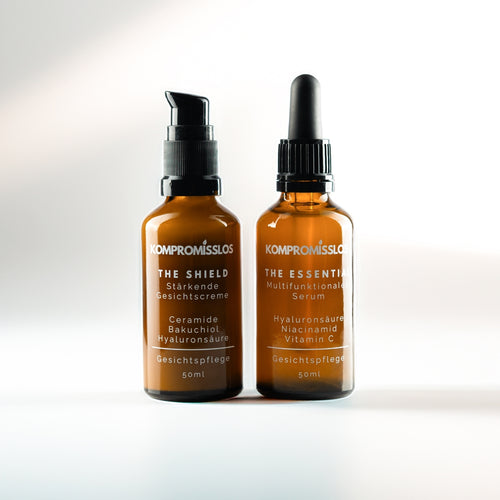
In a split-face study in the journal Dermatologic Surgery, 50 women with signs of photoageing applied 5% niacinamide to one half of the face twice a day for twelve weeks. The researchers saw fewer fine lines, fewer pigment spots and a less sallow complexion than on the comparison side. The authors also point out that niacinamide was well tolerated in several studies. For context: The Duo contains 5% niacinamide, calculated across the serum and cream together. It does not contain azelaic acid.
Which skin tolerates which ingredient better?
With azelaic acid, brief burning is one of the known side effects, whereas niacinamide has been described as well tolerated in studies. The review in Postepy Dermatologii i Alergologii lists mild, transient stinging, burning or itching as the main side effects reported in studies. That is not unusual for an acid and is mostly harmless, but for sensitive skin it can be reason enough to stop using it. Niacinamide is not entirely free of this either: some people react with redness or tingling, especially at high concentrations. What lies behind this is explained in the article on niacinamide side effects.
Roughly speaking, by skin type:
- Dry or mature skin: niacinamide usually fits more easily into everyday use, because it supports the barrier rather than challenging it.
- Oily skin with clogged pores: both are worth considering. If you are mainly looking for an acid that works inside the pore, you will often end up with salicylic acid as an alternative.
- Very sensitive skin: test one ingredient on its own first and wait to see how your skin reacts. Burning that lasts longer than a few minutes is a signal to stop.
- Skin with recurring inflammation: this is not a skin type but a reason to get things checked before you use either ingredient.
Can you combine azelaic acid and niacinamide?
Yes, azelaic acid and niacinamide can generally be combined – there is no known chemical incompatibility between the two. The real question is whether your skin needs two active steps at the same time. It makes sense not to introduce both ingredients on the same day. Start with one, observe your skin for two to three weeks and then add the second. That way, if there is a reaction, you know where it comes from. A practical approach: keep niacinamide in your regular routine and, at first, apply azelaic acid only in the evening and not every day. If it keeps burning over a longer period, the acid is the more likely culprit.
Things are different if a doctor has prescribed you an azelaic acid preparation. In that case, the question of what else you apply belongs in that conversation, not in the comments section of a forum. How azelaic acid fits with retinol, vitamin C and other acids is covered in our guide on what to mix with azelaic acid, and the general rules for retinol in the article on what to mix with retinol.
The best way to try a new acid product is on a small area first for a few days, for example along the jawline. If the skin there stays calm, you can use it on your whole face.
When should the decision be left to a dermatologist?
The decision belongs with a dermatologist as soon as a skin condition is involved or azelaic acid is being considered as a medicine. The evidence for azelaic acid in rosacea and acne comes almost entirely from drug trials. In two randomised studies in the Journal of the American Academy of Dermatology, involving 329 and 335 patients with moderate papulopustular rosacea, a gel containing 15 per cent azelaic acid improved redness in 44 and 46 per cent of those treated, compared with 29 and 28 per cent with a gel containing no active ingredient. These results apply to a tested medicine used for a disease. They cannot be transferred to a cosmetic product at a lower concentration.
Whether a product counts as a medicine depends on its authorisation and its purpose, not on the percentage alone. If you have pustules, persistent redness or itching, a diagnosis is the first step. What skincare can and cannot do in rosacea is a topic of its own – see rosacea skincare – and so is the question of where facial redness comes from and when it needs to be checked. Cosmetics can accompany a treatment, but they do not replace it.
With The Duo, I disclose exactly how much is in it: 5% niacinamide, calculated across the serum and cream together. Azelaic acid is not on our ingredient list, and I am not going to tell you that niacinamide replaces it. The two do different things. What I want to offer with two products instead of eight is simple, fragrance-free everyday care. It cannot replace a diagnosis or a medicine, and it is not meant to. If your skin needs treatment, that decision belongs with a dermatologist. The skincare that follows can stay simple. You can see exactly what goes into the Duo in our full ingredient list.
Frequently asked questions
Azelaic acid or salicylic acid: which is gentler?
That depends less on the ingredient than on the concentration, the base and your skin. Salicylic acid is oil-soluble and works directly in the pore, while azelaic acid acts more broadly and can cause brief burning. Direct comparisons in studies are thin on the ground. If your skin is sensitive, it is best to test just one ingredient on its own and at a low concentration.
How long does azelaic acid take to work?
Expect several weeks to months, not days. The review in Postepy Dermatologii i Alergologii describes a comparative study in rosacea in which the azelaic acid gel was still showing improvements after 15 weeks. That relates to a medicine used for a disease. For cosmetic products, there are hardly any reliable figures on this.
Does azelaic acid burn?
It can. In studies, mild, transient stinging, burning or itching were among the most common side effects. If the sensation fades after a few minutes, it is usually nothing to worry about. If it persists, or if redness or swelling appear, stop using the product and have the reaction looked at.
Is azelaic acid in cosmetics as strong as in medicines?
Usually not. Many cosmetic products contain less azelaic acid or only a derivative, whereas the well-researched medicines work with 15 or 20 per cent. Study results also apply only to the formulation that was tested and cannot simply be transferred to cosmetics. Whether a product counts as a medicine is determined by its authorisation, not by the percentage alone.
How do I spot azelaic acid and its derivatives on an INCI list?
Pure azelaic acid appears as Azelaic Acid in the ingredient list. Often you will find Potassium Azeloyl Diglycinate instead, a compound of azelaic acid and the amino acid glycine. It is not the same substance, and studies on pure azelaic acid do not automatically apply to it. If a percentage is given, it refers to the derivative in question.
Can azelaic acid dry out your skin?
Yes, that is possible, especially at the start and on skin that is already dry. As with other acids, tightness and slight flaking can occur. A richer moisturiser afterwards and less frequent use usually help. If your skin still turns rough and irritated, taking a break makes more sense than adding more product.
Can I use azelaic acid with The Duo?
In principle, yes – there is no known incompatibility with niacinamide. Apply the azelaic acid after cleansing, then the serum and cream as usual. Introduce it slowly, for example on just a few evenings at first, so that you can tell where any reaction comes from. If it is a prescribed preparation, check the order of application with your doctor. The Duo itself does not contain azelaic acid.
Sources
- Sauer N, Oślizło M, Brzostek M, Wolska J, Lubaszka K, Karłowicz-Bodalska K. The multiple uses of azelaic acid in dermatology: mechanism of action, preparations, and potential therapeutic applications. Postepy Dermatologii i Alergologii, 2023. Source
- Thiboutot D, Thieroff-Ekerdt R, Graupe K. Efficacy and safety of azelaic acid (15%) gel as a new treatment for papulopustular rosacea: results from two vehicle-controlled, randomized phase III studies. Journal of the American Academy of Dermatology, 2003. Source
- Bissett DL, Oblong JE, Berge CA. Niacinamide: a B vitamin that improves aging facial skin appearance. Dermatologic Surgery, 2005. Source
- Tanno O, Ota Y, Kitamura N, Katsube T, Inoue S. Nicotinamide increases biosynthesis of ceramides as well as other stratum corneum lipids to improve the epidermal permeability barrier. British Journal of Dermatology, 2000. Source
- Liu H, Yu H, Xia J, Liu L, Liu GJ, Sang H, et al. Topical azelaic acid, salicylic acid, nicotinamide, sulphur, zinc and fruit acid (alpha-hydroxy acid) for acne. Cochrane Database of Systematic Reviews, 2020. Source