What to mix with azelaic acid: retinol, vitamin C, acids and what to keep apart
COMBINING ACTIVE INGREDIENTS
You can mix azelaic acid with most skincare ingredients without any fuss: hyaluronic acid, ceramides, squalane and niacinamide all fit into the same routine. What you should keep apart from azelaic acid are other irritating steps on the same evening – retinol, AHAs, BHAs and a strongly acidic vitamin C serum. Only combine benzoyl peroxide, tretinoin, adapalene and prescription azelaic acid products after talking to the professional who prescribed or recommended them. The rule behind all this: it is not the chemistry that decides, but the total amount of irritation.
Which ingredients can you mix with azelaic acid?
Azelaic acid combines easily with ingredients that do not irritate the skin further: hyaluronic acid, ceramides, squalane, panthenol, glycerin and niacinamide. These work on hydration and the skin barrier rather than on keratinisation, so they tend to take some of the load off your skin instead of adding to it. Things get trickier with anything that can sting, peel or dry out the skin on its own. A 2023 review in Postepy Dermatologii i Alergologii names mild, transient tingling, burning or itching as the main side effects of azelaic acid in studies. Add a second ingredient with a similar profile and these reactions add up, even if the two substances do nothing to each other chemically.
As for niacinamide, briefly: there is no known incompatibility, and what sets the two apart is covered in Azelaic acid vs niacinamide. The general rules for combining skincare ingredients apply here too. The table shows how the most common partners compare.
| Ingredient | Can you combine them? | How |
|---|---|---|
| Hyaluronic acid, ceramides, squalane | Yes | Same routine, applied afterwards |
| Niacinamide | Yes | Same routine, but do not introduce both at once |
| Retinol (cosmetic) | Yes, spaced out | On different evenings, or split between morning and evening |
| Vitamin C as pure ascorbic acid | Yes, kept apart | Vitamin C in the morning, azelaic acid in the evening |
| Vitamin C derivative | Usually yes | Same routine is possible; separate them if it stings |
| AHA, BHA, salicylic acid | Only spaced out | Not on the same evening; count your acid days |
| Benzoyl peroxide, tretinoin, adapalene | Only after consultation | Check with the professional who prescribed them |
Can you use azelaic acid and retinol together?
Yes, you can use azelaic acid and retinol in the same routine, but preferably not layered on the same evening. Both can make your skin feel tight, flake or sting in the first few weeks, and if you start both at once, you will not know which one is to blame when your skin reacts. In practice, that means retinol one evening and azelaic acid the next, or azelaic acid in the morning and retinol in the evening, provided your skin tolerates the acid during the day. Only once your skin has stayed calm on each product separately for a few weeks is it worth trying to layer them in the same evening routine.
In dermatology, pairing it with a retinoid is nothing unusual. A review in the Journal of the American Academy of Dermatology from 2000 summarises a study in which azelaic acid cream became more effective when combined with other topical acne medications such as 0.025 per cent tretinoin cream, benzoyl peroxide or clindamycin. These are acne medicines, however, not cosmetics, and tretinoin is not the same as cosmetic retinol. How to introduce retinol itself and what else goes with it is covered in the article on what to mix with retinol.
Can you use azelaic acid and vitamin C in the same routine?
Azelaic acid and vitamin C fit into the same routine, most easily split up: vitamin C in the morning, azelaic acid in the evening. How well the two work in a single layer depends heavily on which form of vitamin C you use. According to a study in Dermatologic Surgery, pure L-ascorbic acid has to be formulated at a pH below 3.5 to get into the skin. A serum like that is therefore an acidic product in its own right. Layer it directly with another acid and it may sting on sensitive skin.
Vitamin C derivatives, such as magnesium ascorbyl phosphate or 3-O-ethyl ascorbic acid, are a different matter. They are separate substances with their own formulations; the pH requirement from that study applies to pure ascorbic acid. Whether you tolerate a derivative and azelaic acid in one go is something your skin will tell you: if it stays calm, there is nothing against layering them; if it stings, split the two between morning and evening.
Azelaic acid with AHA, BHA or salicylic acid: too much acid at once?
Using azelaic acid together with AHA, BHA or salicylic acid on the same evening is too much for most skin, whereas on separate days the combination is perfectly manageable. Azelaic acid acts on keratinisation, while glycolic, lactic or salicylic acid loosen dead skin cells. Together, they put a double load on the skin’s surface – and that is exactly what hardly anyone takes into account. Two studies in Clinical Therapeutics from 1998 show that the combination has in fact been tested. In one, 20 per cent azelaic acid cream with a glycolic acid lotion was compared with tretinoin for acne and caused less dryness, scaling and redness than tretinoin. In the other, on facial pigmentation in people with darker skin, the combination of azelaic acid and 15 or 20 per cent glycolic acid caused slightly more peeling, burning, stinging or dryness at some time points than the hydroquinone it was compared with, although the scores remained low overall.
Both studies used medicines under medical supervision. For everyday use, that means not every acid is the same, but the load adds up. Which acid suits which skin is explained in AHA, BHA and PHA compared. Here is how to keep the total in check:
- One acid step per evening: either azelaic acid or an AHA or BHA product.
- Count acid toners, exfoliating pads and masks too, not just the serum.
- If your skin feels tight, flakes or stings, cut back the number of acid evenings first.
- Do not start a new acid product in the same week as another new product.
In what order do you apply azelaic acid – morning or evening?
Apply azelaic acid to dry skin after cleansing and follow with the rest of your skincare, typically in the evening. In the evening, there is no sunscreen or make-up going on top, and you can schedule it specifically for evenings without retinol or other acids. Mornings work too, if your skin tolerates it and you apply sunscreen consistently afterwards. With azelaic acid creams and gels, the usual approach is a thin layer, then serum and cream on top once it has absorbed. With a prescribed product, follow the instructions of the professional who prescribed it. How to arrange the remaining steps is explained in the article on which step goes where in your morning and evening skincare.
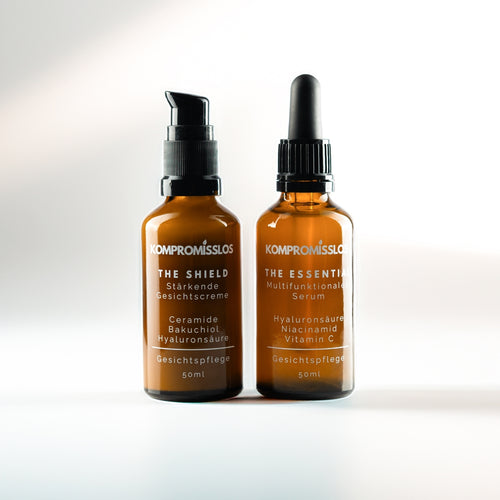
Around the azelaic acid, what you need is not more serums with acids or retinoids but a simple, fragrance-free base. The Duo is that kind of two-step base: The Essential with niacinamide, hyaluronic acid in three molecular sizes and stable 3-O-ethyl ascorbic acid, and The Shield with ceramide NP, squalane, bakuchiol and jojoba oil. One thing to bear in mind when combining: The Duo itself contains vitamin C, niacinamide and bakuchiol. If your skin reacts, that is a reason to use the azelaic acid less often first, not to change your basic skincare.
Try a new azelaic acid product on a small area first before it goes on your whole face. Patch testing skincare at home shows you beforehand whether your skin tolerates it at all.
When should a dermatologist decide on the combination?
The combination is a matter for a dermatologist as soon as a medicine is involved or a skin condition lies behind it. That covers prescription azelaic acid products, benzoyl peroxide, tretinoin, adapalene and topical antibiotics. In these cases, the professional who prescribed them decides what else you use, in what order and how often, because these are exactly the combinations that were tested in studies under medical supervision. The same applies if you want to use azelaic acid for pustules, persistent redness or pigmentation. Where cosmetics reach their limits with a skin condition is covered in the article on what cosmetics can do for rosacea.
A second reason to book an appointment: if a combination keeps burning, weeping or flaking despite a break and reduced use, it is no longer a question of getting the order right. At that point, having it checked is worth more than the next attempt.
I sell two products instead of eight, and exfoliating acids are deliberately not among them. No exfoliant, no toner, no azelaic acid. That is not a statement against azelaic acid but a division of labour: if you need an acid, use it in a targeted way as a separate step. So that you know what you are already applying before you add anything, I disclose the concentrations: 5% niacinamide, 2% vitamin C as stable 3-O-ethyl ascorbic acid and 1% zinc PCA for The Duo as a whole. The cream contains bakuchiol instead of retinol. The Duo has no sun protection, so you need a separate sunscreen during the day, especially when you work with acids. You will find all the active ingredients and their concentrations in one place.
Frequently asked questions
Can I use azelaic acid and hyaluronic acid together?
Yes, this is one of the most straightforward combinations. Hyaluronic acid binds moisture and does not usually irritate; it can even make a routine with azelaic acid more comfortable. Apply the azelaic acid first, then the product with hyaluronic acid. A hyaluronic acid serum without acids does not count as an additional irritant.
Do azelaic acid and bakuchiol go together?
There is no known incompatibility, but there are no studies on the direct combination either. Bakuchiol is neither an acid nor a retinoid, but it is often used as an alternative to retinol. Do not start both at the same time. If your skin reacts, use the azelaic acid less often first.
Can I combine azelaic acid with benzoyl peroxide?
This combination has been tested in acne studies, but with medicines and under medical supervision. Benzoyl peroxide is an acne ingredient and can dry the skin out considerably. Whether and how you combine it with azelaic acid is something to discuss with the professional who recommended or prescribed the products.
Do I need sunscreen with azelaic acid?
Yes, sunscreen belongs in every daytime routine, and all the more so when you use acids. Especially if you use azelaic acid for dark spots, unprotected sun works against what you are trying to achieve. Apply sunscreen in the morning as the last skincare step. The Duo contains no SPF, so sunscreen is always a separate step.
How long should I wait between azelaic acid and moisturiser?
There is no proven waiting time. It is enough for the azelaic acid to have absorbed and for your skin to no longer feel damp. Waiting longer has no proven benefit. What matters more than the minutes is applying the azelaic acid thinly. With a prescribed product, follow the instructions that came with it.
What should I do if my skin burns after a new combination?
Stop the most recently added ingredient and cut azelaic acid back to just a few evenings a week. During this time, use only a simple moisturiser. Brief tingling on application is a known effect of azelaic acid. If the burning persists, or swelling, blisters or weeping appear, have it checked by a doctor.
Where does azelaic acid go if I use The Duo?
After cleansing, typically in the evening: azelaic acid first, then 3 to 6 drops of serum and 3 to 6 pumps of cream as usual. So the order of The Duo stays the same; the acid simply comes before it. If your skin reacts, use the azelaic acid less often first. With a prescribed product, your doctor decides on the order.
Sources
- Sauer N, Oślizło M, Brzostek M, Wolska J, Lubaszka K, Karłowicz-Bodalska K. The multiple uses of azelaic acid in dermatology: mechanism of action, preparations, and potential therapeutic applications. Postepy Dermatologii i Alergologii, 2023. Source
- Webster G. Combination azelaic acid therapy for acne vulgaris. Journal of the American Academy of Dermatology, 2000. Source
- Spellman MC, Pincus SH. Efficacy and safety of azelaic acid and glycolic acid combination therapy compared with tretinoin therapy for acne. Clinical Therapeutics, 1998. Source
- Kakita LS, Lowe NJ. Azelaic acid and glycolic acid combination therapy for facial hyperpigmentation in darker-skinned patients: a clinical comparison with hydroquinone. Clinical Therapeutics, 1998. Source
- Pinnell SR, Yang H, Omar M, Monteiro-Riviere N, DeBuys HV, Walker LC, et al. Topical L-ascorbic acid: percutaneous absorption studies. Dermatologic Surgery, 2001. Source