Uneven skin tone: how to get a more even complexion without make-up
SKIN CONCERNS
An even complexion without make-up does not come from a single product but from three things: working out whether your uneven skin tone is caused by pigment, redness or a dull surface, wearing sunscreen consistently every day, and patiently using two or three well-researched active ingredients such as niacinamide and vitamin C. Allow at least three months before you judge the results. Dark spots and redness do not have to disappear completely for your complexion to look calmer.
What causes uneven skin tone?
Uneven skin tone on the face almost always comes down to one of three causes: unevenly distributed pigment, visible redness or a surface that reflects light unevenly. With pigment, individual pigment cells produce more melanin than their neighbours after sun exposure, after a blemish or under hormonal influence. The result is brownish areas, sometimes sharply defined, sometimes more diffuse. With redness, tiny blood vessels widen, for example on the cheeks, nose and chin, and the face looks pink and blotchy. The third cause is often overlooked: when the outermost layer of skin is dry and rough, it scatters light diffusely, and your complexion looks grey or yellowish even though there is no spot at all. What actually smooths a rough, uneven surface is explained in the article on uneven skin texture.
A study in Dermatologic Surgery shows that these three causes can be looked at separately: in women with photoaged facial skin, the researchers assessed dark spots, red blotchiness and a yellowish, sallow tone one by one. That same distinction is useful at home. If your concern is clearly a few individual brown patches, you will find the background in the article on dark spots on the face. This article is about the bigger picture: a complexion that looks uneven overall.
Is it redness, discolouration or dullness?
You can tell whether you are dealing with redness, discolouration or dullness by the shade and a simple pressure test. Press lightly on the area with a clear glass or a clean plastic ruler. If the colour fades under the pressure and then comes back, it is blood in widened vessels – in other words, redness. If the shade stays the same, the colour sits in the skin itself – in other words, pigment. Dullness is easy to recognise because it is not limited to one area but affects the whole face, and it is usually more noticeable in cool daylight than in warm artificial light. Many people have a mix, for example slightly flushed cheeks plus a few sun spots on the forehead. That is not a problem. It simply means you are not looking for the one product, but building your routine around the strongest cause.
| What you see | Pressure test | Likely cause | Where to start |
|---|---|---|---|
| Brownish spots or patches | Colour stays | Pigment after sun, blemishes or hormones | Sunscreen, niacinamide, vitamin C |
| Pink to red areas on the cheeks and nose | Colour fades | Widened blood vessels, irritated skin | Cut out irritants, support the barrier |
| Grey, yellowish, lacklustre tone | No clear spot | Dry, rough surface, photoageing | Moisture, gentle exfoliation, sunscreen |
If redness is your main issue, start by reading about facial redness, because leaving things out matters more there than any new active ingredient. If your face mainly looks grey and tired in winter, the article on dull skin goes into this in more detail.
Which active ingredients help create a more even complexion?
For a more even complexion, niacinamide and vitamin C are among the well-researched active ingredients you can get without a prescription in everyday skincare. Niacinamide works at a specific point: according to a study in the British Journal of Dermatology, it does not inhibit melanin production itself, but the transfer of pigment from the pigment cells to the surrounding skin cells. In a clinical test reported in the same paper, with 18 participants, skincare with 5% niacinamide reduced hyperpigmentation after four weeks more clearly than the comparison cream without the active ingredient. The Dermatologic Surgery study mentioned above found improvements in dark spots, red blotchiness and yellowish sallowness in 50 women using 5% niacinamide over twelve weeks – in other words, across all three causes. Both papers come out of research by a cosmetics company, which is worth bearing in mind as you read them.
Vitamin C is primarily an antioxidant. A review in the Journal of Clinical and Aesthetic Dermatology describes how it reduces melanin formation, but also points out that clinical studies on topical vitamin C are limited and that the challenge lies in a stable form the skin can absorb well. That is why stable derivatives play a role. Whether you should reach for vitamin C or niacinamide is a separate question, which the article on vitamin C or niacinamide answers.
There are also other options worth knowing about:
- Humectants and ceramides: they smooth the surface, and a smooth surface reflects light more evenly.
- Gentle acids such as lactic acid or PHA: they loosen dead skin cells, but should not be used daily or on irritated skin.
- Tranexamic acid: it is mainly discussed for stubborn patches of pigmentation and is more relevant to individual spots than to your complexion as a whole.
- Retinoids: they renew the surface, but often cause irritation, especially at the start, and can make redness worse.
Why is sunscreen the most important step for an even skin tone?
Sunscreen is the most important step because UV radiation triggers pigment production afresh every day and can therefore partly undo the work of a serum. Pigment cells do not only react to sunburn, but to the everyday dose on your commute, on a walk and through the window. If you apply active ingredients for discolouration in the evening and go unprotected during the day, you are working against yourself. A study in Dermatologic Surgery shows that consistent protection on its own already makes a difference: 32 people applied a broad-spectrum SPF 30 sunscreen to their face every day for a year. By the end, skin texture, clarity, and mottled and spot pigmentation had improved the most, by 40 to 52 per cent compared with baseline. The study had no control group and was carried out by researchers working for a manufacturer, so it is an indication rather than proof. It does, however, fit with what is known about UV light and pigment.
The amount matters. A thin layer of day cream with SPF protects far less than the number on the tube promises. The article on daily sunscreen for your face explains in detail what it needs to do and how it works alongside serum and cream. Even if you are specifically looking for a cream for dark spots, you should treat daily sunscreen as a fixed checkpoint, not an optional extra.
What does a routine for a more even complexion look like?
A routine for a more even complexion needs four steps in the morning and three in the evening, no more. What matters is not so much the number of products as how regularly the right active ingredients reach your skin, and leaving out anything that irritates. Irritated skin reacts with redness and sometimes with new dark patches, especially after inflammation. Layering three serums with acids, retinol and high-strength vitamin C therefore often achieves the opposite.
- In the morning, cleanse your face with water – that is usually enough.
- Apply a serum with niacinamide and vitamin C, working from the centre of your face outwards and down over your neck.
- Follow with a cream that supports the barrier and locks in moisture.
- Finish with sunscreen in a sufficient amount, every day, even when it is overcast.
- In the evening: cleanse (with a mild cleanser if you wear make-up), then serum and cream. A gentle exfoliant once or twice a week at most, and only if your skin is not red.
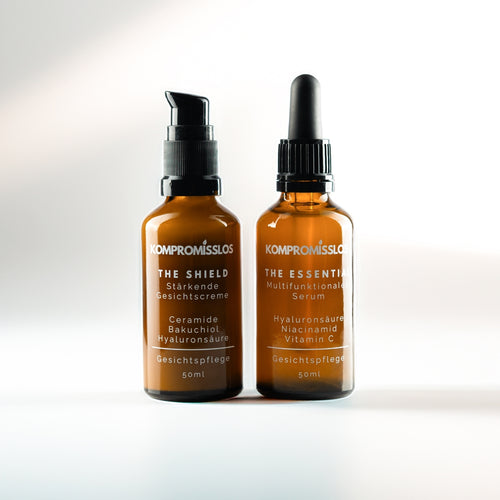
At Kompromisslos, the serum and cream in The Duo cover steps two and three, morning and evening, with 3 to 6 drops of serum followed by 3 to 6 pumps of cream. You need a separate sunscreen, and a cleanser and an exfoliant too if you want them.
Before you start, take a photo of your face in daylight by a window, without make-up and always in the same spot. Take the same photo again after eight and after twelve weeks. The mirror is deceptive because you see yourself every day.
How long does it take for skin tone to look more even?
Depending on the cause, it takes anywhere from a few days to several months for your skin tone to look more even. The surface responds fastest: well-hydrated, smooth skin often looks fresher after just a few days. Redness often calms down within a few weeks once you cut out the triggers. Pigment is the slowest. The study in the British Journal of Dermatology measured a difference after four weeks, the study in Dermatologic Surgery assessed niacinamide over twelve weeks, and with sunscreen the first clear improvements appeared from week twelve and kept increasing up to week 52. So allow at least three months before you judge a product.
How this plays out in everyday life varies from person to person. In her review on Judge.me, Sandra B. writes: “Since I started using it, my skin has looked clearer and more even, and I no longer have any dry patches” (review translated from German). That is one individual experience, not a promise, and it also depends on how consistently sunscreen is part of the routine. If you keep switching products during this time, you will not be able to tell at the end what helped and what did not.
The serum contains niacinamide and vitamin C, and I have disclosed the concentrations: 5% niacinamide and 2% vitamin C as 3-O-Ethyl Ascorbic Acid, both calculated for The Duo as a whole. I chose the stable form of vitamin C because pure ascorbic acid is quite unstable in skincare formulas. What I deliberately left out of the cream is SPF. Sunscreen only works when you apply enough of it, and hardly anyone applies that much with a moisturiser. That is why, for me, it belongs on top as a separate step. The Duo can help give you a more even-looking complexion, but it cannot remove dark spots, and without sunscreen it only does half the job. You can see what role each ingredient plays in our active ingredients with disclosed concentrations.
Frequently asked questions
Does vitamin C help even out skin tone?
Yes, vitamin C can contribute to a more even complexion, because it acts as an antioxidant and, according to a review, reduces melanin formation. Look for a stable form such as 3-O-Ethyl Ascorbic Acid and for packaging that protects it from light and air, otherwise the active ingredient loses its strength before it ever reaches your skin.
Is niacinamide good for uneven skin tone?
Yes, niacinamide is one of the well-researched active ingredients for a more even skin tone. In a twelve-week study with 5% niacinamide, dark spots, red blotchiness and a yellowish, sallow tone became visibly less pronounced, and the participants tolerated the ingredient well. That makes it a good fit for routines in which you want to keep irritation to a minimum.
Do I need an exfoliant for an even complexion?
No, an exfoliant is not a must for an even complexion. It can smooth a rough, dull surface, but used more than once or twice a week it quickly causes irritation, and irritated skin tends to become blotchier. If you have redness or sensitive skin, you are better off leaving it out and relying on moisture and sunscreen.
Do hormonal changes make skin tone uneven?
Yes, hormonal fluctuations can affect pigment production, for example during pregnancy or when taking the pill. Typical signs are widespread, symmetrical brown patches on the forehead, cheeks or upper lip. These can point to melasma, which should be assessed by a dermatologist. Skincare and consistent sun protection can only play a supporting role.
Is a tinted moisturiser a good alternative to make-up?
A tinted moisturiser evens out your skin tone visually, but does not change it. That is perfectly fine if you simply want to cover up less. A tinted sunscreen makes sense because it combines two jobs. In that case, make sure the SPF is stated on the label and that you apply enough of it, because people often use too little of tinted products.
When should you see a dermatologist about uneven skin tone?
It is time to see a professional about uneven skin tone if a spot changes in size, shape or colour, itches or bleeds, if large patches of pigmentation appear suddenly, or if redness comes with pustules, burning or swelling. It is also worth getting it checked if nothing improves after three months of consistent skincare with sunscreen.
Can The Duo make your skin tone look more even?
Yes, The Duo can help give you a more even-looking complexion. The serum contains niacinamide and vitamin C as stable 3-O-Ethyl Ascorbic Acid, and the cream supports the skin barrier. It does not contain sunscreen, so you need that separately in the morning. Allow around three months of regular use, morning and evening, to judge The Duo fairly.
Sources
- Hakozaki T, Minwalla L, Zhuang J, Chhoa M, Matsubara A, Miyamoto K et al. The effect of niacinamide on reducing cutaneous pigmentation and suppression of melanosome transfer. British Journal of Dermatology, 2002. Source
- Bissett DL, Oblong JE, Berge CA. Niacinamide: A B vitamin that improves aging facial skin appearance. Dermatologic Surgery, 2005. Source
- Al-Niaimi F, Chiang NYZ. Topical Vitamin C and the Skin: Mechanisms of Action and Clinical Applications. Journal of Clinical and Aesthetic Dermatology, 2017. Source
- Randhawa M, Wang S, Leyden JJ, Cula GO, Pagnoni A, Southall MD. Daily Use of a Facial Broad Spectrum Sunscreen Over One-Year Significantly Improves Clinical Evaluation of Photoaging. Dermatologic Surgery, 2016. Source