Öko-Test face cream ratings: what the grades mean and how to read them in Switzerland

Fully declared
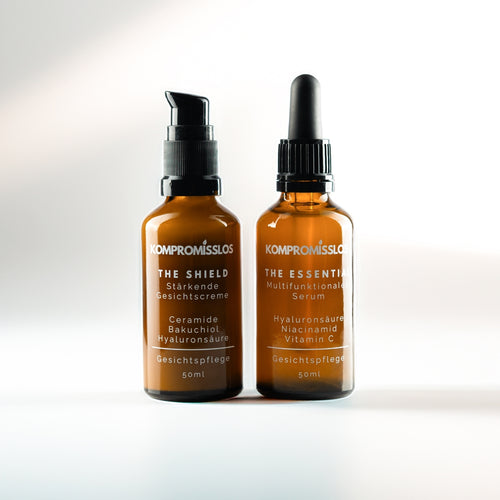
The Duo – serum & face cream
★★★★★ 4.9/5 · 120+ reviews
Instead of a test ranking: a serum and cream with the concentrations of the main actives openly stated. Fragrance-free, dermatologically tested.
CHF 109.90 119.80 · free shipping in Switzerland · 100-day trial
What does Öko-Test actually check in face creams?
With face creams, Öko-Test primarily checks ingredients, advertising claims and packaging, not how well the cream cares for your skin. For the current test in its October 2026 issue, the magazine had laboratories analyse 32 rich face creams for allergenic fragrances, nitro musks and polycyclic musk compounds, cashmeran, diethyl phthalate, and formaldehyde and formaldehyde releasers. Further analyses were added depending on the formulation: where paraffins were declared, the laboratory looked for mineral oil aromatic hydrocarbons, or MOAH for short, and where chlorphenesin was listed, its actual content was measured. Using the ingredient list, Öko-Test also checked for PEG compounds, synthetic polymers and questionable UV filters. For creams with anti-ageing, anti-wrinkle or firming claims, the editors requested product-specific studies. On top of that come environmental points such as unnecessary outer boxes, the proportion of recycled material in plastic packaging and chlorinated compounds. The creams were bought between June and July 2026 in chemists, supermarkets, pharmacies and online. Twelve of the 32 creams were rated ‘very good’.
Öko-Test itself spells out in the small print what is missing from its testing programme: in its January 2024 face cream test, the magazine states that it did not check the effects promised by the manufacturers, apart from certain claims examined by requesting studies. Skin hydration, how quickly a cream absorbs and how well test subjects tolerate it are not part of the test. How the same principle applies to serums is explained in the overview of what Öko-Test and saldo checked in hyaluronic acid serums.
How does Öko-Test arrive at its overall grade, from ‘very good’ to ‘insufficient’?
The overall grade is based on two sub-results, the ‘test result for ingredients’ and the ‘test result for other defects’, with the ingredients forming the basis. For every finding, Öko-Test sets in advance how many grades it will knock off the relevant sub-result. The scale runs from ‘very good’ (sehr gut) through ‘good’, ‘satisfactory’, ‘sufficient’ and ‘poor’ to ‘insufficient’ (ungenügend). The result for other defects then only has a dampened effect on the overall grade: if it is ‘good’, nothing changes. If it is ‘satisfactory’ or ‘sufficient’, the overall grade drops by one, and if it is ‘poor’ or ‘insufficient’, by two. An ingredient finding therefore hits the overall grade directly, while an advertising or packaging defect counts for less. One point is important for putting this in context: according to Öko-Test, its downgrading thresholds are not legal limits unless stated otherwise, but are set by the editors. The table shows some of the rules from the October 2026 test.
What stands out is how strictly Öko-Test checks advertising claims. A brand that advertises anti-ageing benefits without providing a complete study on the specific product loses four grades under other defects, which on its own lowers the overall grade by one. According to Öko-Test, only three manufacturers in the October test submitted such studies at all, and in the editors’ view even these did not show a sufficient advantage over a simple cream.
Why are PEG, silicones, paraffins and fragrances downgraded, and how much does that matter for your skin?
Öko-Test downgrades these groups of substances as a precaution, either because of their allergy potential or because the editors consider natural fats and oils the kinder choice for the skin – not because the substances are banned in cosmetics. There is a different argument behind each group:
- PEG compounds: according to Öko-Test, these emulsifiers can make the skin more permeable to foreign substances. In October 2026 they cost one grade; in the January 2024 test it was still two.
- Paraffins: in October 2026, it is not paraffin itself that is downgraded but a measured MOAH content above 10 mg/kg, because this group of substances can also contain carcinogenic compounds. In the January 2024 test, a paraffin content above 1 per cent also cost a grade on its own. The state of the research is summarised in what is behind the criticism of paraffin and MOAH.
- Silicones: in the January 2024 test, silicones above 1 per cent cost one grade under ingredients, and otherwise two grades under other defects as ‘plastic compounds’. The reasoning at the time was that they do not fit into the skin’s natural balance as well as natural fats and oils. In October 2026, Öko-Test does not mention silicones specifically and downgrades synthetic polymers instead.
- Fragrances: the downgrade is tiered, from one grade for a potential allergen up to five grades for a banned fragrance. A cross-sectional study in the British Journal of Dermatology gave a conservative estimate of 1.9 per cent for fragrance contact allergy in the general population of five European countries, with women affected about twice as often as men. What a label without perfume actually covers is explained in what fragrance-free really guarantees.
Overall, this yardstick is stricter than the law. According to the Federal Food Safety and Veterinary Office (FSVO), the lists of banned and restricted substances in the EU Cosmetics Regulation apply to cosmetics in Switzerland. Chlorphenesin illustrates the difference well: Öko-Test already downgrades a content of up to 0.3 per cent by two grades, taking its cue from the legal maximum concentration. A cream can therefore be legal and still be downgraded. Whether a particular group of substances matters to you personally depends on your skin and your priorities. For an overview of which ingredient warning lists hold up, see the separate article.
What does a good Öko-Test grade say about effectiveness and tolerance?
A good Öko-Test grade says almost nothing about effectiveness and only something indirect about how well your skin will tolerate a cream. ‘Very good’ means that Öko-Test found nothing, either in the laboratory or in the ingredient list, that is downgraded under ingredients, and that there was at most a small deduction under other defects, for example for an outer box. Nobody checks whether a cream makes your dry patches feel softer, whether it pills under make-up or whether it is too rich for your skin. Öko-Test assesses tolerance through substances with a known allergy potential, above all fragrances and preservatives. That is a sensible filter, but not a skin test. Even a cream without a single downgraded substance can sting on your skin, for instance because of a plant extract you react to. Conversely, a cream that lost grades because of an outer box or missing recycling information may be perfectly fine for your skin. The grade is a total made up of very different criteria, and only the reasoning shows which of them is relevant to you. Why a test winner generally tells you little about your own skin is explained in detail in the criteria, not the ranking, for mature skin.
Does a German Öko-Test result also apply to the cream on a Swiss shelf?
An Öko-Test result only applies to the exact product tested, and whether the cream on your Swiss shelf is the same product is something you have to check yourself. Three points make the difference. First, the formulation: manufacturers adjust their formulas over the years, and a version made for another market can have a different ingredient list. If the test names the criticised substance, look for it in the INCI list on your packaging. Second, the timing: the creams in the current test were bought in June and July 2026, while a 2024 verdict is partly based on different downgrading rules. Third, the price: Öko-Test calculates in euros per 50 millilitres, between €1.65 and €51.67 in the October test. For Swiss shelf prices, that is at most a rough guide.
The legal situation, on the other hand, is comparable, because Switzerland adopts the substance lists of the EU Cosmetics Regulation. What is permitted or banned in cosmetics in Germany therefore largely applies here too, and most downgrades remain a stricter, voluntary yardstick set by the editors. Swiss consumer tests sometimes set different priorities. What the K-Tipp face cream test measures is covered in a separate article.
How can you use an Öko-Test result to decide what to buy?
An Öko-Test result works best as an exclusion filter: it shows you which substances and claims you can avoid, but not which cream suits your skin. Four steps are enough:
- Check the test year: does the verdict come from the current test or from an older issue with different rules?
- Read the reasoning: was the cream downgraded for its ingredients or for other defects such as an outer box or the proportion of recycled material?
- Apply the criteria yourself: look for Parfum, Paraffinum Liquidum, Dimethicone or PEG in the INCI list of your cream, even if it has never been tested.
- Let your skin decide: the grade does not replace watching how your skin reacts over a few weeks.
This check also works for creams without a test verdict. The Duo of serum and face cream, for example, has not been tested by Öko-Test and carries no seal. You can still look up what Öko-Test typically downgrades in its disclosed ingredient list: The Duo is fragrance-free and contains no mineral oil or paraffin, silicones, parabens, microplastics or phenoxyethanol. The concentrations are stated openly: 5% niacinamide, 2% vitamin C as 3-O-Ethyl Ascorbic Acid and 1% zinc PCA. That does not replace a test verdict. There is one more point from the October test you can take on board: Öko-Test tends to recommend face care without UV filters, because their sun protection factor usually goes no higher than 15, and recommends a proper sunscreen with a high SPF where needed.
Try it yourself
The Duo – serum & face cream
★★★★★ 4.9/5 · 120+ reviews
Serum with niacinamide, hyaluronic acid and vitamin C, cream with ceramides and bakuchiol. Not happy? A short message is all it takes.
CHF 109.90 119.80 · free shipping in Switzerland · 100-day trial