Best hyaluronic acid serum in Switzerland: what tests check and what you should check yourself
SWISS BUYING GUIDE
If you are looking for the best hyaluronic acid serum in Switzerland, there is, strictly speaking, no current test winner: the most recent major tests we could find were published by the German magazine Öko-Test and the Swiss magazine saldo in October 2024. Öko-Test rated four of 24 hyaluronic acid serums ‘very good’, but it mainly checked for problematic ingredients, not for effectiveness. In saldo’s test of ten serums, one of the two cheapest products came out top for skin hydration. A test verdict helps you rule products out. Your decision should rest on the ingredient list, the absence of fragrance and honest claims.
Which hyaluronic acid serum did well in tests?
In Öko-Test’s October 2024 test, four of 24 hyaluronic acid serums were rated ‘very good’, and in the Swiss saldo test from the same month, an inexpensive serum came out ahead on skin hydration. Öko-Test examined the formulations of 24 products, nine of them certified as natural cosmetics. The top rating went to serums without problematic ingredients and without anti-ageing claims that the manufacturer could not back up. In issue 16/2024, saldo tested ten facial serums which, besides water and glycerin, mostly also contain hyaluronic acid. The editors’ conclusion: you can save your money on the expensive ones, as the test winner was one of the two cheapest products. Stiftung Warentest adopted this test for the German market in November 2024.
We are deliberately not naming products here. Both tests are two years old, formulations get revised, and some of the products are no longer on sale. Anyone searching today for ‘best hyaluronic acid serum 2026’ often ends up on comparison websites that sort products by star ratings and price, without a lab of their own. We have broken down how lists like these come about, using the best retinol serum in Switzerland as an example. The same applies to hyaluronic acid: a seal without a test date and a test report is advertising, not a test.
What do Öko-Test, K-Tipp and others actually check in hyaluronic acid serums?
With hyaluronic acid serums, Öko-Test mainly checks for what should not be in them, while saldo also measured skin hydration. These are two fundamentally different approaches. Among other things, Öko-Test had a laboratory look for fragrances that must be declared on the label, musk compounds, diethyl phthalate and formaldehyde or formaldehyde releasers. On top of that came the content of the preservative chlorphenesin, PEG compounds, silicones and synthetic polymers according to the ingredient list, PVC packaging and a request for the studies behind anti-ageing claims. Öko-Test did not measure skin hydration. In the saldo test, volunteers applied the serums, after which a laboratory used a Corneometer to determine the water content of the stratum corneum, the skin’s outermost layer. According to saldo, half of the serums contained skin-irritating substances.
K-Tipp and saldo come from the same publishing house. When we researched this in October 2026, we did not find a separate, more recent hyaluronic acid serum test by K-Tipp or Kassensturz. A search for a ‘hyaluronic acid serum test in Switzerland’ therefore currently leads back to saldo’s 2024 test.
| Test criterion | Öko-Test 2024 | saldo 2024 | What it tells you |
|---|---|---|---|
| Problematic ingredients | Yes, lab analysis and ingredient list | Skin-irritating substances identified | What you do not want on your skin |
| Skin hydration | No | Yes, Corneometer after application | How well the serum binds water in the short term |
| Anti-ageing claims | Studies requested and assessed | Unknown (report behind a paywall) | Whether the advertising is backed up |
| Tolerance on your skin | No | No | Only you can check that |
What does a test winner tell you about effectiveness?
A test winner tells you little about effectiveness, because most tests do not measure it at all. Öko-Test itself points out that the promised effects were not checked, except by requesting studies on certain claims. There, ‘very good’ means that no critical ingredients were found and that the packaging makes no unsupported claims. That is valuable, but it is a process of elimination. The saldo test comes closer to effectiveness because it measures moisture in the stratum corneum. Even so, it remains a snapshot taken in one group of volunteers. It says nothing about how a serum performs over months on dry, sensitive or mature skin, whether it works well with your cream or whether you enjoy applying it. In its report on the test, Stiftung Warentest reminds readers that prices often say nothing about the quality of cosmetics. A test winner is therefore a useful pointer to which product is soundly made. Whether it suits you is a question it cannot answer. What hyaluronic acid can do in the first place and where its limits lie is covered in our article on what hyaluronic acid really does for skin.
How can you recognise a good hyaluronic acid serum yourself?
You can recognise a good hyaluronic acid serum by five points that take two minutes to check on the packaging or product page. You do not need a test report for this, just the ingredient list and a critical eye for the advertising language. The order roughly reflects how much each point matters.
- Hyaluronic acid appears in the ingredient list as Sodium Hyaluronate or Hyaluronic Acid, not just on the front of the pack. Several molecular sizes are a plus, because large molecules hold water on the surface and smaller ones get a little deeper into the stratum corneum. There is more on this, without the percentage arms race, in the article on its effects linked above.
- The serum is fragrance-free. In a hydrating serum, fragrances do nothing for your skin, but they can trigger contact allergies.
- Supporting active ingredients are listed with their concentrations. ‘With niacinamide’ without a figure tells you very little.
- The claims stick to hydration, how your skin feels and how it looks. Anyone who writes ‘fills in wrinkles’ is promising more than a serum can deliver.
- You can return it if your skin does not like it. A test verdict is no substitute for a trial period on your own skin.
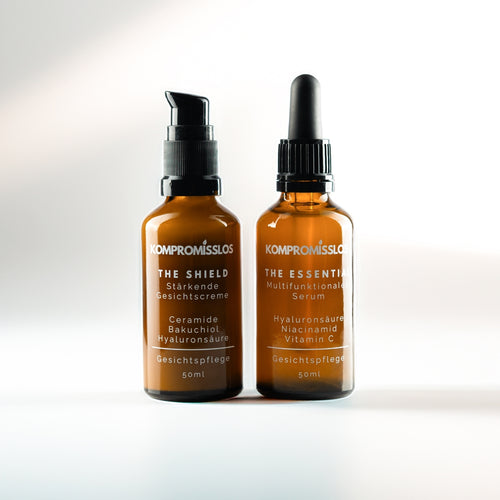
With The Duo, with The Essential as its serum, you can check exactly these points: hyaluronic acid in three molecular sizes, no fragrance, disclosed concentrations of the supporting active ingredients and a 100-day return policy. In a review on Judge.me, J.D. writes: ‘I’m especially delighted with the serum – and also with the whole concept and the great transparency regarding ingredients etc.’ (review translated from German). That is not a test verdict, but it is exactly the point you can check for yourself with any serum.
What do the supporting ingredients and the base tell you about a hyaluronic acid serum?
The supporting active ingredients and the base show whether a hyaluronic acid serum only binds moisture or also does something for the skin barrier. On its own, hyaluronic acid is a humectant. What surrounds it determines how much more the serum can do. Niacinamide is a good example: a study in the British Journal of Dermatology showed that niacinamide increases the production of ceramides in skin cells and, in dry skin, reduced water loss through the skin. Panthenol, glycerin or aloe vera as a base add to the hydration. A stable form of vitamin C gives the serum a second focus; what matters there is explained in our article on the best vitamin C serum in Switzerland.
It is also worth looking at what appears near the top of the list. If Alcohol Denat. is among the first ingredients, the serum is designed more for quick absorption than for keeping sensitive skin calm. Fatty alcohols such as Cetearyl Alcohol, on the other hand, are nourishing texture agents and not the same thing. Which active ingredients work well alongside hyaluronic acid in a routine, and why a layer on top matters, is explained in our article on combining hyaluronic acid. And if you are looking not just for hyaluronic acid but for a serum for demanding skin in general, the criteria in our guide to the best serum for mature skin will help you further.
Which hyaluronic acid serum claims are exaggerated?
The most exaggerated claims are those that make a serum sound like a hyaluronic acid filler injection. Öko-Test checked exactly this: 13 of 24 hyaluronic acid serums advertised an anti-ageing claim, but only four manufacturers submitted complete product-specific studies. And even these, in Öko-Test’s view, showed no advantage over a conventional, often much cheaper comparison product. The editors also note that robust scientific evidence for applied hyaluronic acid working against wrinkles is still lacking. What a hyaluronic acid serum can realistically do is bind moisture, make your skin look plumper and smoother, and make fine lines caused by dryness less visible. It is worth being sceptical of these phrases:
- ‘Fills wrinkles from within’ or ‘like a filler’: a serum works in the stratum corneum, not in the connective tissue.
- ‘Penetrates deep into the skin’: not proven without a study on the specific product.
- ‘Highly concentrated’ without a figure: with hyaluronic acid, a higher percentage does not automatically mean a greater effect.
- ‘Test winner’ without the name, issue and date of the test: impossible to verify.
- ‘Visibly younger in seven days’: a timeframe without a study is just a claim.
I designed The Essential so that you can check it against exactly the criteria in this article without having to take my word for it. It contains hyaluronic acid in three molecular sizes and is fragrance-free. For the supporting active ingredients, I disclose the concentrations that apply to The Duo as a whole: 5% niacinamide, 2% vitamin C as stable 3-O-Ethyl Ascorbic Acid and 1% zinc PCA. You will not find a test-winner seal on our products, and I do not use one in our advertising either. I do not promise what a serum cannot do: it does not fill in wrinkles and it is no substitute for treatment by a professional. You can read in full which active ingredients do which job.
Frequently asked questions
Is an expensive hyaluronic acid serum better?
No, not automatically. In saldo’s 2024 test, one of the two cheapest serums came out top for skin hydration, and in the same report Stiftung Warentest points out that prices often say nothing about the quality of cosmetics. A higher price may reflect supporting active ingredients, manufacturing or packaging, but it may also reflect marketing. We have broken down what you actually pay for in our article on what you are really paying for with expensive face cream.
Is a hyaluronic acid serum with alcohol or fragrance a problem?
For sensitive skin, it often is. Fragrances are among the known triggers of contact allergies: in a study in the British Journal of Dermatology, the conservatively estimated prevalence of fragrance contact allergy in the general population of five European countries was 1.9 per cent. Alcohol Denat. near the top of the list can strip even more oil from dry skin. Nourishing fatty alcohols such as Cetearyl Alcohol are not a problem.
Are hyaluronic acid serums tested in Switzerland?
Yes, but rarely. The most recent Swiss test we found is saldo’s test in issue 16/2024 of ten facial serums, most of which also contain hyaluronic acid. Among other things, it measured skin hydration. When we researched this in October 2026, we did not find a more recent hyaluronic acid serum test by K-Tipp or Kassensturz.
How up to date are test-winner lists?
Often less up to date than the year in the title suggests. The two most recent major lab and measurement tests of hyaluronic acid serums were carried out by Öko-Test and saldo in autumn 2024. Lists with ‘2026’ in the title usually just sort existing products by their ratings. So always check the name of the test, the issue and whether the product still has the same formulation.
Are serums also tested for skin tolerance?
Only indirectly. Öko-Test assesses tolerance via the ingredients, such as fragrances that must be declared or the preservative chlorphenesin, which according to Öko-Test can trigger allergies and irritate the skin. saldo identified skin-irritating substances. No test can show how your own skin reacts; only using the product on your own skin can.
What does ‘very good’ from Öko-Test mean for effectiveness?
For effectiveness, a ‘very good’ from Öko-Test means little. The rating means that the laboratory found no critical substances and that the packaging makes no unsupported anti-ageing claims. By its own account, Öko-Test did not check the promised effects themselves, except through the studies it requested. A ‘very good’ is therefore a useful way to rule products out, not proof that they work.
Do I need an extra hyaluronic acid serum if I use The Duo?
No. The Essential already contains hyaluronic acid in three molecular sizes, and The Shield contains hyaluronic acid too. The cream on top helps keep the moisture this binds in your skin. A second hyaluronic acid serum would mean one more layer, but no new active ingredient. If your skin needs more in winter, use a little more of the serum and cream from The Duo.
Sources
- ÖKO-TEST. Hyaluron-Serum-Test: Was Hyaluronsäure kann und welche Seren am besten sind. ÖKO-TEST, 2024. Source
- Schildknecht A. Test: Ein günstiges Serum befeuchtet die Haut am besten. saldo 16/2024. Source
- Stiftung Warentest. Seren fürs Gesicht: Durstlöscher für die Haut. test.de, 2024. Source
- Diepgen TL, Ofenloch R, Bruze M, Cazzaniga S, Coenraads PJ et al. Prevalence of fragrance contact allergy in the general population of five European countries: a cross-sectional study. British Journal of Dermatology, 2015. Source
- Tanno O, Ota Y, Kitamura N, Katsube T, Inoue S. Nicotinamide increases biosynthesis of ceramides as well as other stratum corneum lipids to improve the epidermal permeability barrier. British Journal of Dermatology, 2000. Source