The best vitamin C serum in Switzerland: 5 criteria that really decide it
COMPARISON AND BUYING ADVICE
No independent testing institute in Switzerland regularly names a best vitamin C serum. Most rankings come from comparison sites that earn money through affiliate links. You will make a more reliable decision using five criteria you can check yourself: the declared form of vitamin C, a disclosed concentration, light-protective packaging, tolerability for your skin’s condition and a right of return that lasts long enough.
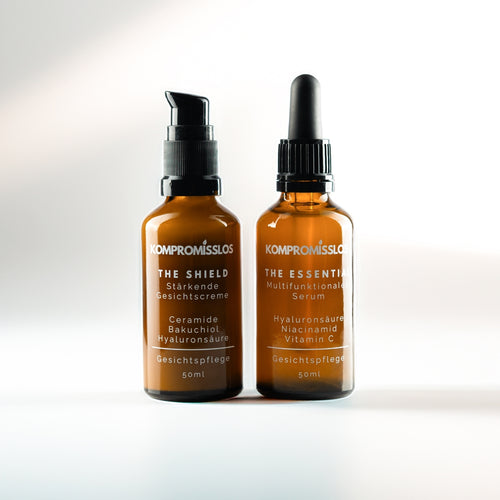
An example from our range: The Duo – serum with vitamin C, niacinamide & hyaluronic acid plus face cream, made in Switzerland, 100-day right of return.
Five similar criteria apply to the cream you put on over the serum: the best face cream for mature skin.
Is there an official test winner for vitamin C serum in Switzerland?
No, there is no official award for vitamin C serums in Switzerland. Consumer magazines do regularly test food, appliances and certain categories of cosmetics, but at present you will not find a recurring test specifically for vitamin C serums. What a search turns up instead are rankings from comparison sites. They are not automatically wrong, but they are rarely based on laboratory data, and many are funded by commission on products sold. You can spot this from the note about advertising links under the product box or in the legal notice. In practice, this means that rather than following someone else’s ranking, you are better off checking for yourself what a manufacturer discloses. Brands that state their concentrations make that easy, because you can compare numbers instead of adjectives. We list all our figures openly on the page about our ingredients and their concentrations, including what each figure refers to.
Which form of vitamin C belongs in a good serum?
What matters is not the words “vitamin C” on the front but the INCI name on the back. Pure L-ascorbic acid appears there as Ascorbic Acid. It is the most thoroughly researched form, but also the most delicate: it needs a very low pH, oxidises quickly and irritates sensitive skin more often. Alongside it there are derivatives that are more stable and milder, including Sodium Ascorbyl Phosphate, Ascorbyl Glucoside and 3-O-Ethyl Ascorbic Acid, listed as Ethyl Ascorbic Acid. These forms first have to be converted in the skin, but they withstand light and air much better and do not need an extremely low pH. If a product only says “vitamin C” without an INCI name, you are missing half the information and cannot even estimate whether the serum is likely to be strong or mild. Whether vitamin C should be your first active ingredient at all, or whether another would suit you better, is covered in the comparison between vitamin C and niacinamide.
What percentage of vitamin C does a serum really need?
The percentage on its own says little, because it only means something together with the form and the formulation. For pure L-ascorbic acid, a study on pig skin in the journal Dermatologic Surgery showed that absorption depends heavily on the formula: the active ingredient only gets into the skin at all below a pH of 3.5, and the highest absorption measured was at 20%. In the same study, two derivatives that were tested did not increase the vitamin C content of the skin. This cannot be transferred one to one, because 3-O-Ethyl Ascorbic Acid was not part of these measurements and pig skin is not human skin. The lesson still stands: a high number on the packaging is no substitute for a well-thought-out formula, and two products with an identical percentage can differ considerably in practice. Our Duo of serum and cream contains 2% 3-O-Ethyl Ascorbic Acid, deliberately chosen as a gentle long-term option rather than a high dose.
How can you tell whether a serum will stay stable?
A good vitamin C serum is packaged so that as little light and air as possible can reach it. Amber glass, dark violet glass or an airless pump are good signs; a clear bottle with a wide opening is a bad one. Also look for the open-jar symbol on the back: the number next to it tells you how many months the contents can be used after opening. Colour is your second indicator. If a serum turns from clear or pale yellow to deep orange or brown, the active ingredient has oxidised and the product no longer belongs on your face. So do not keep the bottle on the windowsill or next to the shower, but somewhere cool and dark in a cupboard – then the contents will stay usable down to the last drop. How many drops make sense per application and in which order you can apply them is explained on the page about how to use the serum and cream.
Five criteria for checking any vitamin C serum yourself
You can run through these five points for any product in a few minutes, whether on the shelf or in an online shop. They replace the missing test winner with a decision of your own that you can actually follow. The order matters: first the form, then the amount, then the packaging. A serum with the perfect concentration in a transparent bottle is of little use to you if it has oxidised after six weeks. Conversely, the best packaging is no help if you do not even know which form of vitamin C is inside. The fifth point is often underestimated: skincare shows its effects over weeks, not days. A two-week right of return is simply not enough, because in that time you can at most judge tolerability, not results. That is why we give you 100 days, so you can try The Duo for CHF 109.90 at your own pace in everyday life.
| Criterion | What to look for | Warning sign |
|---|---|---|
| Form of vitamin C | The INCI name is clearly stated. | The packaging only says “vitamin C”. |
| Concentration | The manufacturer gives a specific percentage. | It only says “high-dose” or “highly concentrated”. |
| Packaging | Dark glass or an airless pump protects the contents. | Clear bottle with a wide opening. |
| Tolerability | The formula suits your skin’s condition. | Several strong acids in the same product. |
| Return period | The period covers several weeks of use. | Returns only accepted for unopened products. |
When a vitamin C serum is not the right choice for you
There are situations in which you are better off waiting or doing without altogether. If your skin currently feels tight, stings or is flaking, the barrier has its hands full, and an additional active ingredient is more likely to unsettle things further. In that case, ceramides, squalane and panthenol are the more sensible choice until your skin has recovered. And if you already use several acids or a retinoid, you do not necessarily need a vitamin C serum on top; fewer active ingredients at once often means a calmer complexion. For sensitive skin, soothing plant extracts are often a better starting point, such as gentian root extract and how to use it. And if inflamed spots are your main concern, the way forward is suitable basic care, as described in the article on causes of and care for blemish-prone skin. With persistent problems, severe redness or changes to moles, your skin belongs with a dermatologist, not on a cosmetics shelf.
For our serum, I deliberately chose 3-O-Ethyl Ascorbic Acid rather than the high-dose pure form. The reason is unspectacular: I wanted a product you can use morning and evening without your skin rebelling after two weeks. A high number on the label would have sold better, but it would also have sent more people back to the drawer. I would rather you use a gentle concentration consistently over months than put up with a strong one for three weeks and then give up. The same thinking lies behind the decision to offer just two products instead of a long product line. What you use every day achieves more than what sounds good.
Frequently asked questions
Which vitamin C concentration is suitable for sensitive skin?
With sensitive skin, you are usually better off with a low concentration and a mild derivative. Pure L-ascorbic acid at a high dose needs a very low pH and is more often experienced as irritating. Start with a product in the low single-digit percentage range and watch your skin over several weeks.
Is an expensive vitamin C serum automatically better than a cheap one?
No, the price tells you nothing about the quality of the formula. It depends on packaging, marketing, production volume and sales channel. Compare the INCI list, the stated concentration and the packaging instead. A transparently labelled product in the mid-price range is often the better choice.
How long does it take before I see a difference?
Allow several weeks of regular use before you can judge any change in your complexion. Skin renewal takes time, and individual days tell you little. That is why a long return period matters more than a quick promise. Take a photo of your face at the start in the same light.
Can I use a vitamin C serum morning and evening?
Yes, with a mild derivative, using it twice a day is normal. Our serum is designed for exactly that, morning and evening, with 3 to 6 drops. If your skin is very sensitive, it is better to start once a day and increase after one to two weeks if everything stays calm.
What does 3-O-Ethyl Ascorbic Acid mean on the INCI list?
It is a stable vitamin C derivative that appears on the list as Ethyl Ascorbic Acid. It withstands light and air better than pure ascorbic acid and is considered gentler to use. The Duo as a whole contains 2% of it.
How can I tell that my serum has gone off?
The clearest sign is the colour. If a clear or pale yellow serum turns deep orange to brown, the vitamin C has oxidised. A change in smell is another warning sign. In addition, stick to the number of months shown in the open-jar symbol.
What should I look for when buying a vitamin C serum in Switzerland?
Look for a Swiss address for the responsible person, clear information about delivery and returns, and a full INCI list in the online shop. With us, delivery costs CHF 3.70 and is free on orders over CHF 60; delivery takes 1 to 3 working days.
Sources
- Pinnell SR, Yang H, Omar M et al., Topical L-Ascorbic Acid: Percutaneous Absorption Studies, Dermatologic Surgery 2001;27(2):137-142. Source