Expensive vs cheap face cream: what you’re really paying for
SWISS BUYING GUIDE
Expensive skincare is not automatically worth it: the price says little about how well a face cream cares for your skin. Part of what you pay goes on the brand, packaging, advertising and retail, not on the formula. Independent tests have already found inexpensive creams that perform just as well as expensive ones, or better. A cream is worth its money when it discloses its active ingredients in amounts you can verify, suits your skin and you use it for long enough.
Are expensive face creams really better?
No, expensive face creams are not fundamentally better than cheap ones, and a high price is no proof of greater effect. What a cream does for your skin depends on three things: which ingredients it contains, in what amounts, and whether the base suits the condition of your skin. These three points do cost the manufacturer money, but they account for only part of the shelf price. An analysis of 174 best-selling body moisturisers in JAMA Dermatology shows how far prices diverge between comparable products: from 0.10 to 9.51 US dollars per ounce. At the same time, the authors note that there is hardly any freely available comparative data on effectiveness. So the price is the one number you always see, and the effect is the one you almost never see.
There is also a psychological effect. In an experiment published in the Journal of the American Medical Association, participants experienced a placebo pill as more effective against pain when they were told it had a high price rather than a low one. This has not been studied in this form for cosmetics, but it seems plausible all the same: whatever costs a lot quickly feels more effective. That is not a criticism of you, but a reason to base your decision on criteria rather than on the price tag.
What are you actually paying for in the price of a face cream?
When you buy a face cream, the formula is only part of what you pay for; the rest is spread across packaging, brand, advertising, retail and manufacturing. Very few brands disclose how large each share is, and the blanket percentages that circulate online are mostly estimates. A more useful question is which cost blocks do something for your skin and which do not. Some items are genuinely relevant to you, such as airtight packaging that protects sensitive active ingredients, or thorough stability testing. Others you pay for without your skin noticing anything: the jar with the gold rim, the campaign with a famous face, the shelf-space fees at the department store. Advertising claims tell you very little here. In the JAMA Dermatology analysis mentioned above, products labelled as recommended by dermatologists had a higher median price than those without that claim, and of the products advertised as fragrance-free, 45 per cent contained at least one substance that can cross-react with fragrances, or a botanical ingredient.
| Cost block | What it can give you | What it does not prove |
|---|---|---|
| Active ingredients and formula | The actual skincare benefit | That the amount is sufficient, as long as no concentration is stated |
| Packaging | Protection from light and air, hygienic dispensing | Effectiveness, if it is mainly heavy and decorative |
| Brand and advertising | Recognition, trust | Anything at all about your skin |
| Retail and distribution | Advice in store, availability | Better quality of the cream |
| Place of manufacture | Traceable production, short supply chains | A better effect simply because of where it comes from |
What do independent tests say about price and effectiveness?
Independent tests show that price is a poor predictor of how a cream will perform. One example is a test by the German consumer organisation Stiftung Warentest of nine anti-wrinkle creams priced between 2.45 and 87 euros. In total, 270 women applied the creams for four weeks, 30 women per product. All nine creams were rated “poor” because none of them achieved the promised visible reduction in wrinkles. According to Stiftung Warentest, the most expensive cream in the test did not even provide adequate moisturisation. Stiftung Warentest’s conclusion on moisture: a similarly good effect could also be had more cheaply with a classic moisturiser that makes no anti-ageing promises.
Tests like this are a useful filter, but not a verdict on your skin. They measure specific things over a limited period, such as moisture after a few weeks or questionable ingredients. If you want to know what the K-Tipp test measures and where its limits lie, it is worth looking at the methodology before you follow a test winner. And if you are looking for a cream for mature skin, focusing on the criteria, not the ranking, will usually serve you better than going for the most expensive or highest-placed product.
How can you tell whether a cream is worth the money?
A cream is worth the money if you can check what is in it and how much, and if you actually use it every day. That sounds obvious, but it rules out many expensive products that rely on mood words rather than facts. Five questions help you put the price into perspective:
- Does the brand state concentrations for the key active ingredients, or only their names?
- Do these active ingredients appear far enough up the INCI list for the amount to be plausible?
- How much product do you get, and how long does it last the way you use it?
- Does the base suit your skin – rich, light, fragrance-free?
- Can you return the product if it does not suit you?
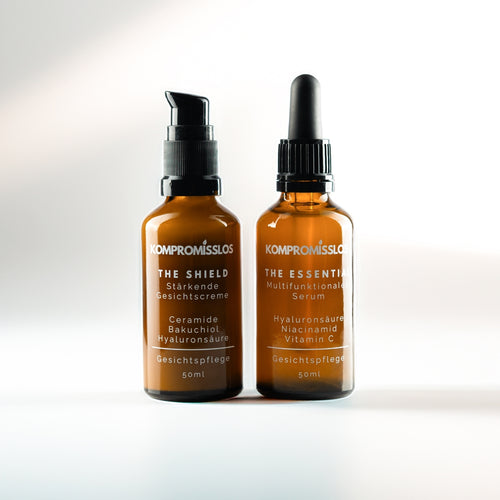
Reviews add to this, but they do not replace it. Lots of stars show satisfaction, not proof of effect, and it helps to know which star ratings are worth trusting. With The Duo, we applied this logic to ourselves: the concentrations of the main active ingredients are disclosed, and if you use both products twice a day, one set lasts around two months. To be honest, not everyone sees that as cheap. In his review on Judge.me, Fabian I. writes: “Not exactly cheap, but absolutely fine for me […]” (review translated from German). This is exactly the trade-off you should be able to weigh up yourself, with facts instead of promises.
Are dupes and cheaper alternatives worth it?
Dupes can be worth it if they contain the key active ingredients in comparable amounts, and they are not worth it if they only copy the packaging, scent and texture. The problem is that you can hardly tell from the front of the pack. Two creams can have a very similar INCI list and still contain different amounts of active ingredient, because the list shows the order but not the quantities. Raw material quality, pH and stability are not printed anywhere on the packaging either. A dupe is therefore a good choice when it discloses something you can compare, such as a percentage for niacinamide or vitamin C. If that figure is missing from both the original and the dupe, you are comparing two unknowns. A dupe is a separate, legal product; counterfeits are something else, sold under the original brand’s name, and how to spot fake skincare is covered in a separate article.
Research on niacinamide shows that an active ingredient in a clearly stated amount can make a difference, regardless of the brand name on the tube. A study of 50 women in Dermatologic Surgery found that 5% niacinamide, applied twice a day for twelve weeks to one half of the face, improved the appearance of fine lines, pigment spots, redness and sallowness compared with the ingredient-free base on the other side. The study was carried out by researchers at a consumer goods company, which is worth knowing when you weigh it up. What matters is this: the effect depends on the ingredient, the amount and how long you use it, not on the brand name.
What do concentration and labelling tell you about the price?
Concentration and labelling tell you more about the value of a cream than its price does, because they show what you are actually getting. According to a fact sheet from the Cantonal Laboratory of Bern, the list of ingredients in Switzerland must be given in descending order of quantity; ingredients below 1 per cent by mass may be listed in any order at the end of the list. Two things follow from this. An active ingredient that features prominently in the advertising but sits right at the end of the list is probably only present in a small amount. And stating a percentage is voluntary, which is precisely why it is a signal. How to read the order and where the limits of this method lie is explained in the article on how to read an ingredient list. For comparing prices, this means: do not compare Swiss francs per tube, but how much disclosed active ingredient you get per application. You will find the monthly calculation in the article on how long 50 ml of face cream lasts and what it costs per month.
I decided to disclose the concentrations in The Duo: 5% niacinamide, 2% vitamin C as the stable 3-O-Ethyl Ascorbic Acid and 1% zinc PCA. I am not required to. I do it because a price cannot be checked without figures like these. And I want to be honest here: our price does not prove anything either. Part of it reflects the fact that The Duo is developed and made in Switzerland, and that alone does not make any cream more effective. What you can judge is the formula. If a cheaper cream discloses comparable active ingredients in comparable amounts and your skin tolerates it well, you do not need ours. Which ingredients are in the Duo and what they are there for is set out in our active ingredients with disclosed concentrations.
Frequently asked questions
Is drugstore skincare worse than pharmacy skincare?
Not fundamentally: whether a cream is good depends on its formula, not on the shelf it sits on, and you can find solid everyday skincare in both places. Where pharmacy brands genuinely differ, for example in advice and in their range for very sensitive skin, is explained in the article on pharmacy skincare compared with drugstore products.
Why are serums often more expensive than creams?
Serums are often more concentrated than creams and come in smaller sizes, frequently in packaging designed to protect ingredients that are sensitive to light and air. A higher price per millilitre is therefore not automatically excessive. It is still worth checking, though, because a serum without stated concentrations is hard to assess. What matters for mature skin is shown in the article on the best serum for mature skin.
Is luxury skincare worth it for mature skin?
Luxury skincare is only worth it for mature skin if the formula is convincing, not because of the name. Mature skin above all needs moisture, barrier lipids and well-tolerated active ingredients in sensible amounts. You can find these across very different price ranges. The specific points you can check are covered in our guide to choosing a face cream for mature skin by criteria, not ranking.
Am I mainly paying for packaging and advertising with expensive creams?
Partly, yes, but hardly any brand discloses how big that part is. Brand building, advertising, elaborate packaging and retail margins are items in the price that do nothing for your skin. A quick cross-check: are concentrations stated, and do the active ingredients appear near the top of the INCI list? If not, you are mainly paying for the extras around it.
Are Swiss products more expensive, and why?
Swiss skincare is often more expensive because wages, rents and production cost more here than in many other countries. Origin alone says nothing about effectiveness. The article on what really makes a Swiss face cream explains this in detail, including how to tell where a product comes from. In the end, what counts for your skin is the formula, not the flag.
Can a cheap cream be just as good?
Yes, a cheap cream can be just as good as an expensive one, or better. Independent tests such as the one by Stiftung Warentest show this, particularly for the basic function of moisturising. If it keeps your skin sufficiently hydrated, is well tolerated and you use it regularly, there is no reason to spend more. Paying more only makes sense if you demonstrably get more for it.
What do I get for the price with The Duo?
You get a serum and a cream with disclosed concentrations: 5% niacinamide, 2% vitamin C as 3-O-Ethyl Ascorbic Acid and 1% zinc PCA, plus ceramides, bakuchiol and squalane. Both are vegan, fragrance-free and developed and made in Switzerland. Used twice a day, The Duo lasts around two months, and with a 100-day right of return you can try it out at your own pace.
Sources
- Xu S, Kwa M, Lohman ME, Evers-Meltzer R, Silverberg JI. Consumer Preferences, Product Characteristics, and Potentially Allergenic Ingredients in Best-selling Moisturizers. JAMA Dermatology, 2017. Source
- Waber RL, Shiv B, Carmon Z, Ariely D. Commercial features of placebo and therapeutic efficacy. JAMA, 2008. Source
- Stiftung Warentest. Antifaltencremes: Falten wegcremen? Klappt nicht! test, 2015. Source
- Bissett DL, Oblong JE, Berge CA. Niacinamide: A B vitamin that improves aging facial skin appearance. Dermatologic Surgery, 2005. Source
- Kantonales Laboratorium Bern. Kennzeichnung von Kosmetika, Merkblatt KL 3.1.25, Version 2, 2021. Source