Anti-wrinkle cream test results: what the test measured and what “poor” really means
SWISS BUYING GUIDE
The anti-wrinkle cream test results from Stiftung Warentest are clear: all nine creams were rated “poor”. The German consumer organisation tested them on 270 women for four weeks, with the anti-wrinkle cream on one side of the face and a simple moisturiser on the other. None of the creams reduced wrinkles enough for the experts to see an improvement with the naked eye in photos of the eye area. So “poor” means the advertising promise was not kept. It does not mean the creams are harmful or worthless.
What did Stiftung Warentest test in anti-wrinkle creams?
Stiftung Warentest checked whether nine anti-wrinkle creams kept their central promise: to visibly reduce wrinkles. The test appeared in issue 1/2016 of its magazine test and has been online since 21 December 2015. The creams cost between 2.45 and 87 euros, so the test covered the whole range, from cheap mass-market products to luxury creams. They were advertised with ingredients such as coenzyme Q10, polypeptides or vitamin A. The decisive criterion was the effect on wrinkles; moisturisation, labelling and advertising claims were among the other points assessed.
On moisture, there were clear differences: according to the test, two creams hydrated the skin very well, while the most expensive cream in the line-up did not even manage that. What this says about the link between price and performance is covered in the article on what you’re really paying for in a face cream. This article deals with the question that comes before it: what this test was actually able to measure.
How was the test carried out, and why does the comparison with a moisturiser matter?
The test was a split-face comparison: each participant applied the anti-wrinkle cream to one side of her face and a standard moisturiser to the other, without knowing which side was getting which cream. It is precisely this comparison that makes the test meaningful. Many creams make skin look smoother after a few days because water in the outermost layer of the skin plumps up fine lines. But any good moisturiser delivers that effect. An anti-wrinkle cream that keeps its promise would therefore have to do visibly more than the comparison side. According to Stiftung Warentest, the test worked like this:
- 270 women took part, 30 per cream.
- For four weeks, they applied cream morning and evening, the test cream on one side and the moisturiser on the other.
- Both sides of the face were photographed in a photo box before the first application and around 16 hours after the last, with the head at the same angle each time.
- Three experts assessed the lines below and beside the eye blind, that is, without knowing which point in time or which product they were looking at.
The design therefore filters out exactly what you feel after applying a cream: that pleasant smoothness. What remains is the question of whether the cream can do more than moisturise.
Why were all nine anti-wrinkle creams rated “poor”?
All nine creams were rated “poor” because none of them reduced fine lines or deeper wrinkles enough for an improvement to be visible to the naked eye. In a few women, the experts did see finer lines under the eye, but not in most of the 30 testers per cream, and in some cases the wrinkles had even increased. The effect on wrinkles made up 40 per cent of the grade, and under the test methodology a “poor” result on this point meant the overall rating could be no better, even for creams that did well on moisture. The verdict is therefore a verdict on the promise on the packaging, not on the cream as a skincare product. The comparison below shows what the rating tells you and what it does not.
| A “poor” rating means | A “poor” rating does not mean |
|---|---|
| The advertised visible reduction in wrinkles did not happen within four weeks. | The cream is harmful or poorly tolerated. |
| There was no visible added benefit compared with a standard moisturiser. | The cream does not moisturise. |
| A high price did not protect against the poor result. | No active ingredient can ever change anything about skin ageing. |
What did the anti-wrinkle cream test not measure?
The test did not measure what individual active ingredients change over many months, how much of them the creams contained or how the skin responds beneath the surface. It was designed around a single question: is the promise visibly kept after four weeks? That leaves three limitations. First, the duration: four weeks is a short time for changes in wrinkles. Second, the method: the assessment was made with the naked eye on photos of the eye area, not with instruments that pick up subtle differences in the skin’s surface. Third, the formula: the ingredients were taken from the label, and the concentration of the advertised active ingredients was not measured.
Read fairly, then, the test does not disprove that active ingredients such as retinoids can have an effect over a longer period. A study in the Archives of Dermatology compared 0.4% retinol with the active-free vehicle in 36 older people with an average age of 87, each applied to one arm. After 24 weeks, there was a significant difference in fine wrinkles in favour of retinol. The Stiftung Warentest test shows something else: what the packaging promised within a short time did not happen. Which ingredients have better evidence behind them is covered in the overview of which ingredients are actually proven to work on wrinkles, and you will find realistic timeframes in the article on how long skincare takes to work.
Is there a more recent Stiftung Warentest test of anti-ageing creams?
There is no more recent Stiftung Warentest test that checks anti-wrinkle creams for their effect on wrinkles. In the facial care overview on test.de, the December 2015 test is the last of its kind; before that, there was a test of eye creams against wrinkles in 2007. More recent tests have asked different questions. The “face creams for dry skin” test from March 2024 assessed 14 creams mainly on moisturisation, application and how they felt on the skin. Moisture was measured on the forearm, in 22 female testers per cream, and wrinkles were not assessed.
What is new is a report published on test.de on 4 May 2026. It is based on a laboratory analysis by the Chemical and Veterinary Investigation Office (CVUA) in Karlsruhe, which examined 94 facial care products containing vitamin A, including 70 face creams. Around a third of these creams did not contain enough vitamin A to be able to achieve an anti-ageing effect. The report gives the threshold for effectiveness as at least 0.05 per cent. In sheet masks and eye pads, the experts found effective levels in only 33 per cent of products. So this analysis does not measure the effect on the skin, but whether there is enough of the active ingredient in the product. It complements the Stiftung Warentest test at exactly the point the test left open. For more on how to judge retinol products, see the article on what retinol serum tests actually measure.
What do the test results mean for buying a cream in Switzerland?
When you buy, the result is above all a filter for advertising promises: a cream that promises visibly fewer wrinkles within a few weeks has not delivered that proof in an independent test. Stiftung Warentest is a German organisation, but many of the brands it tested are also on Swiss shelves. For Swiss tests, it is worth knowing what the K-Tipp face cream test measures, because there too the test design determines how much the result can tell you. These questions help when you buy:
- Does the cream promise something a test has not confirmed, such as visibly fewer wrinkles in a short time?
- Does the brand state concentrations for its active ingredients, or only their names?
- What do you really expect: moisture and skin that feels smoother, or deep wrinkles disappearing?
- Can you watch how the product works on your own skin for longer than four weeks?
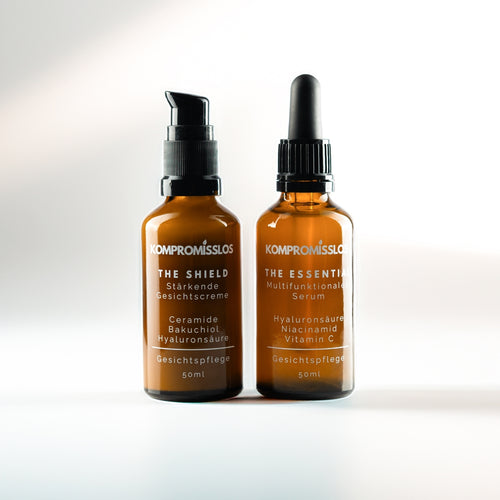
The most reliable effect in the test was moisture. Many of the lines that bother you are also dehydration lines. It helps to be able to tell dehydration lines from wrinkles before you pay for a promise. Against new wrinkles, daily sun protection has good evidence behind it: in a randomised trial published in the Annals of Internal Medicine, the group using sunscreen every day showed no detectable increase in skin ageing after 4.5 years. For deep wrinkles or loss of volume, the right person to see is an aesthetic or dermatological specialist, not a jar of cream. The Duo with disclosed concentrations takes up the lesson of the test: no wrinkle promise, but instead 5% niacinamide, 2% vitamin C as 3-O-Ethyl Ascorbic Acid and 1% zinc PCA, hyaluronic acid in three molecular sizes in the serum, and ceramide NP, squalane and bakuchiol in the cream. With the 100-day return policy, you can try it on your skin for much longer than four weeks.
I do not sell The Duo as an anti-wrinkle cream, and I do not promise “visibly fewer wrinkles in four weeks”. A promise I cannot back up has no place in my product descriptions. Instead, I disclose the concentrations so that you can compare for yourself what is inside, rather than having to take a promise on trust. For the cream, I chose bakuchiol instead of retinol. I am just as open about the limits: The Duo does not smooth out deep wrinkles either. What it can do is provide moisture and support the skin barrier, which makes skin look plumper and suppler. What slows down new wrinkles is sun protection, and The Duo does not contain any, so you need a separate product during the day. Which active ingredients are in it, and in what amounts, is set out on the page with all active ingredients and concentrations.
Frequently asked questions
Which anti-wrinkle cream came out top in the Stiftung Warentest test?
No anti-wrinkle cream came out top in the Stiftung Warentest test. All nine creams were rated “poor” because none achieved the advertised visible reduction in wrinkles. If you come across a Stiftung Warentest “test winner” among anti-wrinkle creams online, you are usually reading an assessment of moisturisation or a different test, not a verdict on the effect on wrinkles.
Does the Stiftung Warentest result also apply in Switzerland?
Yes, the test’s conclusion also applies in Switzerland, because many of the brands tested are sold here too, and skin in Zurich reacts no differently from skin in Berlin. The prices in euros and the retailers refer to Germany. The lesson remains the same: a wrinkle promise on the packaging is not proof.
Isn’t the anti-wrinkle cream test too old to tell us anything?
For individual products, the 2015 test is indeed old, as formulas may have changed since then. The method, however, is not outdated: a comparison against a moisturiser, assessed blind, is still a strict benchmark today. Stiftung Warentest has not carried out a more recent wrinkle test, which is why this one is still quoted.
Were expensive pharmacy creams included in the test?
Yes, one of the nine creams was a pharmacy brand, and prices ranged from 2.45 to 87 euros, well into luxury territory. Where a cream was sold played no part in the verdict: what was assessed was whether the promised visible reduction in wrinkles happened, and no cream achieved it. Buying from a pharmacy or paying a high price is therefore no proof that a cream works.
Has Stiftung Warentest tested retinol creams?
The facial care overview on test.de does not list a dedicated effectiveness test for retinol creams. In the 2015 anti-wrinkle cream test, some products advertised vitamin A, among other ingredients. In May 2026, test.de reported on a laboratory analysis by CVUA Karlsruhe, which found that around a third of 70 face creams with vitamin A contained too little vitamin A for an anti-ageing effect.
Why do I still notice an effect after applying cream?
You notice an effect after applying cream because moisture plumps up the outermost layer of the skin and makes fine dehydration lines look softer. That effect is real, but it is a moisturising effect that a simple cream also delivers. That is exactly why Stiftung Warentest compared each anti-wrinkle cream with a moisturiser on the other side of the face.
Has The Duo been tested by Stiftung Warentest?
No, The Duo has not been tested by Stiftung Warentest, and it does not come with a wrinkle promise either. Instead, the concentrations of the key active ingredients are disclosed, and the products are designed to provide moisture and support the skin barrier. With the 100-day return policy, you can try The Duo on your own skin for longer than any four-week test.
Sources
- Stiftung Warentest. Antifaltencremes: Falten wegcremen? Klappt nicht! test 1/2016, online 21.12.2015. Source
- Stiftung Warentest. Anti-Aging-Kosmetika: Kosmetik mit Vitamin A, Wirksamkeit oft fraglich (Untersuchung des CVUA Karlsruhe). test.de, 2026. Source
- Stiftung Warentest. Gesichtscremes für trockene Haut im Test. test.de, 2024. Source
- Kafi R, Kwak HS, Schumacher WE, Cho S, Hanft VN, Hamilton TA et al. Improvement of naturally aged skin with vitamin A (retinol). Archives of Dermatology, 2007. Source
- Hughes MC, Williams GM, Baker P, Green AC. Sunscreen and prevention of skin aging: a randomized trial. Annals of Internal Medicine, 2013. Source