K-Tipp face cream test: what it measures and what you need to check yourself
TESTS AND COMPARISONS
A K-Tipp face cream test essentially checks three things: how much a cream increases skin moisture in the lab, how pleasant it is to apply and whether it contains questionable ingredients. It tells you nothing about how your skin will look after eight weeks, or whether the formula suits your skin’s current condition.
For the bigger picture across all the tests, see face cream test winners in Switzerland.
What exactly does a K-Tipp face cream test measure?
Above all, it measures skin moisture – in the lab, on a small group of test subjects. For a test of tinted day creams, the Swiss consumer magazine K-Tipp had the products checked by an external laboratory: on ten women aged between 29 and 60, a Corneometer was used to measure how the skin’s moisture level changed shortly before application and four and eight hours afterwards, in each case on the inner forearms. On top of that came an assessment of how the creams performed in use and an analysis for undesirable ingredients. If you want to know what is actually in a product, there is no way round the full ingredient list anyway. The measurement itself is a clean, transparent method for answering exactly one question: how much water does the cream hold in the top layer of the skin over a few hours? What you can’t derive from it is the question that really occupies you when you buy: what will my skin look like in two months if I use this product morning and evening?
Does price say anything about the test result?
No – and the tests have shown this very clearly for years. K-Tipp reported on a test of 14 face creams for dry skin in which 22 women applied the cream morning and evening for two weeks. The product that provided the most moisture cost just under CHF 17. A discounter’s own-label cream costing CHF 3 moisturised slightly less but still did well, while a branded product around ten times as expensive ended up at the bottom of the table. So a product’s price is not a signal of quality, in either direction. It tells you something about marketing budget, packaging, sales channel and raw material costs, and these four things bear no fixed relation to one another. Rather than looking at the price tag, it makes more sense to look at the price per application. Convert the bottle price into the number of applications it gives you, and you are comparing figures that genuinely have something to do with each other.
What a cream test doesn’t measure
What isn’t measured is tolerance over several weeks, the build-up of the skin barrier and whether the concentration of an active ingredient has been chosen sensibly in the first place. A Corneometer records a condition at a single point in time. Your skin, however, changes over weeks, depending on the season, your hormones, stress and how calm your routine is. On top of that, many tests look at either moisturisation or ingredients, rarely both in the same depth. In one test of tinted day creams, the assessment explicitly focused mainly on application; in another, the ingredients weren’t checked at all. An overall rating can therefore mean something completely different depending on how the test was set up. Nor does a test check whether two products work well together – even though, day to day, that is exactly what decides whether a routine runs smoothly or the products get in each other’s way. When you put two tests side by side, always read what was measured first, then how the sample was made up, and only then the ranking.
| What a test measures | What follows from it | What you need to check yourself |
|---|---|---|
| Moisture level after 4 to 8 hours | The cream holds water in the skin in the short term | How your skin looks after 6 to 8 weeks |
| Questionable ingredients in the lab | Certain substances can or cannot be detected | Whether you personally react to fragrances |
| Application and skin feel | A test group likes the texture | Whether the texture suits your skin’s condition |
| Price per 100 millilitres | The price per litre can be compared | The price per application over the whole bottle |
Why you’ll hardly find small Swiss brands in the tests
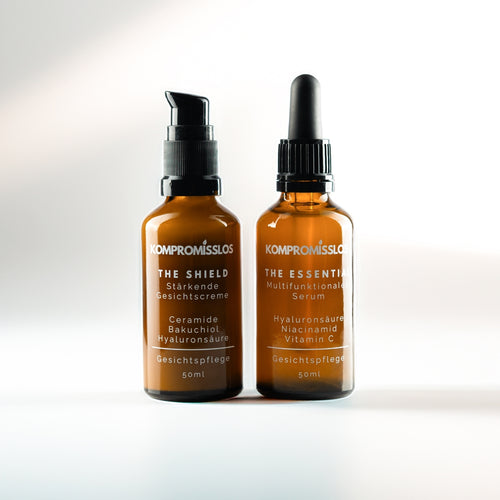
Consumer tests almost always draw their sample from mainstream retail – Migros, Coop, chemists, discounters and large online shops. That makes sense, because a test should be relevant to as many readers as possible and the products tested need to be available everywhere. Small Swiss brands that sell direct practically never appear in this selection. That doesn’t mean they are better or worse; it simply means they weren’t part of the sample. To be clear: our Duo of serum and cream has never been tested by K-Tipp. We don’t carry a test seal, we don’t print a test rating on our packaging and we won’t invent one either. What we do instead is disclose every relevant concentration so that you can compare for yourself. The Duo of serum and cream contains 5% niacinamide, 2% hyaluronic acid and 2% vitamin C as 3-O-Ethyl Ascorbic Acid.
How to use a test result for your own decision
Use a test as a filter, not as an instruction to buy. In practice, that means three things. First, read the test criteria before you read the ranking, because winning the moisturisation category says nothing about the ingredients, and vice versa. Second, check whether the product category tested is actually yours, because a tinted day cream, a night cream and a serum do different jobs. Third, compare the result with your skin’s current condition, not with your skin type. If your skin currently feels tight and shows redness, a cream that moisturises strongly in the lab but contains fragrance may be a worse choice for you than an unremarkable product from the middle of the table. This is exactly why we pared our skincare down to two products that are designed to work together. How we apply this thinking to choosing active ingredients is explained in our comparison vitamin C or niacinamide.
When a test winner is the wrong choice for your skin
A test winner is the wrong choice when it contains precisely the substance your skin reacts to. That isn’t a theoretical case. In a test of twelve face creams for dry skin, only a single product kept the skin sufficiently moisturised over 24 hours – and that very product contained fragrances that can trigger allergies. In another test, none of the twelve day creams tested received the top rating, because even the four best-placed products each contained a problematic substance. For sensitive skin, this means the ranking is the wrong place to start. Begin with the ingredient list and cross off anything you don’t tolerate. Only then look at which of the remaining products did well. If your complexion is unsettled, it’s also worth looking at your routine as a whole – you’ll find more on this in our article on blemish-prone skin.
Two weeks is too short to judge a skincare product. Allow six to eight weeks in which you change nothing else. Only then will you know what the product has done and what was down to the summer, your sleep or your new cleanser.
I made a deliberate decision not to print test ratings or seals on our packaging, even though I know they sell. The reason is simple: a test rating is a snapshot of someone else’s sample, and I can’t explain to you how it came about. A percentage I can explain. That’s why we state openly how much niacinamide, hyaluronic acid or bakuchiol is in our skincare, rather than a verdict someone else has reached. That is less comfortable, because it makes us comparable, but it is the only figure I can stand behind. If you want to judge our skincare, judge it by your skin after eight weeks and by what customers write in their reviews. Dominic Bertschin
Frequently asked questions
Where can I find K-Tipp’s face cream tests?
The tests appear first in the print edition and are then available in the test archive on ktipp.ch. Some of the content is reserved for subscribers, but the summary with the test set-up and overall rating is usually freely accessible. Always check the issue number and the year, because older tests may include products that no longer exist.
Is a K-Tipp test winner automatically the best cream for me?
No. A test winner is the product that performed best in a particular sample according to particular criteria. Whether it suits your skin depends on your skin’s current condition and what it tolerates. Read the test criteria and the ingredients first, and only then the ranking.
Has The Duo by Kompromisslos been tested by K-Tipp?
No. Our serum and our cream have not featured in any K-Tipp test, and we carry no test rating. Consumer tests draw their samples almost exclusively from mainstream retail; small direct-to-consumer brands are generally not included. Instead of a seal, we disclose the concentrations of all relevant active ingredients.
What is the difference between K-Tipp, saldo and Kassensturz?
K-Tipp and saldo are two Swiss consumer magazines that publish product tests and in some cases pick up each other’s results. Kassensturz is the consumer affairs programme on Swiss television, which carries out some tests together with saldo. The test set-ups differ, so it’s worth reading up on the method for each test.
Why do so few face creams get the top rating?
Because many tests assess the ingredients as well as moisturisation, and a single substance rated as critical is enough to lower the overall rating. In a test of twelve day creams, none received the top rating, because even the four best-placed each contained a problematic substance. So the rating assesses more than just how well a cream cares for the skin.
How long should I try a face cream before judging it?
Allow six to eight weeks and change nothing else in your routine during that time. After two weeks, the most you can tell is whether you like the texture and whether your skin tolerates it. Anything to do with the look of your skin takes longer, because the top layer of the skin is constantly renewing itself.
Does a cream test tell you anything about natural skincare?
Only indirectly. Tests look at individual products, not categories, and in the same tests natural skincare products sometimes do well and sometimes badly. What is always telling is the specific formula: which active ingredients in which concentration, which fragrances and which preservatives. That’s on the packaging, not in the ranking.
Sources