Kassensturz and Saldo face cream tests: how the lab tests work and what the ratings miss
SWISS BUYING GUIDE
To make sense of a Kassensturz face cream test, you need to tell two kinds of test apart: the efficacy test with volunteers and the laboratory analysis of the ingredients. In the 2014 anti-wrinkle cream test, 30 women per cream applied it to one half of their face for a month, and wrinkle depth and moisture were measured. In the 2020 day cream test with Saldo, a laboratory looked for fragrance allergens, PEG and EDTA. A good rating means wrinkles around 9 per cent shallower in the first case, and in the second only that fewer problematic substances were found.
How does Kassensturz test an anti-wrinkle cream in the lab?
Kassensturz tests an anti-wrinkle cream by having volunteers apply it to one half of their face for a month while a laboratory measures wrinkle depth before and after. In the test SRF published on 3 June 2014, the consumer programme Kassensturz and the French-speaking Swiss consumer organisation FRC had 13 creams priced between CHF 4.95 and CHF 118 tested. Each product was tested by 30 women aged between 30 and 71 in a laboratory specialising in skin testing. They applied the cream, in neutral packaging, morning and evening to one half of their face, while the other half received a standardised laboratory cream.
Three things were assessed: the anti-wrinkle effect, measured with the FOITS technique before the start of the test and after one month; skin hydration, measured with a Corneometer; and the testers’ own verdict, collected by questionnaire. FOITS stands for Fast Optical in vivo Topometry of Human Skin. A paper in the journal Biomedizinische Technik describes the method as a fast, contact-free 3D measurement of the skin surface that replaces the earlier detour via silicone impressions of the skin. In other words, the device records the relief of the surface. Whether you can see a change in the mirror is not something it measures.
| Criterion | Anti-wrinkle cream test 2014 | Day cream test 2020 |
|---|---|---|
| Partners | Kassensturz and FRC | Kassensturz and Saldo |
| Number of creams | 13 | 12 |
| Method | 30 volunteers per cream, one month, half-face comparison | Chemical analysis at the Dr. Wirts + Partner laboratory, Hanover |
| Measured | Wrinkle depth (FOITS), skin moisture, testers’ verdict | Fragrance allergens, PEG and EDTA, musk compounds, preservatives |
| Not measured | Problematic substances in the formula | Effect on wrinkles or moisture |
What does a ‘good anti-wrinkle effect’ in a Kassensturz test mean in figures?
In the 2014 Kassensturz test, a ‘good anti-wrinkle effect’ meant, in plain terms, wrinkles that were 9 per cent less deep. That is how SRF itself puts it, adding that even with the good creams, 91 per cent of the wrinkle depth remains. Whether the eye can perceive what the measuring instruments recorded is, in SRF’s words, questionable. This is the most important sentence in the whole test, because it translates the rating scale: ‘good’ means measurable, not visibly rejuvenated.
The distribution is revealing too. Only two of the 13 creams achieved a ‘good’ for anti-wrinkle effect; the other eleven were all rated ‘satisfactory’. According to SRF, the differences showed up in skin hydration, where four products were rated unsatisfactory. When the wrinkle scores are this close together, moisture goes a long way towards deciding who comes out on top. That fits with what a cream can do on the skin’s surface: well-hydrated skin looks smoother, but deep wrinkles do not disappear as a result. Which active ingredients have studies behind them beyond that is a separate question, namely which anti-wrinkle ingredients are actually proven. For reading the test, the figure is enough: 9 per cent is an honest result, but it is not a facelift.
What does Saldo look for when it checks the ingredients in day creams?
When checking the ingredients in day creams, the laboratory working for Saldo and Kassensturz looks above all for allergenic fragrances and for substances that can make the skin barrier more permeable. In the test published on 22 September 2020, the chemical laboratory Dr. Wirts + Partner in Hanover analysed twelve day creams bought from retailers. It looked for these groups of substances:
- Allergenic fragrances above 10 milligrams per kilo, i.e. above the level from which they must be declared in leave-on products.
- Fragrances with an increased allergy potential.
- PEG, PEG derivatives and EDTA, which act as stabilisers and binding agents and, according to the test, make the skin more permeable to foreign substances.
- Synthetic musk compounds and cashmeran, which were not found in any product.
- Preservatives, all of which were within the permitted amounts.
Fragrances were rated strictly because they serve no skincare purpose in a cream. How relevant that is can be seen from a study in the British Journal of Dermatology involving more than 3,000 people tested in five European countries: the conservatively estimated prevalence of fragrance contact allergy was 1.9 per cent, and about twice as high in women as in men. What fragrance-free covers in practice is explained in the article on what fragrance-free really guarantees.
On PEG, the test is stricter than the scientific literature. A safety assessment in the journal Toxicology concludes that PEGs and their derivatives barely penetrate intact skin and are safe under the usual conditions of use in cosmetics, but should not be applied to damaged skin. So here, the test marks products down as a precaution. How to put such classifications into perspective is covered in the overview of which ingredient warning lists actually hold up.
Why does the cheapest cream sometimes win the Kassensturz test?
The cheapest cream sometimes wins the Kassensturz test because a simple, well-made formula can meet the criteria being measured just as well. In 2014, the cheapest product in the line-up, a Q10 day cream from Lidl costing CHF 4.95, was the test winner, with a good anti-wrinkle effect and very good skin hydration. The two most expensive creams, at CHF 118 and CHF 99.90, ended up in the lower half of the table with an overall rating of ‘satisfactory’. In the 2020 allergy test, one of the four best creams was among the cheapest at CHF 7.90 per 100 millilitres, while by far the most expensive cream, containing seven problematic fragrances above the level that requires declaration, was rated ‘unsatisfactory’.
That does not mean expensive creams are inherently worse. It means that moisture, a slight smoothing of the surface and leaving out fragrance are not expensive qualities. A high price often pays for things no laboratory measures. What those are in detail is set out in the article on what you’re really paying for in a face cream. One important point if you are searching for the ‘Kassensturz test winner’: both tests are snapshots. According to SRF, one supplier withdrew another cream, rated unsatisfactory in 2020, from its range, and formulas change over the years. Whether the 2014 test winner still has the same formula today is something the test cannot tell you.
What does a one-month test on volunteers not show?
A one-month test on volunteers does not show how a cream works on your skin over several months or whether you tolerate it in the long term. A month is a short period. Anything that goes beyond moisture and a smoother surface can hardly be captured in that time. Then there is the group: 30 women per cream are enough to measure an average, but not to pick up rare reactions. A contact allergy often only develops after repeated exposure. The dermatologist interviewed in the 2020 Kassensturz report warns that even people whose skin has caused no problems so far can react to elevated amounts of fragrance. If you suspect you are reacting to fragrances, an allergy test with a dermatologist will give you a clear answer.
The 2014 efficacy test also did not analyse what the creams contain. Conversely, the 2020 allergy test did not measure a single wrinkle. Neither test says anything about your skin type, the rest of your routine or how the cream performs under make-up or sunscreen. The label on the pack does not fill this gap either. How manufacturers’ own tests are set up and what ‘dermatologically tested’ means is a separate question. The most honest test is still your own, over several weeks and with only one change at a time.
Before switching to a new cream, make a note of how your skin feels and take a photo in the same light. After eight to twelve weeks, you can then see whether anything has changed, rather than relying on a feeling.
How do you read an overall rating when efficacy and ingredients are rated separately?
The best way to read an overall rating is to check first which type of test lies behind it, and then which criterion pulled the rating down. A ‘good’ in the anti-wrinkle cream test says nothing about fragrances, and a ‘good’ in the allergy test says nothing about efficacy. In the 2020 test, even the four best creams did not get beyond a grade of 5 because they contained PEG derivatives, and SRF noted that none of the products was free of problematic substances. For the general question of how to use test ratings in your own decision, it is worth looking at what the K-Tipp face cream test measures.
- Identify the type of test: an efficacy test with volunteers, as in 2014, or a laboratory analysis of the formula, as in 2020.
- Check the year: a test from 2014 or 2020 assesses the formula as it was at the time.
- Find the reason for any deductions: fragrances, PEG or too little hydration matter to a different degree for every skin.
- Read the current pack: you can read the ingredient list yourself and compare it with the test.
- Observe for yourself: the rating is no substitute for what your skin shows after a few weeks.
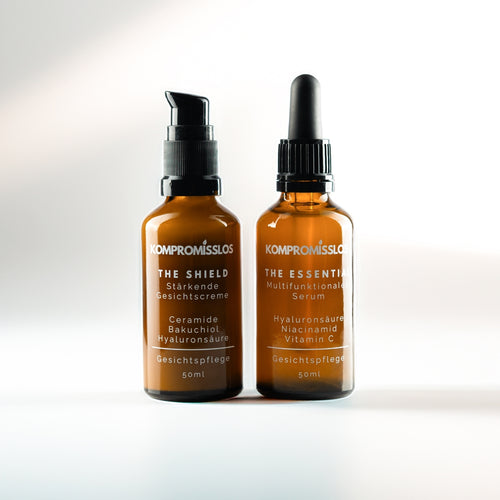
You can run exactly this check on any cream, including one that has never been tested. The Duo of serum and cream discloses 5% niacinamide, 2% vitamin C as 3-O-Ethyl Ascorbic Acid and 1% zinc PCA, is fragrance-free and, according to its INCI, contains no fragrance allergens such as limonene or linalool. PEG derivatives and EDTA do not appear in the disclosed INCI. Whether it suits your skin is something you will see after eight to twelve weeks, and that is what the 100-day return policy is for.
The Duo was not part of any Kassensturz or Saldo test, and I am deliberately saying so here. That is precisely why I disclose the concentrations: 5% niacinamide, 2% vitamin C as 3-O-Ethyl Ascorbic Acid and 1% zinc PCA apply to The Duo as a whole, and the full list is on the page with all ingredients from A to Z. So you do not have to wait for a rating; you can check for yourself. The Duo is fragrance-free because fragrances contribute nothing to skincare and were a key reason for deductions in the 2020 allergy test. What I cannot promise you: a cream does not smooth out deep wrinkles. The 9 per cent from the Kassensturz laboratory is a good reminder of what skincare can realistically achieve.
Frequently asked questions
Where can I find the Kassensturz face cream tests?
You can find the Kassensturz tests on srf.ch in the ‘Kassensturz Espresso’ section under Tests, where SRF also lists all its tests, tastings and test winners from A to Z. The anti-wrinkle cream test dates from June 2014, the day cream allergy test from September 2020. Saldo publishes its tests on saldo.ch, some of them only for subscribers.
Who carries out the lab tests for Kassensturz and Saldo?
The lab tests are carried out by external specialist laboratories, not by the editorial teams themselves. The 2020 allergy test was analysed by the chemical laboratory Dr. Wirts + Partner in Hanover. According to SRF, the 2014 anti-wrinkle cream test was carried out by a laboratory specialising in skin testing, which the article does not name. SRF describes the criteria tested in each test report.
Are PEG and EDTA in a face cream dangerous?
For PEG, the scientific literature gives the all-clear on intact skin: a safety assessment in Toxicology considers PEGs and their derivatives safe in cosmetics, but not suitable for damaged skin. Kassensturz and Saldo nevertheless mark down PEG and EDTA as a precaution, because they can make the skin more permeable. If your skin is irritated or compromised, it is worth checking the INCI.
Does an older Kassensturz test winner still have the same formula today?
Not necessarily. A test assesses the formula at the time of purchase, and manufacturers change formulas or take products off the market. So compare the INCI on the current pack with what the test criticised or praised. With a test from 2014, this comparison is particularly important.
Does the FRC in French-speaking Switzerland test the same creams as Kassensturz?
Partly. For the 2014 anti-wrinkle cream test, Kassensturz and the FRC had the same 13 creams tested jointly in the laboratory. For the 2020 day cream allergy test, SRF names Saldo as its partner, not the FRC. Each report states whether a test was carried out jointly. For French-speaking Switzerland, it is also worth looking at frc.ch, where the consumer organisation publishes its own tests.
Was The Duo tested by Kassensturz or Saldo?
No, The Duo was not tested by either Kassensturz or Saldo. You can still apply the tests’ criteria yourself: the concentrations of the main active ingredients and the full INCI are disclosed, and The Duo is fragrance-free. How your skin responds to it is something you will only find out by using it yourself over a few weeks.
Sources
- Elke D. Discounter-Antifalten-Creme besser als teure Kosmetika. SRF Kassensturz, 03.06.2014. Source
- Kägi M, Kressbach M. Tagescremes im Allergie-Test: Makellos ist keine. SRF Kassensturz, 22.09.2020. Source
- Piche E, Häfner HM, Hoffmann J, Jünger M. FOITS (fast optical in vivo topometry of human skin): new approaches to 3-D surface structures of human skin. Biomedizinische Technik, 2000. Source
- Diepgen TL, Ofenloch R, Bruze M, Cazzaniga S, Coenraads PJ, Elsner P et al. Prevalence of fragrance contact allergy in the general population of five European countries: a cross-sectional study. British Journal of Dermatology, 2015. Source
- Fruijtier-Pölloth C. Safety assessment on polyethylene glycols (PEGs) and their derivatives as used in cosmetic products. Toxicology, 2005. Source