Dermatologically tested: what the label means and what it doesn’t guarantee
BUYING ADVICE SWITZERLAND
‘Dermatologically tested’ means that a cosmetic product has been tested on people under the supervision of a dermatologist and was well tolerated. The label does not tell you how many people took part, what skin types they had or how long the test lasted. It is not an official seal, it usually says nothing about how well the product works, and it does not guarantee that your skin in particular will tolerate it. A full ingredient list and the absence of common irritants tell you more.
What does ‘dermatologically tested’ mean on cosmetics?
On cosmetics, ‘dermatologically tested’ means that the finished product has been tested on people and that a dermatologist supervised the test. That is how it is described in the technical document on cosmetic claims adopted in 2017 by a working group chaired by the European Commission, with representatives of the EU and EFTA member states. It is not legally binding; it is intended as a collection of good practice. It also states that consumer self-perception surveys alone are not enough to support this claim. In case C-99/01, the European Court of Justice described what the average consumer expects: the product has been tested for its effects on the skin, and the results were positive and showed that it was well tolerated.
What the label leaves out is almost everything you actually want to know: the number of participants, their skin types, how long the test lasted and how strictly the results were assessed. A small test on resilient skin and a large one with sensitive participants carry exactly the same wording on the pack. The label is a minimum statement, not a quality grade. Nor does it have anything to do with where the raw materials come from. That is what natural skincare certifications are for, and they check entirely different things.
How does a dermatological test work?
A dermatological test is usually carried out as a patch test, as an in-use test or as a combination of the two – and which one was chosen is not stated on the pack. In a simple patch test, the product is applied under a plaster on the back or arm, and a specialist then checks the area for redness or swelling. The repeated patch test, known internationally as HRIPT, is stricter: the product is applied to the same spot again and again over several weeks so that sensitisation – the development of an allergy – can also be detected. A commentary in Cutaneous and Ocular Toxicology describes the HRIPT as a method more than half a century old that is still used as a confirmatory test in several countries, and criticises it on ethical and scientific grounds because it can itself sensitise the volunteers.
In an in-use test, participants use the product as intended and a specialist assesses their skin over the course of the test. The EU document does not set a minimum number of participants. It does, however, call for a study protocol, statistically sound planning and qualified staff. The testing is done on people. Whether a product or its raw materials were ever tested on animals is a question the label does not answer – more on that in cruelty-free cosmetics in Switzerland.
What is the difference between tested, approved and recommended?
‘Tested’ describes a process, whereas ‘approved’ and ‘recommended’ sound like a verdict – and only the first has a reasonably clear interpretation. Phrases such as ‘dermatologically approved’ or ‘skin tolerance confirmed by dermatologists’ usually refer to the same test result in practice, just worded more confidently. The EU document has no definition of its own for them, so if in doubt, ask for the test report. ‘Recommended by dermatologists’, on the other hand, is not a test claim at all but a recommendation, which may be based on a survey, a partnership or simply marketing.
A study in JAMA Dermatology shows how little such a phrase says about tolerance. It looked at the best-selling body moisturisers at three major US online retailers: 95 per cent of the products labelled ‘dermatologist-recommended’ contained at least one ingredient from the allergen series of the North American Contact Dermatitis Group. The authors describe such terms in the US market as marketing tools with little to no regulatory oversight. The criteria specialists actually apply to skincare are covered in what dermatologists look for in a moisturiser.
| Claim | What is behind it | What it does not tell you |
|---|---|---|
| Dermatologically tested | Tested on people under dermatological supervision, well tolerated | How many people, which skin types, whether you will tolerate it |
| Clinically tested | Tested according to a clinical protocol under qualified supervision | Whether a dermatologist was involved and what was measured |
| Tolerance tested | A target group tolerated the product well in the test | Who was in the target group |
| Hypoallergenic | Designed to have a very low allergenic potential | That an allergy is impossible |
| Recommended by dermatologists | A recommendation, not a test result | Who recommended it and on what basis |
What does ‘hypoallergenic’ really tell you if you have allergies?
If you have allergies, ‘hypoallergenic’ only tells you that a product is meant to be formulated so that it causes allergies as rarely as possible – not that it is allergy-free. The EU document is stricter here than with ‘dermatologically tested’: anyone who uses the term ‘hypoallergenic’ is expected to avoid known allergens and their precursors entirely and to back up the very low allergenic potential with robust data, for example from monitoring after the product goes on sale. The same section states explicitly that the term does not guarantee a complete absence of allergy risk.
On the shelf, things often look less strict. In the JAMA Dermatology study, 83 per cent of the moisturisers marketed as hypoallergenic contained at least one ingredient from the same allergen series. If you have a known contact allergy, the word is therefore of little help. What does help is your allergy card or the results of patch testing at your dermatologist’s, checked against the ingredient list. When it comes to fragrance, it is worth taking a closer look at what fragrance-free really guarantees, because that claim is also interpreted with varying strictness.
What is behind ‘clinically tested’ and percentage claims?
‘Clinically tested’ means that a product has been tested on people according to a clinical protocol or in a clinical setting, under the supervision of a medically or scientifically qualified professional – not necessarily a dermatologist. That is how the EU document defines it, and it calls for a report setting out the objective, procedure, protocol, results and statistics, signed by the person responsible. The word ‘clinical’ makes you think of a hospital, but it mainly describes the setting of the test, not its outcome.
Percentage claims along the lines of ‘x per cent confirm a more even complexion’ are worth reading carefully. The figure may come from a measurement or from a survey in which participants tick a box to record their impression. If you see words like ‘confirm’, ‘feel’ or ‘notice’, there is usually a survey behind it – in other words, self-perception. That is not worthless, but it is not the same as a measured value. Look in the small print for the number of participants, the length of the test and a comparison group. If none of that is there, the percentage is mostly window dressing. And a test that measures effectiveness says nothing about tolerance – and vice versa.
What tells you more about tolerance than the label?
The ingredient list, the number of products you use and a test of your own tell you more reliably than anything printed on the pack whether skincare is likely to suit you. The label tells you that a group of strangers tolerated the product. Whether you are one of them depends on your skin, any known allergies and the rest of your routine. These four points will get you further:
- Read the ingredient list before you buy: a complete INCI list that you can view online can be checked against your allergy card – a label cannot.
- Watch out for fragrance and essential oils: if your skin reacts quickly, their absence often says more than a test claim.
- Use only a few products at a time: every additional product is a new variable, and if you do react, you will not know what caused it.
- Test it yourself: a patch test at home before you first use a product on your face tells you more about your skin than any group of strangers.
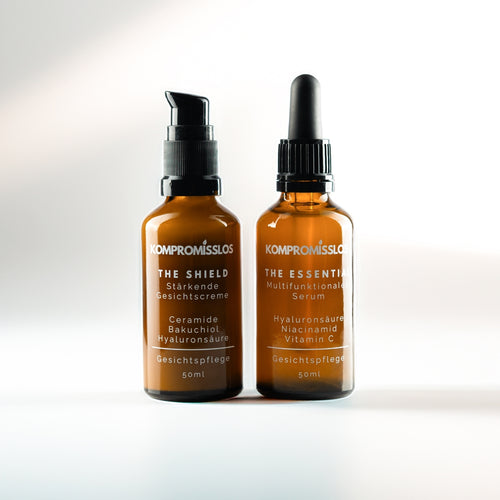
In her review on Judge.me, Beatrice writes about the serum and cream: ‘Very well tolerated and goes a long way’ (review translated from German). That is an honest individual experience, but it is no more a guarantee for your skin than a label is. How much weight to give comments like this is covered in our guide to which skincare star ratings are worth trusting. The Duo of serum and face cream is dermatologically tested and fragrance-free, and its full ingredient list is open to view. Those last two points in particular are ones you can check for yourself.
If your skin clearly burns, turns red or itches after a new product, stop using it. If the symptoms persist or come back with every new product, that calls for an assessment by a dermatologist, not the next change of product.
The Duo is dermatologically tested, and I say so openly. But I do not sell it as a promise that everyone’s skin will tolerate both products, because no test can deliver that. A label sums up the result of a group of strangers in two words. That is why I decided to disclose what you can check for yourself: the full ingredient list, the concentrations in the Duo, such as 5% niacinamide and 2% vitamin C as 3-O-Ethyl Ascorbic Acid, and the fact that both products are free from fragrance. If you have a known allergy, check the ingredients from A to Z against your allergy card before you order. That takes more effort than a seal, but it is more honest.
Frequently asked questions
Is ‘dermatologically tested’ a protected term?
No, it is not a protected seal with a fixed test protocol. However, the ban on deception applies: advertising claims for cosmetics must not be misleading, in Switzerland too. Anyone who writes ‘dermatologically tested’ should therefore be able to show that a corresponding test was carried out. How many people have to take part, and for how long, is not specified, though.
Who carries out dermatological tests?
Usually specialist testing institutes commissioned by the manufacturer, under the supervision of a dermatologist. As a rule, the manufacturer chooses the institute and the test design and pays for the test. That is standard practice and nothing underhand, but it also means the criteria are not set independently. Only a test report with a protocol shows how rigorous the testing was.
Is a Dermatest seal trustworthy?
A seal from a testing institute is only as meaningful as the test behind it. It is a private mark, not an official one. It shows that an institute has tested and rated the product, but not automatically how many people with which skin types took part. It becomes verifiable when the year of testing, the type of test and the criteria assessed are openly available.
Does ‘dermatologically tested’ mean my skin will tolerate the product?
No. It only means that the test group tolerated the product well. Your skin may react differently, especially if you have a known contact allergy or an irritated skin barrier. Testing on a small area of skin before you first use the product on your face tells you more about your own reaction than any label.
Do cosmetics have to be tested in Switzerland?
For safety, yes; on volunteers, not necessarily. According to a fact sheet from the consumer protection office of the canton of Aargau, cosmetics do not have to be registered or approved. Before they are first sold, however, they need a product information file with a safety report drawn up by a qualified expert. A dermatological test on people is an additional check, not a general obligation.
Are products without this label worse?
No. Some manufacturers skip the test or the claim, for instance because it costs money and is not generally required. Every product has to go through a safety assessment, with or without the label. A short ingredient list without fragrance can tell you more about tolerance than a test claim on a product containing perfume.
What does dermatologically tested mean for The Duo?
The Duo has been dermatologically tested. As with any product carrying this claim, that is a statement about a test group, not a guarantee for your skin. That is why the full ingredient list and the concentrations of the main active ingredients are openly available, and both products are fragrance-free. You can take your time finding out whether the Duo of serum and cream suits you, with a 100-day right of return.
Sources
- Sub-Working Group on Claims, Working Group on Cosmetic Products. Technical document on cosmetic claims. Version of 3 July 2017, endorsed by the Working Group on Cosmetic Products, 2017. Source
- Xu S, Kwa M, Lohman ME, Evers-Meltzer R, Silverberg JI. Consumer Preferences, Product Characteristics, and Potentially Allergenic Ingredients in Best-selling Moisturizers. JAMA Dermatology, 2017. Source
- Basketter DA. The human repeated insult patch test in the 21st century: a commentary. Cutaneous and Ocular Toxicology, 2009. Source
- Kanton Aargau, Departement Gesundheit und Soziales, Amt für Verbraucherschutz. Merkblatt Nr. 26: Vertrieb von Kosmetika in der Schweiz. Stand 26.03.2026. Source