Skincare reviews: how to tell which star ratings are worth trusting
BUYING AND BRANDS
Skincare reviews are accounts of individual people’s experiences, not a test. They only become meaningful once you check three things: the number of reviews, how they are spread across all the star ratings, and whether the texts mention skin condition, how long the product was used and a specific observation. An average rating on its own tells you almost nothing about whether a product suits your skin.
What does the average rating really tell you?
The average rating shows how satisfied most customers were, and little else. It is a mean, and means smooth out exactly what would matter most to you: the spread. A 4.6 can mean that almost everyone gave four or five stars. It can just as well mean that a great many people gave five stars and a small group gave one. Those are two completely different pictures, and only one of them warns you about a possible problem. It is more useful to look at the distribution across all five levels and at whether the bad reviews keep naming the same issue. If a pattern repeats itself there – a texture, say, or a scent – you have real information. If nothing repeats, the spread is normal noise. On our site, all the feedback on our two products is openly visible, including the critical reviews.
How can you spot a review that is actually useful?
A useful review names three things: the reviewer’s skin condition, how long they used the product and a specific observation. If one of these is missing, the text remains a general impression. “Great product, would buy again” tells you nothing about whether your dry, reactive skin will cope with it. “After six weeks morning and evening, my skin feels much less tight after washing” tells you a lot, even though it is only one person. Also notice whether the text describes the product or praises the brand. Descriptions can be checked; praise cannot. And check whether the person is actually comparable to you, because your skin condition matters more than your skin type and changes with the season, age and stress. A page such as The Duo’s product page, which shows the full formula alongside the stars, makes this check easier than a bare overview of ratings.
| Feature | Meaningful review | Less meaningful review |
|---|---|---|
| Skin condition | Stated specifically, e.g. dry and reactive | Missing entirely |
| Duration | A timeframe such as six weeks | None given, or “straight away” |
| Observation | Describes a change that can be checked | Sticks to adjectives such as “brilliant” |
| Focus | Refers to the product | Refers to delivery or packaging |
| Tone | Also mentions what doesn’t work | Reads like advertising throughout |
Are skincare reviews the same as a consumer test?
Skincare reviews are not a test, not even when you add them all up. The Swiss Commission for Fairness (Schweizerische Lauterkeitskommission) defines a test as establishing properties using a prescribed, suitable method, and its principles state that customer surveys and questioning third parties without a neutral test design do not, as a rule, count as a test. The difference is practical, not merely formal: a test checks the same thing in every product under controlled conditions, while a review describes one person’s experience with a single product. Both are useful, but they answer different questions. If you want to know whether a cream reaches certain laboratory values, our look at the face cream test by the Swiss consumer magazine K-Tipp will help. If you want to know how a texture feels in everyday use, a review will help. How such tests are set up and what they deliberately leave out is covered in our overview of what cream tests measure and what they don’t.
What is and isn’t allowed with reviews in Switzerland?
Invented or bought reviews are unfair practice in Switzerland. Anyone who makes incorrect or misleading statements about their own goods acts unfairly under Article 3(1)(b) of the Federal Act against Unfair Competition. The Swiss Commission for Fairness adds to this for testimonials, meaning people’s subjective statements about their experience with a product: they are unfair if they do not stick to statements about the product and if their content and author cannot be substantiated. Manipulating rankings and reviews by means of bots or fake profiles is also covered as unfair in the same principles. On top of that comes a rule that is often overlooked in everyday life: advertisers must be able to prove that their claims are correct. For you, that means that if you notice a suspicious cluster of reviews, you are entitled to ask how they came about and whether they are tied to a purchase.
A detail many people miss: most shops sort reviews by “most helpful” or “newest” by default. Make a point of switching the sorting to the worst reviews for once. Those two minutes will tell you more about a product than the star rating above them.
How many reviews does it take for the rating to mean something?
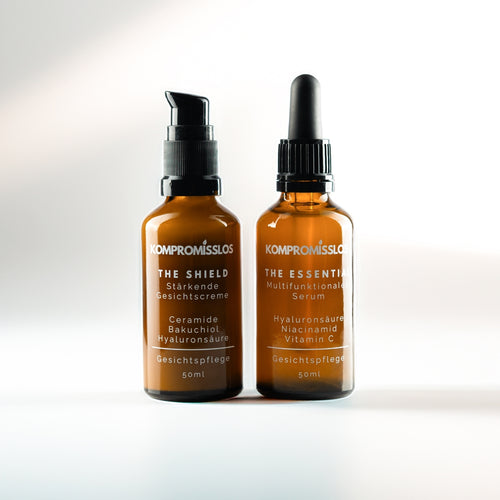
From around a hundred reviews upwards, an average becomes reasonably reliable; below that, it fluctuates a lot. You can work this out yourself. With 125 reviews and an average of 4.9, a single one-star review pulls the figure down to about 4.87. With twelve reviews and the same starting point, it drops to about 4.6. So the same dissatisfied person barely changes the picture in one case and changes it dramatically in the other. That is exactly why a 5.0 from eight reviews is not a better signal than a 4.7 from three hundred, but a weaker one. Our Duo of serum and cream currently has over 125 reviews and an average of 4.9, and that is a small base. It is enough to show a tendency, not to provide a guarantee. The reverse is also true: ten thousand reviews do not make a product right for you; they only make the average more precise. Taken together, the two figures – number and distribution – give you a picture. Either one on its own does not.
When are reviews no help to you?
Reviews are no help if your concern is a medical one. Persistent redness, weeping or itchy patches, changes to moles, or a reaction that does not settle after you stop using a product belong with a dermatologist, not in a star-rating system. Skincare looks after the skin; it does not replace a medical assessment. Reviews are also of little help if what you really have is a question about the formula. Whether a concentration suits you – for example the 5% niacinamide in the Duo – is not something you can read from stars; you can read it in the full overview of active ingredients. And if you are torn between several products, a list of criteria will get you further than a ranking, as our article on criteria rather than rankings shows. Reviews are an indication of how a product performs in everyday life, nothing more. They replace neither the ingredient list nor trying the product yourself on your own skin over several weeks.
I deliberately set the right of return at 100 days, and for precisely this reason. A review after three days says little about skincare, because hardly anything shows in three days. If you have 100 days, you judge on the basis of experience rather than first impressions.
Frequently asked questions
How can I spot fake skincare reviews?
Warning signs are several very similarly worded texts within a few days, consistently promotional language and the absence of any specific detail about skin condition or duration. A single sign proves nothing. If three of them come together, scepticism is justified. Also check whether the platform ties reviews to a verified purchase.
Is a 5.0 rating better than a 4.7?
Not automatically. What matters is how many reviews the rating is based on. A 5.0 from eight reviews tips over with a single critical voice, while a 4.7 from three hundred reviews is much more stable. A flawless rating on a small base is more a reason to take a closer look than proof of quality.
Do reviews on a brand’s own website count for less than those on platforms?
Not as a matter of principle, but they need to be checked differently. On the brand’s own site, the brand decides what is displayed, so the key question is whether critical reviews are visible too. If you find only four and five stars there, the spread is missing and the average loses its meaning.
How long should someone have used a product for their review to mean something?
For tolerability and texture, one to two weeks is enough. For statements about how the skin looks, four to eight weeks make sense, because skin needs time. Treat reviews with no timeframe as first impressions. They tell you something about scent, consistency and packaging, not about how the product performs day to day.
Is a brand allowed to delete negative reviews?
That is a grey area. Anyone who creates a misleading overall picture by deliberately removing critical voices is moving into the territory of incorrect or misleading statements under the Act against Unfair Competition. Removing offensive or obviously fake posts is a different matter. How an individual case is assessed is a legal question.
What should I look at instead of reviews?
At the full ingredient list, at concentration details you can follow and at the returns conditions. You can check these three points yourself without having to take anyone’s word for it. Reviews add everyday experience to this, for example on texture, scent and how long a product lasts. As the sole basis for a decision, they are too imprecise for skincare.
Sources
- Schweizerische Lauterkeitskommission, Grundsätze Lauterkeit in der kommerziellen Kommunikation (principles of fairness in commercial communication), as of January 2025. Source
- Swiss Confederation, Bundesgesetz gegen den unlauteren Wettbewerb (Federal Act against Unfair Competition, UWG, SR 241), 1986. Source