Best retinol serum in Switzerland? What the tests actually measure
TESTS AND COMPARISONS
Lists of the best retinol serum in Switzerland tell you less than their titles promise. Most of the rankings online are editorial selections with no laboratory measurements behind them. Genuine consumer tests measure wrinkle depth and skin hydration over a few weeks, and the differences turn out to be small. So look at concentration, how the product is used and how well your skin tolerates it, rather than at a seal of approval.
The same criteria apply to the cream you use on top: best face cream for mature skin.
What do tests actually check in a retinol serum?
Reputable consumer tests check two things: a measurable change in wrinkle depth and skin hydration, both over a defined period under laboratory conditions. An anti-wrinkle cream test by the Swiss consumer affairs programme Kassensturz from 2014 shows what that looks like. In it, 30 women aged between 30 and 71 each applied one product to one half of their face for a month, while the other half served as a comparison with a standard cream. Wrinkle depth was measured optically before and after the month. The result is the figure that really matters: an anti-wrinkle effect rated as good meant wrinkles around 9% less deep. In other words, over 90% of the wrinkle depth remained. That is exactly the order of magnitude to keep in mind when you read a list of test winners. The difference between first and seventh place is usually smaller than the difference between consistent and irregular use in everyday life. How much you apply, and how often, matters more than a product’s position in a list.
What is behind the online lists of best retinol serums?
Most of these lists are editorial recommendations, not laboratory tests. That isn’t automatically bad, but it is something different from a measured result. When a page says “test winner”, it is worth checking whether a method is described at all: how many people, for how long, what exactly was measured and with which device. If that is missing, you are looking at a selection based on the ingredient list, price and popularity. It also helps to check whether the site earns a commission on sales. That is permitted too, and often perfectly fine when openly declared, but it explains why the same products top so many lists. And look at the publication date. The cosmetics market moves quickly, many rankings stay online unchanged for years, and some of the products they recommend are no longer available in that formulation. The table below separates the types of test so that next time you compare products, you can tell immediately what you are looking at.
| Type of test | What is actually checked | What remains open |
|---|---|---|
| Editorial best-of list | Ingredient list, price, availability | Whether the product does anything for your skin |
| Laboratory consumer test | Wrinkle depth and hydration under controlled conditions | Whether the result applies to the condition of your skin |
| User reviews | Tolerance, texture, everyday practicality | Measurable change without a comparison group |
| Manufacturer’s own efficacy study | An endpoint defined by the manufacturer | Independence and comparison with other products |
How much retinol can a serum contain in Switzerland?
Since 1 November 2025, the EU has capped face products, including serums, at 0.3% retinol equivalent. For body lotions, the limit is 0.05%. This was laid down in Regulation 2024/996, which also requires a warning about daily vitamin A intake. The reason is not the skin itself but the total intake of vitamin A from food and cosmetics combined. Products already delivered may be sold off until 1 May 2027. This matters for lists of test winners: older articles sometimes recommend products with 0.5 or 1% retinol, which may no longer be newly placed on the market in that form. So if a list boasts about a particularly high dose, check when the article was published. Besides, more of an active ingredient doesn’t mean better results – often it mainly means more irritation.
A note on Switzerland: The Swiss Ordinance on Cosmetic Products (VKos) is broadly aligned with EU law, and many products sold in Switzerland come from the EU market anyway. Whether the limit has already been adopted word for word in the VKos: [OPEN: CHECK].
What to look for when you buy a retinol serum
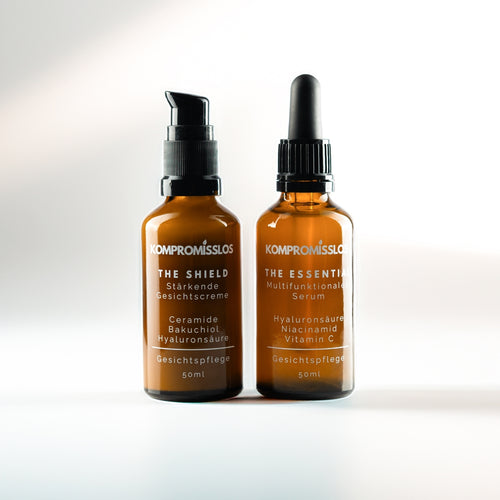
Look for a declared concentration, a low starting dose and whether the brand explains how to build up your routine. A retinol serum is applied in the evening, two to three times a week at first, and only increased once your skin stays calm. During the day, consistent sun protection is part of it, because your skin may become more sensitive to light. It also makes sense not to introduce any other potent products during the same period; otherwise, if your skin reacts, you won’t know what triggered it. We don’t sell a retinol serum ourselves – our approach is in The Duo of serum and cream instead. So here is our honest assessment: if you decide on retinol, one well-dosed product makes more sense than three at once. And if your skin tends to feel tight or turn red easily anyway, the slower route via a stable skin barrier is usually the better one. Which active ingredients our products contain, and in what amounts, is set out on our page about ingredients and concentrations.
Bakuchiol instead of retinol: what it means in practice
Bakuchiol is a plant-based active ingredient that is discussed as a gentler alternative to retinol, but chemically it is something entirely different. Our Duo contains 0.3% bakuchiol, based on the Duo as a whole. These 0.3% have nothing to do with the legal retinol limit of 0.3%; the figures happen to be the same and are not comparable. What speaks for bakuchiol: it is considered better tolerated and doesn’t make your skin sensitive to light in the same way. What speaks against it: the evidence is considerably thinner than for retinol, and if you already get on well with retinol, there is no compelling reason to switch. We deliberately combine bakuchiol with plant extracts such as gentian root extract and what it does in skincare and with foundational active ingredients, rather than selling a single powerhouse. You can see how it all comes together in the finished product on the product page for our Duo.
When a retinol serum is not the right choice
If your skin is irritated right now, if you are pregnant or breastfeeding, or if you already use prescribed treatments, a retinol serum is not the right place to start. During pregnancy and breastfeeding, vitamin A skincare products are usually advised against; clarify this with the professional treating you, not with a list of test winners. The same goes for persistent redness, painful inflammation or skin that gets worse over several weeks: cosmetics care for the skin, they don’t replace a dermatological assessment. And if blemishes are your main concern, it is worth looking at the causes before you reach for the strongest active ingredient available. A test-winner seal doesn’t replace that assessment. What genuinely helps in that situation is covered in our article on blemish-prone skin and its causes. Whether vitamin C or niacinamide in your routine makes more sense for you is explained in the corresponding article.
We don’t appear in any retinol test, and the reason is simple: I don’t sell a retinol serum. When I was developing the Duo, the question of whether retinol belonged in it was very much on the table. I decided against it, because a product that requires a build-up phase, planned breaks and additional sun protection doesn’t fit a two-step routine. Instead, I chose 0.3% bakuchiol, together with 5% niacinamide and 2% hyaluronic acid in the Duo. It is the slower option, and I say so openly. If you want the stronger effect and are prepared to accept irritation, a classic retinol serum will serve you better.
Frequently asked questions
Is there an official best retinol serum for Switzerland?
What you find online as the “test-winning” retinol serum is usually an editorial best-of list with no laboratory measurements. A seal alone therefore tells you little. Always check whether a method is described: number of people, duration, what exactly was measured and how. If not, you are looking at a selection, not a test.
How much retinol can a face serum contain?
Since 1 November 2025, the EU has set a maximum concentration of 0.3% retinol equivalent for face products; for body lotions it is 0.05%. A warning about daily vitamin A intake is also mandatory. Products already delivered may be sold off until 1 May 2027.
How much can an anti-wrinkle product realistically achieve?
Less than advertising suggests. In a laboratory test by the Swiss consumer affairs programme Kassensturz, an anti-wrinkle effect rated as good meant wrinkles around 9% less deep after one month. Most of the wrinkle depth remained. In the long run, regular use and sun protection make more difference than the choice between two products.
Is bakuchiol a full replacement for retinol?
No, it is a different substance with its own profile. Bakuchiol is considered better tolerated and doesn’t make your skin sensitive to light in the same way, but the evidence is thinner than for retinol. If you get on well with retinol, there is no need to switch. For sensitive skin, it is the gentler way to start.
How often should you apply a retinol serum at first?
The usual approach is to start with two to three evening applications a week and only increase once your skin stays calm. During the day, consistent sun protection is essential. Don’t introduce any other potent products during the same period, or you won’t be able to tell what caused a reaction.
Why doesn’t Kompromisslos appear in any retinol test?
Because we don’t sell a retinol serum. Our Duo relies on 0.3% bakuchiol, 5% niacinamide and 2% hyaluronic acid, each based on the Duo as a whole. It is deliberately the gentler option, for a routine of two steps instead of five products.
When should you avoid retinol?
When your skin is irritated, during pregnancy and breastfeeding, and if you already use prescribed treatments. In these cases, the professional treating you decides what makes sense. Persistent redness, painful inflammation or skin that keeps getting worse should also be assessed by a dermatologist, not in an online shop.