Best bakuchiol serum in Switzerland: what these tests actually compare
COMPARISON
Search for the best bakuchiol serum in Switzerland – or a bakuchiol “test winner” – and you end up on comparison sites, not at a laboratory test. As of August 2026, no independent Swiss consumer organisation has tested bakuchiol products. If you are looking for a bakuchiol product, you therefore have to decide for yourself based on concentration, supporting ingredients, packaging and how well your skin tolerates it, rather than on a seal of approval. Those four criteria can be checked; a test seal often can’t.
Is there a bakuchiol test winner in Switzerland?
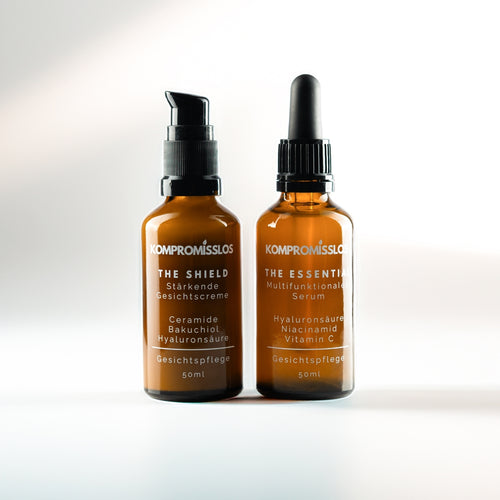
No. As of August 2026, there is no bakuchiol test winner chosen by an independent Swiss consumer organisation. Neither the Swiss consumer magazine K-Tipp nor the Swiss TV consumer programme Kassensturz has so far published a laboratory study specifically on bakuchiol products. What comes up for this search is almost entirely comparison sites and shop lists: editors line up products based on manufacturer information, price and customer reviews, and crown a winner. Nothing is tested in the sense of being measured. That isn’t a criticism of these sites, just a description of their method. For you, it means a bakuchiol award is no substitute for checking for yourself. It makes more sense to look at the declared concentration, the supporting ingredients and how well your skin tolerates the product. These points are exactly why, with The Duo with 0.3% bakuchiol, we disclose what is in it and in what amount. A ranking can give you a shortlist, but it can’t make the decision for you. So a more useful question than who won is what information a brand volunteers.
What comparison sites check – and what they don’t
Comparison sites almost always check data they can get without a laboratory: price per millilitre, pack size, availability, star ratings and the ingredient keywords. What isn’t checked are the things that determine whether a product works: the actual concentration of the active ingredient, its stability in the formula, the pH and whether the packaging keeps out light and air. A serum with 0.1% bakuchiol and one with 1% can therefore sit side by side in the same ranking without the difference ever showing. It’s a similar story with creams: there, too, the big studies usually measure not effectiveness but contaminants and labelling, as our article on what cream tests actually measure shows. Studies with a laboratory component are more meaningful, such as the one described in our article on K-Tipp’s face cream test. Once you have understood this difference, you read every ranking differently and look at the method before the placing.
What bakuchiol concentration makes sense?
Bakuchiol concentrations between around 0.2% and 1% make sense, and the best-known clinical study used 0.5%. More is not automatically better: bakuchiol is a fat-soluble plant compound, and above a certain amount what mainly increases is the potential for irritation, not the benefit. What it is combined with also matters. Bakuchiol on its own in an otherwise empty serum does less for your complexion than a moderate amount together with moisture and barrier care. The Duo contains 0.3% bakuchiol, along with 5% niacinamide and 2% vitamin C as 3-O-ethyl ascorbic acid. That is deliberately less than in the study, but in a formula that stays comfortable morning and evening. If you want to know where bakuchiol comes from in the first place, the introductory article is worth reading before any product comparison. A high percentage on the label is first and foremost a sales argument, not proof of a good product.
How to recognise a well-thought-out bakuchiol product
You can recognise a well-thought-out bakuchiol product by four pieces of information a brand gives voluntarily: the percentage, the supporting ingredients, the packaging and the directions for use. If the percentage is missing entirely, bakuchiol often sits far down the ingredient list and is therefore present only in a very small amount. If the active ingredient stands alone, without moisture binders and without lipids, it works against dry skin rather than with it. And a clear bottle on the shelf is the worse choice for a light-sensitive plant compound. The table below compares what a ranking shows you about a product with what you can check yourself in two minutes. How bakuchiol works in the skin is only half the answer; the formula around it is the other half. The fourth point deserves a close look: honest directions for use state how often and in what order, rather than simply telling you to apply it every day.
| What to check | What a ranking shows | What you can check yourself |
|---|---|---|
| Concentration | Usually not stated at all | The brand’s stated percentage, otherwise its position in the INCI list |
| Supporting ingredients | As a bare list of keywords | Whether moisture and lipids have been factored in |
| Packaging | Only as a product photo | Whether the container keeps out light and air |
| Tolerance | Through other buyers’ star ratings | Your own skin after two to four weeks |
| Buying in Switzerland | Often links to shops abroad | Delivery, return period and a named contact |
You will find the full formula, including all percentages, on our ingredients page.
Bakuchiol or retinol: what the research shows
The research shows comparable results, with bakuchiol being better tolerated. In a randomised double-blind study in the British Journal of Dermatology, researchers compared 0.5% bakuchiol twice a day with 0.5% retinol once a day in 44 participants over twelve weeks. Both groups showed a clear reduction in wrinkle surface area and dark spots, with no statistically significant difference between the two ingredients. Flaking and stinging, however, were more common in the retinol group. That doesn’t make bakuchiol a magic bullet, but it does make it the calmer option for skin that reacts to retinoids with irritation. The context is important: these results apply to the formula tested, not automatically to every product with bakuchiol on the label. Which choice suits you is discussed in our article on bakuchiol or retinol for sensitive skin, and how tests in this category are set up is explained in our article on what retinol serum tests check.
When you don’t need bakuchiol, and when to see a specialist
You don’t need bakuchiol if your skin is currently acutely irritated, raw or badly flaking. In that phase, every additional active ingredient adds more unrest than benefit; a few weeks of pure moisture and barrier care make more sense. Nor do you need bakuchiol if you already tolerate a retinoid well and are happy with it: layering two ingredients with a similar aim doesn’t double the effect. And there is a clear line between cosmetics and medicine. Persistent redness, weeping patches, sudden changes to moles, severe flare-ups or problems that don’t settle belong with a dermatologist. Skincare can improve how your skin looks, but it is no substitute for a medical assessment. During pregnancy or breastfeeding, too, it is better to discuss new active ingredients with a specialist first rather than relying solely on a product description online.
In short: a test seal tells you how a product was ranked in a list. It tells you nothing about how your skin will look in four weeks’ time.
I deliberately chose 0.3% bakuchiol rather than 1%, even though a higher number would look better on the label. The reason is how it is used: The Duo is applied morning and evening, so bakuchiol goes on the skin twice a day. At that frequency, tolerance matters more to me than a record-breaking number, especially as many of our customers have already experienced flaking with retinol. On top of that, I didn’t want a serum built around a single active ingredient. In practice, 0.3% bakuchiol together with 5% niacinamide, ceramides and squalane does more than bakuchiol alone at a high dose. What that means for real skin is described in the feedback from more than 125 reviews.
If you would rather skip the comparisons and start with a streamlined routine, you will find the serum and cream as a Duo with every percentage openly declared.
Frequently asked questions
Is there an official bakuchiol test winner in Switzerland?
No. As of August 2026, no independent Swiss consumer organisation has published a laboratory study on bakuchiol products. The results that come up for this search are from comparison sites that rank products based on manufacturer information, price and customer reviews. As a rule, there is no measurement of concentration or stability behind them.
What bakuchiol concentration makes sense?
Typical, sensible concentrations are between around 0.2% and 1%. The best-known clinical study used 0.5% twice a day. Higher values don’t automatically do more, because the potential for irritation rises with the amount. More important than the maximum figure is whether moisture and barrier care have been built into the same formula.
How much bakuchiol is in The Duo?
The Duo contains 0.3% bakuchiol, based on the combination of The Essential serum and The Shield cream. Other ingredients include 5% niacinamide, 2% vitamin C as 3-O-ethyl ascorbic acid, 2% hyaluronic acid and 1% zinc. All percentages refer to the Duo as a whole, not to either product on its own.
Is bakuchiol better than retinol?
Better is the wrong word; gentler is closer to the mark. In a randomised double-blind study over twelve weeks, 0.5% bakuchiol and 0.5% retinol achieved comparable results for wrinkle surface area and dark spots, while the retinol group reported flaking and stinging more often. For sensitive skin, bakuchiol is therefore often the calmer choice.
Does bakuchiol make your skin sensitive to light?
Bakuchiol is not a vitamin A derivative, and the discussion about increased sensitivity to light mainly concerns retinoids. That is why bakuchiol can also be used in the morning. Even so, daily sun protection remains the most effective step against visible skin ageing, whatever other active ingredient you use. There is no reason to use bakuchiol only in the evening.
How long does it take to see a difference?
Allow eight to twelve weeks. The bakuchiol study mentioned above ran for twelve weeks, with measurements after four and eight weeks. Moisture and skin feel usually change sooner; lines and evenness take longer. If you switch after ten days, you will rarely see what a product can actually do.
What should you look for when buying in Switzerland?
Look for three things: a declared percentage, packaging that protects against light and air, and a supplier that delivers to Switzerland and offers a fair return period. At Kompromisslos, that means a 100-day right of return, delivery for CHF 3.70 and free on orders over CHF 60, with delivery in one to three working days.
Sources
- Dhaliwal S. et al., Prospective, randomized, double-blind assessment of topical bakuchiol and retinol for facial photoageing, British Journal of Dermatology, 2019. Source