How to spot fake skincare: signs of counterfeit products on marketplaces
SWISS BUYING GUIDE
To spot fake skincare, look for a combination of small discrepancies rather than a single tell-tale sign: a price well below the usual one, a seller without a full address, blurry printing, spelling mistakes, a batch code that is missing or does not match, and a scent or texture that is different from the original. A perfect copy is almost impossible to spot from the outside. Your best protection is therefore not a close look at the tube but where you buy it: directly from the manufacturer or from a retailer the manufacturer names.
How can you tell if cosmetics are fake?
Fake cosmetics usually give themselves away on three levels: the listing, the packaging and the product itself. In the listing, the signs are a conspicuously low price, a huge range of bestsellers and descriptions such as “replica”, “in the style of” or “grey import”. Stop Piracy, the non-profit Swiss platform against counterfeiting and piracy, treats “replica” or “copy” as a clear sign of a fake and advises caution with “in the style of” or “grey import”. On the packaging, look out for cheap cardboard, washed-out colours, crooked lettering, missing mandatory information and typos. In the product itself, the differences are ones you only notice side by side with the original: a different scent, a different colour, a thinner or lumpy consistency. No single feature proves anything. Attractive packaging is no proof of authenticity either, because according to Stop Piracy, quality seals and documents can be faked too. But if two or three of these signs come together, stop weighing it up and simply do not use the product.
To be clear about the scope: this is about imitations of genuine branded products that pass themselves off as the original, not about legally sold cheap cosmetics, nor about dupes that openly present themselves as products in their own right. Whether a cheaper alternative is good enough is a separate question, and it comes down to what you’re really paying for in an expensive face cream.
Where do fakes turn up most often: marketplaces, social media or resale platforms?
Fakes turn up wherever an unknown seller stands between you and the manufacturer: third-party sellers on large marketplaces, shops that pop up through social media ads, and classified-ad and resale platforms. There are no public, reliable figures specifically for cosmetics in Switzerland, so a distinction is more helpful than a ranking. On large marketplaces, it is often not just the platform operator that sells, but a large number of third-party sellers alongside it. The risk of fakes therefore does not depend on the name of the platform, but on who is listed as seller and shipper in the specific listing. Shops found through social media ads follow a different pattern: a new domain, aggressive discounts, a countdown timer and a legal notice with details that lead nowhere. Stop Piracy explicitly names unusual domain names containing words such as “outlet” or “cheap”, or a Swiss place name, as a warning sign. On resale platforms, finally, the problem is less the seller than the lack of control: an opened product bought second-hand may be genuine, decanted or fake, and you have no way of checking for sure. For skincare that goes on your face every day, that is a poor trade for saving a few francs.
What do the packaging, batch code and label reveal about authenticity?
The packaging, batch code and label reveal the most when you have a known original to compare them with, and they tend to expose bad fakes rather than good ones. The batch code is a short code that the manufacturer prints on the tube or bottle, and usually on the outer box as well, so that a production run can be traced. If it is missing altogether, has been covered with a sticker or made illegible, or if the codes on the box and the container differ, that is a strong warning sign. Conversely, a code that is present proves little, because counterfeiters can copy codes too. On the label, three things are worth checking: a responsible company with a full address, a legible ingredient list and the symbol for shelf life. What this jar symbol means is explained in the article on skincare shelf life after opening. It also helps to compare the ingredient list with the list the manufacturer publishes on its website. If the order or individual ingredients differ, something is wrong. If the packaging also advertises Swiss origin, it is worth knowing how to tell where a product really comes from, because claims of origin get copied as well. How to decode a list like this is shown in the article on how to read an ingredient list.
| Feature | Suspicious if | How telling it is |
|---|---|---|
| Price | Well below the manufacturer’s price for no apparent reason | High as a warning sign, but not proof |
| Batch code | Missing, covered with a sticker or different on the box and the tube | High if it is missing or does not match |
| Label and printing | Typos, blurry lettering, no company address | Medium, as good copies are cleanly printed |
| Ingredient list | Differs from the list on the manufacturer’s website | High if the original publishes a list |
| Scent and texture | Different from usual, perfumed instead of neutral, separated or lumpy | Medium, only in comparison with the original and only once opened |
Why is fake skincare more dangerous than a fake T-shirt?
Fake skincare is more dangerous because you apply it to the skin on your face every day and can neither see nor check what is in it. With a fake T-shirt, the worst that happens is a badly sewn seam. With a fake cream, you do not know what it contains, who filled it under what hygiene conditions, or whether anyone is responsible for its safety at all. Stop Piracy puts it soberly: counterfeiters do not care about your health and safety, and when it comes to warranty or liability claims, nobody can be held to account because the manufacturers are unknown.
Two laboratory analyses show what this can mean in practice. A team from the University of Nantes examined two fake sunscreens bought online, reporting in the European Journal of Dermatology: both the SPF and the UVA protection factor were 1, and the products contained no UV filters at all. Anyone relying on them is effectively unprotected in the sun. The second risk is the opposite: an active ingredient that has no business being there. In an analysis by the University of Bologna, published in the Journal of Pharmaceutical and Biomedical Analysis, the team found the corticosteroid betamethasone valerate at a total concentration of 0.036 per cent in a cream sold as a cosmetic, even though corticosteroids are banned in cosmetics. You cannot detect substances like these by smell or texture.
So the question is not just whether you have lost money. The question is whether you put a product on your skin whose origin nobody can guarantee.
How do you check a retailer before you order?
The most reliable way to check a retailer is to look on the manufacturer’s website to see where the product is officially sold, and only then place your order. If the retailer is not listed there and you cannot find out either way, ask the manufacturer – Stop Piracy recommends this too. On top of that, there are a few checks that take less than five minutes and weed out most dubious listings.
- Legal notice: a full company address that actually exists, plus a phone number and email.
- Price: compare it with the manufacturer’s price. According to Stop Piracy, even a small discount on very popular products can be a red flag.
- Sellers on marketplaces: who sells and who ships – the platform operator or a third-party seller with only a few, very recent reviews?
- Language and images: machine-translated text, typos in the terms and conditions, product photos that a reverse image search reveals as copied.
- Quality seals: a genuine seal links to the certifying body. A seal without a link is decoration.
- Returns: a clear returns address rather than just an email address.
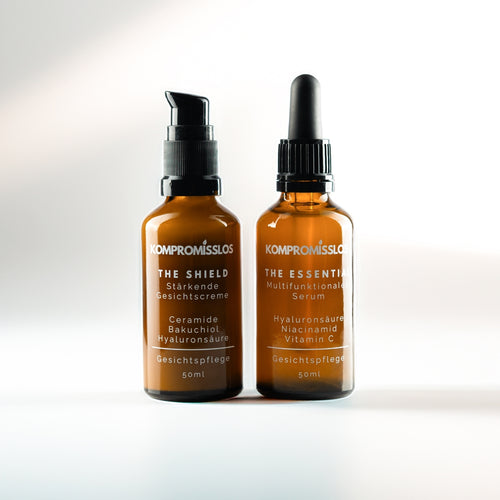
For The Duo, the answer is simple: you order The Duo directly from our shop at kompromiss-los.ch, with delivery to Switzerland and Liechtenstein and a 100-day right of return. In his review on Judge.me, Simon B. writes: “For once, a product where you know where it comes from” (review translated from German). With skincare for your face, that is no small detail, and it starts with where you buy.
Check the parcel as soon as it arrives, before you open anything: seal intact, batch code identical on the box and the container, ingredient list matching the manufacturer’s website. Photograph everything while it is still sealed.
What should you do if you have bought or used a fake?
If you have bought a fake, first stop using it, keep the evidence and report the case to the seller and the platform. Keep the order confirmation, proof of payment, photos of the packaging and batch code, and your correspondence with the seller. On a marketplace, contact customer service with the seller’s name and the product. If you paid by credit card, Stop Piracy recommends also informing the credit card company and disputing the charge within the deadline. Shops with the Swiss .ch domain can be reported to the cybercrime police or the cantonal police. There are two things you should not do, however: according to Stop Piracy, you must not send back a fake ordered from abroad, because exporting counterfeits is prohibited, and reselling it within Switzerland is a criminal offence as well. What claims you have against a retailer in general is explained in the article on your real rights when buying skincare online.
If you have already used the product and your skin reacts with redness, burning, swelling or a rash, have it seen by a dermatologist or your GP. Take the product and its packaging with you so that it is clear what you applied. If your eyes are affected or the symptoms cover a large area, do not wait and see. When you later start using a new product, you can patch test a new face product at home before it goes on your whole face.
I decided to disclose the concentrations of the key active ingredients and the full INCI list, and a side effect of this is that our products can be verified. If you have a pack in front of you, you can compare it with the full INCI list for The Duo. The page lists the serum and the cream together in a single list, so every ingredient on your pack must appear there. The same goes for the scent: The Duo is fragrance-free, so a noticeably perfumed or floral scent would be a warning sign. But I want to be honest about where this stops. A published ingredient list does not protect you from a perfect copy, because anyone who fakes a product can copy a list too. That is why, in the end, what counts is not how carefully you check a tube, but where you buy it.
Frequently asked questions
Are products on Amazon or Galaxus fake?
Not across the board. On large marketplaces, the operator often sells alongside many third-party sellers, and the risk of fakes lies mainly with unknown third-party sellers. So check in the listing who sells and who ships, and compare this with the manufacturer’s list of retailers. If the only seller is a third party without a traceable address, you are better off buying directly from the manufacturer.
Is a very low price always a sign of a fake?
No, but it is a typical warning sign. Discontinued packaging, end-of-line stock or promotions can explain a low price. It becomes suspicious when a sought-after product is permanently offered far below the manufacturer’s price and the retailer gives no reason. Stop Piracy points out that with very popular products, even a small discount can be a red flag.
Can I check if a product is genuine using the batch code?
Only to a limited extent. A batch code that is missing, covered with a sticker or different on the box and the tube is a strong warning sign. A code that is present, however, does not prove authenticity, because counterfeiters can copy codes. The safest option is to send the manufacturer a photo of the code, because only they can match it against their own production.
Am I allowed to bring fake cosmetics into Switzerland?
No. According to Stop Piracy, importing counterfeits into Switzerland is prohibited even for private use. Customs can detain the goods and seize and destroy them at your expense; the procedure is handled by the Swiss Federal Institute of Intellectual Property. The law only provides for criminal penalties for commercial imports, but the trademark owner can claim damages. If you are not sure whether the goods are genuine, Stop Piracy recommends doing without them.
What should I do if my skin reacts to a fake product?
Stop using the product immediately and have the reaction looked at by a dermatologist or your GP. Take the product and its packaging with you. If your eyes are affected, or if there is severe swelling or a widespread rash, do not wait and see. Do not try to treat the reaction yourself with other products.
How do fake cosmetics smell or feel?
Often different from the original, but not always. Typical differences are a pungent, chemical or heavily perfumed smell, a different colour, a watery, separated or lumpy consistency and a feel on the skin that does not match the product you know. If you notice anything like this, stop using the product, even if the packaging looks genuine.
Where can I buy The Duo and be sure it is genuine?
Directly from our shop at kompromiss-los.ch, with delivery to Switzerland and Liechtenstein and a 100-day right of return. There you order The Duo, serum and cream together without any middlemen. If you see an offer elsewhere and are unsure, email us at info@kompromiss-los.ch before you order.
Sources
- Couteau C, Catroux S, Le Roy C, Gauvrit J, Wielgosz-Collin G, Paparis E, et al. Sunscreen products: little-known cosmetic counterfeits. European Journal of Dermatology, 2025. Source
- Fiori J, Andrisano V. LC-MS method for the simultaneous determination of six glucocorticoids in pharmaceutical formulations and counterfeit cosmetic products. Journal of Pharmaceutical and Biomedical Analysis, 2014. Source
- Stop Piracy, Schweizer Plattform gegen Fälschung und Piraterie. Fälschungen und illegale Angebote erkennen. Abgerufen 2026. Source
- Stop Piracy, Schweizer Plattform gegen Fälschung und Piraterie. Wissenswertes für Konsumentinnen und Konsumenten. Abgerufen 2026. Source
- Stop Piracy, Schweizer Plattform gegen Fälschung und Piraterie. Fälschung, was tun? Abgerufen 2026. Source