Right of withdrawal in Switzerland: can you return opened skincare bought online?
SWISS BUYING GUIDE
You can only return opened skincare in Switzerland if the shop allows it in its terms. There is no statutory right of return or exchange here, not even when you buy online. The right of withdrawal in the Code of Obligations only covers doorstep, street, promotional-trip and telephone sales. What the law does give you in principle is the statutory warranty for defects, unless the shop restricts it in its terms and conditions. For everything else, including a cream your skin does not tolerate, the shop’s terms and conditions decide.
Can you return opened skincare in Switzerland?
You can only return opened skincare in Switzerland if the shop allows it, because you have no legal entitlement to a return. On its page about the right of return in online retail, the trade association Handelsverband.swiss states that in Switzerland there is no legal entitlement to an exchange or a return. Each shop therefore decides for itself whether, for how long and in what condition it takes goods back. With skincare, condition is the sticking point. An opened bottle can no longer be sold, which is why many shops exclude opened products. Even the association, which requires the certified online retailers carrying its Swiss Online Garantie quality seal to offer a right of return, allows them to exclude hygiene-sensitive items such as opened perfumes and opened consumables. Under these minimum rules, used items generally lose the right of return. At the same time, the page states explicitly that companies may set more generous rules.
For you, this means the key question is not what the law allows, but what the terms of that particular shop say. If they say ‘unopened only’ or ‘in original packaging’, an opened cream is ruled out, even if it does not suit you. If they state explicitly that you may try the product, things look different. Read that sentence before you buy, not once your skin is already reacting.
Is there a right of withdrawal for online purchases in Switzerland?
No, there is no general statutory right of withdrawal for online purchases in Switzerland. The Code of Obligations only provides a 14-day right of withdrawal in situations where you are made an offer without having sought it out. Under Art. 40b CO, it applies if the offer was made to you at your workplace, in residential premises or their immediate vicinity, on public transport, in public streets and squares, at a promotional event combined with an excursion, or by telephone. In addition, the goods or services must be intended for personal or family use, and the amount you pay must exceed 100 francs (Art. 40a CO). If you expressly requested the contract negotiations yourself, there is no right of withdrawal in any case (Art. 40c CO).
An online shop where you choose and order products yourself is not covered by these rules. In Switzerland, the 14 days you know from many shops are therefore either a voluntary promise or borrowed from EU law, which a shop then applies to all its customers. Legally, what counts for you is what the shop promises in its terms – and that is also what you can hold it to.
What if your skin does not tolerate the cream?
If your skin does not tolerate a cream, you can usually only return it if the shop gives you that option. The statutory warranty applies to defects, meaning cases where the item has lost its value or its fitness for the intended use, or where these are significantly reduced (Art. 197 CO). A flawless cream that simply does not suit your skin is usually not a defect in this sense. It is a different matter if the product has gone off, smells or looks noticeably different from usual, or does not match what is declared on the label. In that case, report it immediately, because the warranty requires you to notify the seller of the defect promptly.
‘Not tolerating’ a product is an umbrella term. A study in the journal Contact Dermatitis, in which dermatologists assessed 151 people with skin reactions to cosmetics, found allergic contact dermatitis in 28 per cent; irritant reactions were equally common at 27 per cent. For the return, this distinction hardly matters, but for your next cream it does. Before you decide, it is best to work out whether a stinging cream is harmless or a sign it doesn’t suit you, and whether new spots after switching products are more likely to be skin purging or a reaction. Severe or persistent reactions should be assessed by a dermatologist, not by customer service.
What is the difference between a right of return, a guarantee and goodwill?
A right of return is a voluntary promise from the shop, the warranty for defects is statutory, a guarantee is an additional promise, and goodwill is a concession you have no claim to. In everyday language the terms get mixed up, but legally they mean different things. The statutory warranty only covers defects. You inspect the goods as soon as is practicable in the ordinary course of business and report any defect immediately (Art. 201 CO). You can then cancel the purchase or ask for a price reduction (Art. 205 CO). For goods that exist in many identical units, such as a cream from the same production run, you can also demand a flawless replacement of the same kind (Art. 206 CO). Claims become time-barred two years after delivery (Art. 210 CO). A shop may restrict or exclude the warranty in the contract, unless it has fraudulently concealed a defect from you (Art. 199 CO). A right of return, by contrast, applies even without a defect, but only to the extent the shop sets out.
| Term | Basis | When it applies | What you get |
|---|---|---|---|
| Right of return | The shop’s terms, voluntary | Even without a defect, within the deadline and conditions | Whatever the shop promises: money, a voucher or an exchange |
| Right of withdrawal | Law, Art. 40a et seq. CO | Only for doorstep, street, promotional-trip and telephone sales over 100 francs | Contract reversed, withdrawal within 14 days |
| Statutory warranty | Law, Art. 197 et seq. CO | For a defect that is reported immediately | Contract reversed, price reduction or replacement |
| Guarantee | Promise by the manufacturer or retailer | As described in the guarantee | Whatever the guarantee specifically promises |
| Goodwill | Concession in an individual case | When the shop chooses to | No entitlement, solution by agreement |
What about orders from EU shops?
If you order from an EU shop while living in Switzerland, you do not automatically have the statutory EU right of withdrawal. Within the EU, the Consumer Rights Directive 2011/83/EU gives you 14 days to withdraw from a distance contract without giving any reason. From a Swiss perspective, however, consumer contracts are governed by the law of the country where you live if the supplier received your order here, or if an offer or advertising reached you here and you placed the order from here. A choice of law is excluded (Art. 120 of the Federal Act on Private International Law, PILA). Many EU shops nevertheless grant their right of withdrawal to all customers through their terms. So here too, what counts is the wording of the terms and conditions.
Even where the EU right of withdrawal applies, it often does not help with opened skincare. The directive excludes sealed goods that are not suitable for return for health protection or hygiene reasons if they were unsealed after delivery (Art. 16(e)). You are also liable for any loss in value caused by handling the goods beyond what is necessary to examine them (Art. 14(2)). As a rule, using a cream for a week is likely to go beyond simply examining it. On top of that, you have to send it back across the border, and it pays to work out in advance what customs, VAT and return postage cost when you order from Germany. If you want to avoid this, it is worth looking at Swiss suppliers first, for example if you want to buy vegan cosmetics in Switzerland.
What should you look for in a skincare shop’s terms and conditions?
In a skincare shop’s terms and conditions, look above all at whether opened products are explicitly accepted for return and how long the return period is. The other points seem minor, but they cost you money if you overlook them. Check these five points before you order:
- Condition: do the terms say ‘unopened’ or ‘in original packaging’, or do they state explicitly that you may try the product?
- Deadline and start date: does the period run from the order or from receipt, and is an email enough to meet the deadline?
- Refund: is the money returned to your original payment method or do you only get a voucher, and who pays for shipping and return postage?
- Warranty: is it restricted, for example to a replacement instead of a refund?
- Subscription: does the right of return also apply to follow-up deliveries, and how do you cancel?
On the last point, it is worth asking whether a skincare subscription or a one-off purchase is the better way to start while you do not yet know a product. When it comes to choosing a shop in general, it helps to know what to look for when you buy natural skincare in Switzerland. And before you order anything at all, it pays to be able to tell which star ratings are worth trusting rather than just counting the stars.
With skincare, the return period is the most important point. Whether your skin tolerates a cream often shows after just a few applications; whether it actually does anything usually only after weeks. A 14-day period is enough for the first, but rarely for the second.
Reviews also show that a fair verdict takes time. One anonymous review on Judge.me says: “But to really be able to tell the difference from other products, I will test it for a little longer” (review translated from German).
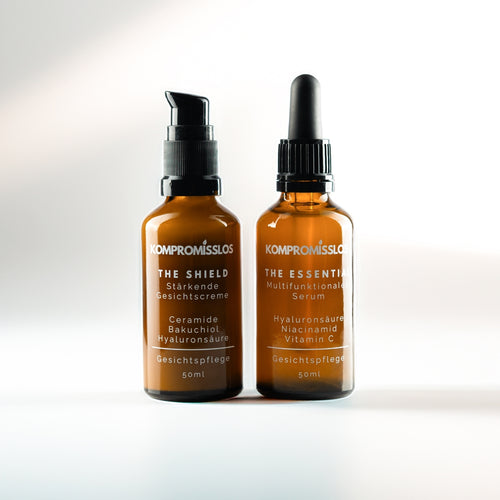
I set a 100-day right of return for Kompromisslos because skincare takes weeks before you can judge it fairly. A return period that runs out before anything can even show on your skin is of little use to you. Our returns page explains that you have 100 days to test and how returns work. The fact that The Duo consists of just two products helps here: you are testing one serum and one cream, not eight steps at once, so in the end you are more likely to know what made the difference. What I cannot do is promise you that your skin will tolerate both. What you can do is follow the application instructions as intended from day one, so that your verdict after a few weeks actually means something.
Frequently asked questions
Does a shop have to take back opened skincare?
No, as long as there is no defect, a shop in Switzerland does not have to take back opened skincare. There is no statutory right of return, and even the minimum rules of Handelsverband.swiss allow shops to exclude opened hygiene items and used goods. Whether you can return an opened cream depends entirely on the shop’s terms.
How long should a return period for skincare be?
Long enough for you to test the product not only for tolerance but also for its effect. Tolerance often shows in the first few days, visible changes usually only after several weeks of regular use. Two weeks are therefore usually only enough to check tolerance. How long skincare takes to work depends on the active ingredient.
Do I need proof that my skin did not tolerate a product?
The law does not require any proof for a voluntary return; it follows the shop’s terms. A defect is different: you have to report it to the seller immediately and be able to show it. For your own sake, it is still worth having severe or recurring reactions checked. A patch test at a dermatology practice shows whether a contact allergy is behind them.
Will I get my money back or a voucher?
That depends on why you are returning the product. If there is a defect, you can cancel the purchase, and the seller then has to refund the price you paid (Art. 205 and 208 CO). For a voluntary return without a defect, the shop’s terms determine whether you get money, a voucher or an exchange. If they say nothing about it, ask before you buy.
Can I return a gift?
Only if the shop allows it, and usually via the person who bought it. The shop’s contractual partner is the buyer, not the recipient, and the refund usually goes through the original order. If you are giving skincare as a gift, check the return conditions beforehand and think about how to choose a skincare set that actually gets used.
What should I do with a cream my skin does not tolerate?
Stop using it rather than waiting to see whether things improve. Keep the packaging, ingredient list and order confirmation until you know whether you will return it or want to show it to a professional. Then check the return deadline and contact the shop in good time. If you have severe redness, swelling or persistent burning, have it checked by a dermatologist.
How do returns work if The Duo does not suit me?
You notify us of the return by email to info@kompromiss-los.ch within 100 days of receipt; the email is enough to meet the deadline. You then have 14 days to send the products back, and you pay the return postage. Within 14 days of receiving your return, we refund the full amount, including the shipping costs paid with the order, to your original payment method. All the conditions are set out on our returns page, so you can try The Duo at your own pace.
Sources
- Schweizerische Eidgenossenschaft. Bundesgesetz betreffend die Ergänzung des Schweizerischen Zivilgesetzbuches (Fünfter Teil: Obligationenrecht), SR 220, Art. 40a–40c, 40e, 197, 199, 201, 205, 206, 208, 210. Fedlex, Stand 1. Oktober 2026. Source
- Schweizerische Eidgenossenschaft. Bundesgesetz über das Internationale Privatrecht (IPRG), SR 291, Art. 120. Fedlex, Stand 1. Januar 2026. Source
- Europäisches Parlament und Rat der Europäischen Union. Richtlinie 2011/83/EU vom 25. Oktober 2011 über die Rechte der Verbraucher, Art. 9, 14 und 16. Amtsblatt der Europäischen Union L 304, 2011. Source
- HANDELSVERBAND.swiss. Rückgaberecht im Onlinehandel (Mindestanforderungen im Rahmen des Gütesiegels Swiss Online Garantie). Abgerufen am 7. Oktober 2026. Source
- Berne B, Tammela M, Färm G, Inerot A, Lindberg M. Can the reporting of adverse skin reactions to cosmetics be improved? A prospective clinical study using a structured protocol. Contact Dermatitis, 2008. Source