Buying vegan cosmetics in Switzerland: where, what to check and delivery costs
VEGAN COSMETICS IN SWITZERLAND
You can buy vegan cosmetics in Switzerland directly from Swiss manufacturers, in organic and health food shops, at chemists with a vegan range, or from online shops with a warehouse in Switzerland. What you can rely on is not the word “vegan” on the front, but the full ingredient list, a responsible person you can actually reach and delivery without any customs surprises.
Where can you buy vegan cosmetics in Switzerland?
Four routes work reliably: directly from the manufacturer, in an organic or health food shop, at chemists with a vegan range and from online shops that deliver from a Swiss warehouse. Buying directly from the manufacturer has the advantage that, if you have a question about the formula, you reach someone who knows the answer rather than just reading out the back of the pack. Bricks-and-mortar shops score because you can check the texture and scent before you buy, though their selection of concentrated vegan skincare sets is often small. Online shops with a Swiss warehouse usually work out cheapest overall, because customs duties and clearance fees do not apply and delivery takes just a few working days. Ordering from shops abroad is the only route with a real risk of surprises: the product price looks low, but then come delivery, import VAT and, depending on the carrier, a customs clearance fee that wipes out the advantage completely.
That is why a price comparison only makes sense once you count every cost up to your front door. A serum costing 39 euros in a German shop can, after conversion, delivery and import charges, end up more expensive than a Swiss product with a supposedly higher shelf price. You can read how other customers have found it in the reviews from more than 125 ratings.
| Where to buy | Strength | What to look out for |
|---|---|---|
| Directly from the manufacturer | First-hand information about the formula. | Is there a reachable address and a name? |
| Organic and health food shops | You can try the texture and scent before you buy. | The range is often small and changes with the seasons. |
| Online shop with a Swiss warehouse | No import charges, short delivery times. | Check that it really ships from Switzerland. |
| Shop abroad | Wide choice of international brands. | Import VAT and a customs clearance fee come on top. |
How can you tell whether a product is really vegan?
From the ingredient list on the back, not the symbol on the front. The term “vegan” is not legally defined for cosmetics, so any brand may use it according to its own criteria. What is mandatory, however, is a full list of ingredients using the international INCI nomenclature. Animal-derived raw materials appear there under names you should know: Cera alba or Beeswax for beeswax, Mel for honey, Lanolin for wool wax from sheep’s wool, Carmine and CI 75470 for a red dye made from scale insects, plus Collagen, Elastin, Keratin and Propolis. Squalane is a special case: the raw material can be obtained from shark liver or from olives and sugar cane, and the INCI name is identical in both cases. The only way to find out is to ask the supplier directly – and a clear answer is a good sign. We publish our complete ingredient list so that you can make this check yourself.
How are cosmetics regulated in Switzerland?
In Switzerland, cosmetic products do not need individual approval from the authorities; instead, the company bears full responsibility for the safety of its products. According to the Federal Food Safety and Veterinary Office (FSVO), a product information file including a safety report must exist for every cosmetic product before it is first placed on the market. Checks are not carried out in advance but afterwards, by the cantonal enforcement authorities, which can take samples from shops and request documentation. On top of that, there is a ban on misleading claims: advertising for cosmetics must not mislead and must not promise medical effects. Which substances are banned or only permitted in limited amounts is determined, via the Swiss Ordinance on Foodstuffs and Utility Articles, by the European Cosmetics Regulation, with a small number of Swiss deviations. For you as a shopper, that means two things: basic safety is regulated, but the meaning of advertising terms is not. A brand that promises a lot has therefore not tested more – it has simply phrased things more boldly.
Vegan, not tested on animals, natural: is it all the same thing?
No – these are three different claims that can overlap but do not have to. Vegan means there are no animal-derived raw materials in the formula. “No animal testing” refers to how the product and its ingredients were tested. In Switzerland, under the Ordinance on Foodstuffs and Utility Articles, cosmetic products may not be placed on the market if the formulation or individual ingredients have been tested on animals in order to meet the requirements of food law. Natural cosmetics, in turn, describes where the raw materials come from and is not a protected term in Switzerland, which is why each brand may choose its own interpretation. Natural cosmetics containing beeswax are therefore not vegan, and a vegan product can be entirely synthetic. Plant-based active ingredients such as gentian root extract and its effects show that the two can be combined. If all three points matter to you, check them one by one rather than as a bundle.
How does delivery of cosmetics work within Switzerland?
With a Swiss supplier, delivery could hardly be simpler: you order, it is packed in Switzerland, Swiss Post delivers it, and there are no import formalities. With us, delivery costs CHF 3.70 and is free on orders over CHF 60; delivery takes 1 to 3 working days. You can pay with Twint, credit card, Apple Pay or Klarna – the payment methods commonly used in Switzerland. If a product does not suit you, you have a 100-day right of return, which makes sense for skincare because tolerability only becomes clear over several weeks. If you order from abroad instead, import VAT and a customs clearance fee from the carrier come on top, and sending things back becomes a hassle. With cosmetics, also bear the temperature in mind: in high summer and in winter, a parcel should not sit in the letterbox for days. How to use the products afterwards is explained in our guide to using them.
When are vegan cosmetics the right choice, and when not?
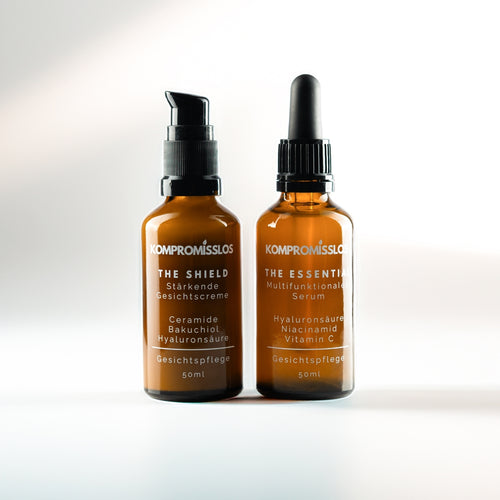
Vegan cosmetics are the right choice if you want to exclude animal-derived raw materials for ethical reasons or if your skin reacts to ingredients such as lanolin and propolis. They are not a quality seal: a vegan product can irritate, and a non-vegan one can be extremely well tolerated. What matters is what is actually in the formula, in what quantity, and whether your skin stays calm with it over several weeks. If you are looking for a pared-back vegan routine, our set of serum and cream gives you exactly two steps instead of seven. And there is a clear limit. Cosmetics care for the skin and can improve its appearance; they do not treat disease. If you have persistent redness, weeping or flaking patches, severe itching or changes to moles, see a dermatologist. With blemish-prone skin, a careful look at the causes will help you more than the next change of product.
I built the formula as vegan from the start because I wanted a reason for every raw material that went beyond tradition. Beeswax is in many creams because it has always been in them. I chose plant-based alternatives instead and accepted that this made the formulation more complex and more expensive. And I deliberately sell only in Switzerland and Liechtenstein, even though that keeps the market small. That way, the journey from the warehouse to you is short, nobody pays import charges, and I can answer every question about the formula myself rather than passing it on.
Frequently asked questions
Are vegan cosmetics automatically free from animal testing?
No. Vegan describes the formula; “no animal testing” describes how the product and its ingredients were tested. A product without animal-derived raw materials can contain substances that were tested on animals at some point. So check the two points separately, because in terms of content and law they have nothing to do with each other.
Is the term vegan legally protected for cosmetics?
No, there is no legal definition of vegan for cosmetic products. The only binding rules are that all ingredients must be declared using the INCI nomenclature and that advertising claims must not mislead. The real check is therefore down to you and a careful look at the ingredient list.
Which animal-derived ingredients are common in cosmetics?
The most common are Cera alba or Beeswax for beeswax, Mel for honey, Lanolin from sheep’s wool, and Carmine and CI 75470, a red dye made from scale insects. Then there are Collagen, Elastin, Keratin and Propolis. Squalane can be of animal or plant origin and is worth asking about.
Do cosmetics need official approval in Switzerland?
No, there is no individual approval. As part of its self-regulation, the company is responsible and must have a product information file with a safety report ready before placing a product on the market. Checks are carried out afterwards by the cantonal enforcement authorities, not in advance through an authorisation procedure like the one for medicines.
How much does delivery of cosmetics within Switzerland cost?
With us, delivery costs CHF 3.70 and is free on orders over CHF 60. Delivery takes 1 to 3 working days. You can pay with Twint, credit card, Apple Pay or Klarna. Other Swiss suppliers are usually in a similar price range.
Is it worth ordering vegan cosmetics from abroad?
Rarely. On top of the product price come delivery, import VAT and, depending on the carrier, a customs clearance fee, and returning items becomes complicated and expensive. So always work out the final price to your front door before comparing. With a supplier that has a Swiss warehouse, these costs disappear entirely.
How many products do I need for a vegan routine?
For most skin conditions, cleansing, a serum, a cream and sunscreen during the day are enough. More products mean more variables and make it harder to see what is actually working. If you are unsure which active ingredient suits you, the comparison vitamin C or niacinamide will help.