Ordering skincare from Germany to Switzerland: customs, VAT and return costs
SWISS BUYING GUIDE
If you order skincare from Germany to Switzerland, there has been no customs duty to pay since 2024, but you do pay 8.1 per cent import VAT on the value of the goods plus shipping. If that tax comes to 5 francs or less – in other words, if the value including shipping is below 63 francs – importing costs you nothing. Above that, the carrier adds its customs clearance fee: at Swiss Post, 13 francs plus 3 per cent of the value of the goods. On small orders, this quickly eats up any price advantage.
Is there customs duty on cosmetics from Germany?
No, there has been no customs duty on cosmetics from Germany since 1 January 2024. On that date, Switzerland abolished its tariffs on industrial goods. According to the Federal Office for Customs and Border Security (FOCBS, known in German as BAZG), this applies to goods in chapters 25 to 97 of the customs tariff, except for some products in chapters 35 and 38 that are classed as agricultural products. Cosmetics, perfume and personal care products fall under chapter 33 and are therefore duty-free. That does not mean a parcel from Germany comes free of charges, though. When it comes to facial skincare, what many people loosely call ‘customs’ now consists of two other items: import VAT, which is Swiss value added tax on imported goods, and the fee that Swiss Post or a courier charges for customs clearance. Together, these two can come to more than you might expect.
The country of origin makes no difference to import VAT. A parcel from Germany, France or Austria is taxed in exactly the same way. Swiss Post’s fee is a different matter: parcels from the EU are cheaper to clear than parcels from other countries. That is also why the sums look different if you want to know what gets added when you import Korean skincare to Switzerland directly.
How much VAT do you pay when ordering from Germany, and from what amount?
When you order from Germany, you pay 8.1 per cent import VAT as soon as that tax exceeds 5 francs. This is the standard rate of Swiss VAT; cosmetics do not qualify for the reduced rate. The tax is not calculated on the product price alone, but on the value of the goods including shipping costs and services. Swiss Post turns this into a simple threshold: from a value of 63 francs including shipping, a parcel is liable to charges at the 8.1 per cent rate. If the charges come to less than that, Swiss Post says it will not bill you anything, which means no customs clearance fee either. The legal basis is an ordinance issued by the Federal Department of Finance: goods are exempt if the tax due per assessment notice is no more than 5 francs.
The words ‘per assessment notice’ matter. The limit applies to each parcel cleared through customs, not to each product. If you order three creams in one parcel, the total value is what counts. If an order arrives in several parcels and Swiss Post recognises that they belong together, it says it will clear them on the total value, provided that value is taxable. Splitting an order artificially is therefore not a reliable way to stay under the threshold.
What do Swiss Post, DHL or DPD charge for customs clearance?
At Swiss Post, customs clearance for a parcel from the EU costs 13 francs for the clearance service plus a surcharge of 3 per cent of the value of the goods. That is what Swiss Post’s price list says as of October 2026, and the amounts are quoted excluding VAT. If you pay the import costs online, Swiss Post takes 1.50 francs off this basic fee. If information about the parcel is missing and you only reply to the request to confirm its value after three working days, a further 20 francs is added. The fee is not a government charge but the price of a service: the carrier handles the customs formalities for you and charges for its work. That is why every carrier has its own price list. DHL, DPD, UPS and other couriers charge their own rates, which you can look up with the carrier in question before you order. Which service will deliver your parcel is usually stated in the shop’s shipping information.
One detail makes the bill higher than it looks: the customs clearance fee itself forms part of the amount on which import VAT is calculated. So you also pay the 8.1 per cent on the fee. Swiss Post cites Article 54 of the Swiss VAT Act for this. The table below shows what this means for typical order values.
| Value of goods incl. shipping | Swiss Post clearance fee | Import VAT at 8.1 per cent | Total import costs |
|---|---|---|---|
| CHF 40 | none | none (below 5 francs) | CHF 0 |
| CHF 64 | approx. CHF 14.90 | approx. CHF 6.40 | approx. CHF 21.30 |
| CHF 80 | CHF 15.40 | approx. CHF 7.70 | approx. CHF 23.10 |
| CHF 150 | CHF 17.50 | approx. CHF 13.55 | approx. CHF 31.05 |
These figures are an example for a parcel from the EU, cleared by Swiss Post and paid by invoice, without the online discount and without any additional services. Import VAT is calculated on the value of the goods plus the fee. The jump at the threshold is striking: an order worth 60 francs costs you nothing extra, while one worth 64 francs costs you more than 20 francs on top.
Why is the German price not what you end up paying?
The German price is not your final price because it includes German VAT, which may not apply to a delivery to Switzerland, and because the Swiss charges are only added after checkout. The standard rate of German VAT is 19 per cent. If a shop sends the goods to Switzerland itself, German VAT law treats this as a tax-exempt export delivery. That is why some shops show a lower price as soon as you enter a Swiss delivery address. Whether and how a shop passes this saving on is up to the shop, so it is worth looking at the amount in the final step of checkout rather than the price tag in the product listing.
On top of that amount come shipping costs to Switzerland, import VAT, the customs clearance fee and possibly a foreign currency fee charged by your card provider. Also check whether the shop’s free shipping threshold applies to deliveries abroad at all. Only the total of all these items can be compared fairly with a price in francs. And even then, the price tells you little about what you’re really paying for in a face cream. A fairer comparison than price per tube is price per month, because how long 50 ml of face cream lasts depends heavily on how much you use. A cheap cream that runs out after four weeks can end up costing more than a pricier one that lasts twice as long.
What does it cost to send cosmetics back to Germany?
Sending cosmetics back to Germany costs you the postage for an international parcel, some effort with the export and often part of the import costs you have already paid. The parcel leaves Switzerland as an export and is declared to Swiss customs by the carrier. Who pays the return postage is set out in the shop’s terms. The import VAT you paid does not come back automatically. Under Article 60 of the Swiss VAT Act, it is refunded on application if the goods are re-exported unchanged and unused. If you have already used the product and the purchase is reversed, the law reduces the refund to reflect that use. The application should, as a rule, be made when the export is declared; after that, you can only submit it in writing to the FOCBS within a short period of the export document being issued. The law covers the refund of the tax, not of the customs clearance fee, because that fee is the price of a service.
Whether you can return opened cosmetics at all depends on the shop’s terms. It is worth knowing your real rights when returning skincare bought online. In practice, this is how to go about it:
- Read the terms: who pays the return postage, and does the deadline run from the order date or from delivery?
- Save the customs documents: Swiss Post keeps the assessment notice and the customs clearance invoice available to download online for three months.
- Raise the refund when you send the parcel: when you hand it in, ask how the application for a refund of the import VAT can go with it.
- Keep the receipts: hold on to the proof of postage for the return and the tracking number until your money is back.
When is ordering from Germany worth it, and when does it not add up?
Ordering from Germany is mainly worth it if a particular product is only available there or if the price difference remains significant after all charges. Below 63 francs including shipping, you only pay for delivery, which makes this the cheapest range. Just above that threshold is the most expensive, because the basic fee of 13 francs falls on a small order value. On larger orders, the fee is spread more thinly, but it remains a fixed cost. Once you factor in import VAT, the customs clearance fee and any return postage across the border, the price advantage often shrinks considerably. With a shop based in Switzerland, these items disappear, and a return is simply a domestic parcel. If you want to compare retailers, you will find pointers on buying vegan cosmetics in Switzerland.
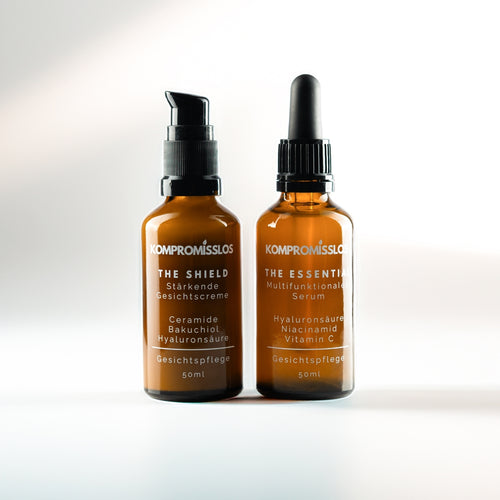
For our own product, this has a very practical side: The Duo, our serum and face cream, is developed and made in Switzerland, sold only in Switzerland and Liechtenstein and paid for in francs. If you want to return it, our 100-day return policy applies: you let us know by email within 100 days and get the full amount back, including the shipping costs you paid, to your original payment method. The return postage is on you.
Before you pay, work out the value of the goods including shipping in francs. If it is just over 63 francs, it is often cheaper to leave one product out or to deliberately order enough for the fee to be spread over more goods.
I deliberately sell Kompromisslos only in Switzerland and Liechtenstein, with prices in francs. The Duo is developed and made in Switzerland. For you, that means no import, no customs clearance fee and no card from the courier through your door. But I will be honest too: a German product can still work out cheaper despite all the fees. If you have one that works for your skin, there is no need to switch because of this. What I can influence is the number of parcels. Two products instead of eight means fewer orders and fewer items that would add up on an order from abroad. How long the serum and cream last together is explained in the instructions for use: two to four months, depending on how much you use.
Frequently asked questions
Do I have to pay anything on an order under 60 francs?
No, apart from the shop’s shipping costs. As long as the import VAT is no more than 5 francs, it is not charged. According to Swiss Post, a parcel only becomes liable to charges at the 8.1 per cent rate from a value of 63 francs including shipping. Below that, Swiss Post does not bill you anything, which means no customs clearance fee either.
Why is the postman charging fees for my parcel from Germany?
Because Swiss Post clears your parcel through customs and passes two items on to you: import VAT of 8.1 per cent, which goes to the federal government, and its own customs clearance fee of 13 francs plus 3 per cent of the value of the goods. Since 2024, there has been no customs duty on cosmetics. If you pay the import costs online, you save 1.50 francs on the basic fee.
Can I get the German VAT back?
When you buy online, usually indirectly: if the shop delivers to Switzerland itself, this counts as a tax-exempt export, and some shops then show the price without German VAT. If you buy in a shop in Germany, the shop needs proof of export. The purchase must come to more than 50 euros including VAT, and the goods must leave the country before the end of the third month after the month of purchase. Whether the shop refunds the VAT is up to the shop.
Can I bring cosmetics from Germany across the border by car?
Yes. For travellers, there is a value allowance of 150 francs per person per day, and there is no customs duty on cosmetics. If the total value exceeds 150 francs, the ordinance makes the entire amount taxable, not just the part above the limit. You declare these goods when you cross the border, for example with the FOCBS’s QuickZoll app.
Are cosmetics from Germany the same as those sold in Switzerland?
Often yes, but you cannot rely on it. Manufacturers can formulate and package products differently for individual markets, even if the product name stays the same. The only way to be sure is to compare the ingredient lists of both versions. The guide on how to read an ingredient list shows you how.
Who pays the postage if I send something back to Germany?
That is set out in the shop’s terms. A free returns label does not automatically apply to parcels from Switzerland as well. If the returns policy says nothing about other countries, ask before you send anything back. If the price advantage is slim, it is best to factor in the return postage before you order.
Do I have to pay customs on The Duo, and how do returns work?
No. The Duo is developed and made in Switzerland and sold only in Switzerland and Liechtenstein, so there is no import and no customs clearance fee. To return it, let us know by email within 100 days and you will get the full amount back, including the shipping costs you paid; the return postage is on you. You will find everything about the product on the page for The Duo serum and cream.
Sources
- Bundesamt für Zoll und Grenzsicherheit BAZG. Aufhebung Industriezölle (in force since 1 January 2024, chapters 25 to 97 of the customs tariff). Accessed 7 October 2026. Source
- Die Schweizerische Post. FAQ Import: Zoll und MWST (liability to charges, service fees, value enquiries, customs documents). Accessed 7 October 2026. Source
- Eidgenössisches Finanzdepartement EFD. Verordnung über die steuerbefreite Einfuhr von Gegenständen in kleinen Mengen, von unbedeutendem Wert oder mit geringfügigem Steuerbetrag (SR 641.204), Art. 1 and 2, as of 1 January 2025. Source
- Bundesgesetz über die Mehrwertsteuer (Mehrwertsteuergesetz, MWSTG, SR 641.20), Art. 54 and 60, as of 31 March 2025. Source
- Bundesrepublik Deutschland. Umsatzsteuergesetz (UStG), § 4 No. 1(a), § 6(3a) and § 12(1). Accessed 7 October 2026. Source