Korean skincare in Switzerland: where to buy it and what to look out for
BUYING AND BRANDS
The easiest way to buy Korean skincare in Switzerland is from Swiss online shops with stock held in the country and from a handful of shops in larger cities. If you order directly from Korea, import tax applies from a consignment value of around CHF 62, plus a customs clearance fee. You should also check whether the labelling complies with Swiss regulations.
Where can you buy Korean skincare in Switzerland?
You can buy Korean skincare in Switzerland in three ways: from Swiss online shops with a warehouse in the country, from individual shops and concept stores in larger cities such as Zurich, and by importing directly from Korea or from a shop in the EU. Buying within Switzerland is the most straightforward route, because there are no import charges and returns are handled under Swiss conditions. The same checks apply, incidentally, when you buy vegan cosmetics in Switzerland. Buying in a shop has the advantage that you can judge the texture and scent before you buy, but the selection is much smaller and the range changes often. Importing directly gives you the widest choice, but costs time, fees and patience. If you reorder regularly rather than trying something once, buying within Switzerland almost always works out better, because the extra costs add up again with every order.
| Where to buy | Delivery time | Extra costs | Returns |
|---|---|---|---|
| Swiss online shop with stock in Switzerland | Domestic delivery, usually a few working days | No import tax, no customs clearance fee | Returns under Swiss conditions |
| Shop, for example in Zurich | Available immediately | No additional charges | Exchange possible in store |
| Online shop in the EU | Several working days plus customs clearance | Import tax from a consignment value of around CHF 62, plus customs clearance fee | Returns abroad usually at your own expense |
| Ordering directly from Korea | Often several weeks | Import tax plus a CHF 16 basic fee and a 3 per cent surcharge on the value of the goods | Returns are complicated and expensive |
What should you watch out for when importing directly from Korea?
When you import directly from Korea, you pay import tax and a customs clearance fee on top of the product price. According to the Federal Office for Customs and Border Security (FOCBS), tax amounts of up to five francs are not collected, which at the standard rate of 8.1 per cent corresponds to a consignment value of around CHF 62 including delivery costs. Above that, import tax is due. For consignments from countries outside the EU, Swiss Post also charges a basic fee of CHF 16 plus 3 per cent of the declared value of the goods. For goods worth CHF 100, that means a CHF 16 basic fee, a CHF 3 surcharge and the import tax on top. So always calculate with the consignment value including delivery costs, not the product price alone. On top of that come long delivery times, parcels held up at customs, and a right of return that barely exists in practice, because sending something back to Asia usually costs more than the product itself. Once a parcel has been held for inspection, there is nothing you can do to speed it up.
How is labelling different in Switzerland?
Swiss labelling requires information that is often missing from an original pack from Korea. Cosmetics are classed here as utility articles and fall under food legislation. That is why the pack must show, among other things, the responsible person with their address, the contents, the shelf life, the complete list of ingredients in INCI nomenclature, and warnings in an official language. There is also a hard limit on content: according to the Federal Food Safety and Veterinary Office (FSVO), the only colourants, preservatives and UV filters permitted are those listed in Annexes IV, V and VI of the European Cosmetics Regulation, to which Swiss law refers. This is where the most common stumbling block lies: some Korean sun care products use UV filters that are not on these annexes. Such a product is therefore not intended for the Swiss market, even if it is sold perfectly legally on the shelves in its country of origin.
For you, this means two things. Without a legible list of ingredients, you cannot check whether a product contains a substance your skin has reacted badly to before. And without a responsible person with an address in Switzerland, you have no one to contact if you have a complaint.
Which K-beauty ingredients can you also get locally?
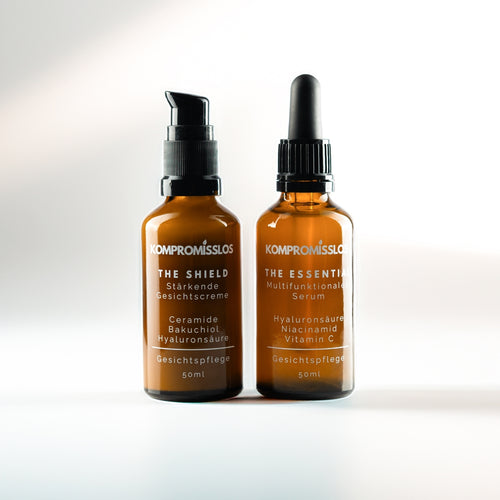
The best-known K-beauty ingredients have long ceased to be exclusively Korean. You will find niacinamide, hyaluronic acid, ceramides, panthenol and stable forms of vitamin C in Swiss formulas too. The raw materials themselves are standard goods traded internationally, not a mark of origin. The Duo of The Essential serum and The Shield cream, for example, contains 5% niacinamide, 2% hyaluronic acid, 2% vitamin C as 3-O-ethyl ascorbic acid, 1% zinc and 0.3% bakuchiol, together with ceramides, squalane, panthenol and aloe vera. All percentages apply to the Duo as a whole, not to either product on its own. The difference between markets rarely lies in the active ingredient and almost always in two other things: whether a concentration is stated at all, and whether you can read the list of ingredients in a language you understand. Our complete list of ingredients is publicly available, including the ingredients without a stated percentage, such as ceramides and jojoba oil.
One customer wrote to tell us that she had ordered a set directly from a Korean online shop and, on unpacking it, found two things she had not expected: a bill for customs clearance and a pack whose information she could not read. She wanted to know whether a particular ingredient that her skin had reacted to in the past was also in our products. We were able to send her the complete list straight back, because it is openly available anyway. That is exactly what buying within Switzerland is about. Not better active ingredients, but being able to see what you are getting.
When is a Swiss alternative worth it, and when is it not?
A Swiss alternative is worthwhile if transparency, short delivery routes and a genuine right of return matter more to you than the widest possible choice of products. Switching makes little sense, on the other hand, if you are attached to a very specific texture, such as a particular essence or a sunscreen with a finish you have not come across anywhere else. Then switching is not progress, just a swap. It clearly makes sense if your routine has grown to six or eight steps over the years and your skin is still unsettled. We have broken down separately what all those steps actually achieve: what the 10-step routine does and does not deliver. In that case, a pared-back routine of serum and cream is often the more effective lever than yet another product. The criteria that count when comparing local brands are set out in our overview of natural skincare from Switzerland.
When should your skin be seen by a professional?
Your skin should be seen by a professional as soon as the issue goes beyond skincare. Persistent redness with pustules, weeping or flaking patches, sudden swelling, a mole that changes, or a reaction that does not subside after you stop using a product are all reasons to book an appointment with a dermatologist. This applies wherever a product comes from. Cosmetics care for the skin and support the skin barrier; they do not replace a diagnosis. With a direct import there is also a practical point: if you cannot say for certain what was in a product, finding the cause becomes more difficult. So keep the packaging and order confirmation until you know that your skin tolerates the product well. If you are prone to sensitive skin, it is better to introduce new products one at a time and wait in between. How others have found the switch is described in the reviews from our customers.
I deliberately created two products for Kompromisslos rather than a multi-step routine, even though the trend pointed the other way for years. The reason is simple: the more steps there are, the harder it is to work out which one is upsetting your skin. And I decided to state the concentrations openly, even if 0.3% bakuchiol sounds like very little. I would rather give you a figure you can check than a promise that sounds good. The people who write to us most often are those coming from a long routine who no longer know which product does what. For them, the Duo is the alternative.
Frequently asked questions
Where is the best place to buy Korean skincare in Switzerland?
The most straightforward option is a retailer with stock in Switzerland, because there is no import tax or customs clearance fee and returns are handled within the country. If you search for korean skincare switzerland, on the other hand, you often end up with international sellers whose extra costs only become apparent when the parcel arrives.
Can you buy Korean skincare in a shop in Zurich?
Yes, in Zurich and other larger Swiss cities, some concept stores, perfumeries and Asian supermarkets stock K-beauty products. The selection is smaller than online, but you can see the texture, scent and pack information before you buy. Call ahead, because the range changes frequently and is rarely shown in full online.
Is it worth ordering directly from Korea?
Rarely. From a consignment value of around CHF 62 including delivery, import tax is added, and for consignments from outside the EU, Swiss Post also charges a CHF 16 basic fee and a 3 per cent surcharge on the value of the goods. On top of that come weeks of delivery time and a return that usually costs more than the product itself.
Is K-beauty allowed in Switzerland?
Cosmetics from Korea may be sold in Switzerland if they meet Swiss requirements. These include labelling with the responsible person, contents, shelf life and INCI list, as well as the restrictions on colourants, preservatives and UV filters. If this information is missing from a pack, the product is not intended for the Swiss market.
Are Korean sunscreens approved in Switzerland?
Only if their UV filters are listed in Annex VI of the European Cosmetics Regulation, to which Swiss law refers. Some Korean formulas use filters that are not on that list. Such products are not intended for the Swiss market, even if they are sold legally in their country of origin.
Do I really need ten steps for K-beauty in Switzerland?
No. The number of steps says nothing about the result. What matters is cleansing, moisture, active ingredients and protection, and these can be covered with just a few products. Many steps also make troubleshooting harder when your skin reacts, because you can no longer tell which product was the trigger.