Natural skincare in Switzerland: what to look for when you buy
NATURAL SKINCARE IN SWITZERLAND
Natural skincare in Switzerland is not a protected term. That is why three things matter: the full ingredient list on the packaging, traceable concentrations of active ingredients rather than just their names, and a retailer based in Switzerland with clear delivery terms and a right of return. Certification labels such as NATRUE or COSMOS help you put a product in context, but they are no substitute for looking at the back of the pack.
What defines natural skincare in Switzerland?
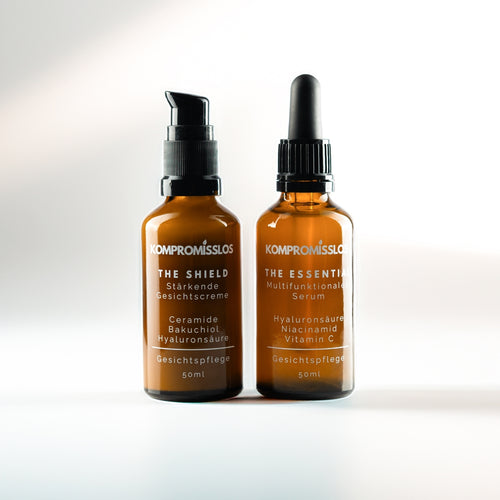
Natural skincare has no legal definition in Switzerland, so there is no official rule on when a cream may call itself natural. What is regulated is safety and labelling: among other things, the Swiss Ordinance on Cosmetic Products (VKos) requires the full composition to be listed on the packaging in descending order of quantity. This list is your most important source of information – more important than any word on the front. In practice, natural skincare means products that rely mainly on plant and mineral raw materials and avoid silicones, mineral oils and synthetic fragrances. How strictly a manufacturer interprets this is up to them, as long as they do not mislead. That is exactly why it pays to look at the back rather than at the advertising. We list every concentration openly on the page for our Duo of serum and cream. You can read exactly what is in it and why in the overview of our ingredients.
What to look for in a natural face cream from Switzerland
With a natural face cream from Switzerland, first check whether the active ingredients it mentions are listed with a concentration. An active ingredient on the packaging says little on its own, because it may be present in an amount that does nothing for your skin. If a percentage is given, on the other hand, you can compare. Second, the position in the ingredient list helps: whatever comes far down the list is only present in small amounts. Third, the length of the list counts. Lots of plant extracts in one formula look good, but for sensitive skin they increase the likelihood that one component will not be tolerated. And fourth: a fragrance that is not advertised still exists. Parfum appears as a separate entry in the list, even if it is of natural origin. For comparison, you will find our serum and cream with their percentages disclosed.
| Claim on the pack | What it actually tells you | What to look for |
|---|---|---|
| With organic extracts | At least one raw material is certified; the rest need not be. | Whether the extract is near the start or the end of the list. |
| Dermatologically tested | Tolerance was tested, not effectiveness. | Whether any claim about effects is backed up as well. |
| Free from silicones and parabens | A statement about what is missing, not about what works. | Which active ingredients are included instead. |
| Swiss Made | A defined share of the manufacturing costs is incurred in Switzerland. | Whether this means manufacturing or just filling. |
| With hyaluronic acid | Hyaluronic acid is included, in an unknown amount. | Whether a percentage is given. |
How vegan natural skincare differs from organic skincare
Vegan natural skincare avoids animal-derived raw materials entirely, whereas organic skincare avoids conventional farming. These are two different promises that can overlap, but do not have to. A certified organic cream may contain beeswax, honey or lanolin and is then not vegan. Conversely, a vegan product can use raw materials from conventional farming. The two claims appear separately on the packaging, so an organic label is no substitute for a vegan label, and vice versa. You can recognise the most common animal-derived ingredients in skincare by a handful of names: Cera Alba for beeswax, Mel for honey, lanolin from sheep’s wool, Carmine as a red dye made from scale insects, and collagen of animal origin. If both matter to you, you therefore need both claims, not just one. We have opted for purely plant-based and synthetically produced raw materials – including squalane from plant sources rather than from shark liver, as used to be common.
Buying natural skincare online in Switzerland: what matters in a shop
When you buy natural skincare online in Switzerland, what matters most is where the retailer is based. If you order from a shop abroad, customs clearance, VAT and a longer delivery time may be added depending on the value, and returning something becomes a hassle. A retailer based in Switzerland spares you all that, and if in doubt, the price advantage from abroad will cost you more time than it is worth. Also check whether delivery time, delivery costs and the return period are clearly stated on the site before you buy, rather than hidden in the small print. Look at the payment options too: Twint is widely used in Switzerland, and it also shows you whether a shop is genuinely geared to the Swiss market. A right of return matters more with skincare than with other purchases, because it takes a few weeks to find out whether your skin gets on with a formula. And read reviews for their content rather than their average score, as you can see in our customer reviews.
Our key facts, for comparison: delivery CHF 3.70, free on orders over CHF 60, delivery time 1 to 3 working days within Switzerland and Liechtenstein, 100-day right of return, payment by Twint, credit card, Apple Pay or Klarna.
How many products do you really need?
For most skin types, two products designed to work together – a serum and a cream – are enough. The reason is simple: the more formulas you combine, the harder it becomes to tell which of them is good for your skin and which is not. If you apply five layers in the morning and your skin reacts, you have five suspects. With two products, you have two. On top of that, active ingredients add up. If you use vitamin C in your serum, your cream and an ampoule, you quickly end up at a concentration that sensitive skin no longer likes. It makes more sense to judge one combination over several weeks. Two products also make your routine easier to live with, because you can keep it up even on busy days. Our article on vitamin C or niacinamide explains which active ingredients complement each other. You will find amounts, order and timing on our how-to-use page.
When natural skincare is not the right choice
Natural skincare is care, not therapy, and that is exactly where the line is. If your skin stays very red for a long time, weeps, flakes or hurts, or if patches change, that belongs with a dermatologist, not on a skincare shelf. The same applies to pronounced, inflamed skin changes and to anything that appears suddenly with no obvious trigger. Skincare may influence the appearance of your skin; it does not treat any condition, and any product that promises you otherwise crosses a line. A professional can also tell within a few minutes whether skincare is the right approach at all. If you have known allergies, caution is worthwhile too: a test on the inside of your elbow over two to three days costs you little and may spare you an unpleasant week. In our article on blemish-prone skin, we explain what helps with mild blemishes and where skincare reaches its limits.
I launched Kompromisslos with exactly two products, even though everyone told me a range needs choice. The reason was a very practical experience: for years, I had bought products that had an active ingredient in large letters on the front and its concentration nowhere. So I turned that around and disclosed the figures. Together, the serum and cream in the Duo contain 5% niacinamide, 2% hyaluronic acid, 2% vitamin C as 3-O-ethyl ascorbic acid and 0.3% bakuchiol, plus edelweiss extract and gentian root extract at 2% each. You do not have to take my word for it that this is good. You can do the maths and compare – and I prefer that to any promise.
Frequently asked questions
Is natural skincare a protected term in Switzerland?
No. There is no legal definition of natural skincare in Switzerland. Safety and labelling are regulated, not the term itself. Private certification labels such as NATRUE or COSMOS set their own criteria and so create a degree of comparability. Without a label, the ingredient list on the packaging remains your most reliable guide.
Is natural skincare automatically vegan?
No. Natural skincare may contain animal-derived raw materials such as beeswax, honey, lanolin or carmine. Vegan means that none of these raw materials is used. If both matter to you, look for two separate claims, because an organic label on its own says nothing about whether a product is vegan.
How can I tell if natural skincare is from Switzerland?
By the responsible person named on the packaging, who must have a Swiss address if the product is sold exclusively here. Swiss Made refers to a defined share of the manufacturing costs being incurred in Switzerland. So if origin matters to you, check whether it is the manufacturing or just the filling that takes place in Switzerland.
Is natural skincare without a certification label worse?
Not necessarily. Certification costs money and time, which is why some smaller brands do without it even though they would meet the criteria. A label saves you research, but it is no substitute for an ingredient list. Conversely, a label says nothing about whether the active ingredients are dosed high enough.
Is natural skincare better for sensitive skin?
Not as a rule. Plant-based raw materials are not automatically better tolerated; essential oils and fragrances of natural origin are in fact among the more common triggers of reactions. For sensitive skin, what matters is less where the raw materials come from than a short, fragrance-free ingredient list and a test on the inside of your elbow before you use a product for the first time.
How long does natural skincare keep once opened?
The open-jar symbol on the packaging gives the period after opening, usually 6 to 12 months. Products with few or mild preservatives are more sensitive to heat and light. Store them somewhere cool and dry, and do not dip your fingers into open jars – use pump dispensers instead.
How much does good natural skincare cost in Switzerland?
The price on its own says little about quality; what matters is the price per application. Work out the bottle price against how long it lasts. Our Duo of serum and cream costs CHF 109.90 and lasts 2 to 4 months depending on how often you use it, which makes comparing it with other products fairer.
Sources
- Eidgenössisches Departement des Innern (Federal Department of Home Affairs, FDHA), Verordnung des EDI über kosmetische Mittel (VKos) [Swiss Ordinance on Cosmetic Products], SR 817.023.31. Source