CBD face cream: what CBD and hemp seed oil can do and what Swiss rules allow
ACTIVE INGREDIENTS
A CBD face cream is legal in Switzerland as long as its THC content stays below 1.0 per cent and it is not advertised as having a healing effect. The evidence for what CBD actually does on the skin, however, is thin: lab experiments show effects on sebaceous gland cells, but good studies of CBD facial skincare in humans are largely missing. Hemp seed oil is something else entirely – a skincare oil rich in linoleic acid with practically no CBD. So what counts is what the INCI list says and in what amount, not the hemp leaf on the packaging.
What is the difference between CBD, hemp extract and hemp seed oil?
CBD, hemp extract and hemp seed oil come from the same plant, but in skincare they are three different raw materials. CBD, short for cannabidiol, is a single cannabinoid found mainly in the flowers and leaves of the hemp plant. In cosmetics, it is either added as a pure substance or contained in an extract. A hemp extract is made from the leaves or flowers and, depending on how it is produced, contains CBD, other cannabinoids and further plant compounds – in varying amounts. Hemp seed oil, on the other hand, is pressed from the seeds. The seeds naturally contain no more than traces of cannabinoids, which is why hemp seed oil is a skincare oil like sunflower or jojoba oil, not a CBD product.
This is exactly where most of the confusion on the shelf comes from. A cream with ‘hemp’ or ‘cannabis’ in its name may contain CBD, only seed oil, or both. The green leaf on the packaging will not tell you which – the ingredient list will.
| Raw material | INCI name | Contains CBD | Role in skincare |
|---|---|---|---|
| Isolated CBD | Cannabidiol | Yes, as a pure substance | Active ingredient, little studied on the skin |
| Hemp extract from leaves or flowers | Cannabis Sativa Leaf Extract | Depends on the extract, amount rarely stated | Mix of active compounds with a variable composition |
| Hemp seed oil | Cannabis Sativa Seed Oil | No, traces at most | Skincare oil rich in linoleic acid |
What can a CBD face cream really do, according to studies?
Based on current research, very little has been proven for CBD face cream: there are interesting lab findings, but hardly any meaningful studies in humans. The most frequently cited paper comes from the lab: a study in the Journal of Clinical Investigation showed that CBD slowed sebum production and dampened inflammatory signalling pathways in cultured human sebaceous gland cells and in skin samples. That is an interesting mechanism. But a cell culture is not facial skin, and a lab experiment cannot tell you what a finished cream with an unknown amount of CBD does once you apply it.
Closer to real life is a systematic review and meta-analysis published in Frontiers in Pharmacology in 2025. It analysed 17 studies with a total of 3,359 participants in which cannabinoids and cannabis extracts were used for skin conditions. The only statistically significant result was a small reduction in itching. For dry skin, redness and water loss through the skin, the authors found no significant effect, and they call for larger, standardised studies. Put honestly, this means that, as far as we know today, CBD is not an active ingredient that can replace proven building blocks such as niacinamide, ceramides or humectants. If you are hoping a CBD cream will make your skin noticeably calmer, what you are mainly buying is hope.
What does hemp seed oil do for the skin?
What hemp seed oil mainly gives your skin is lipids: it is a light, quickly absorbed skincare oil with a high proportion of polyunsaturated fatty acids, above all linoleic acid. Linoleic acid is a building block of certain barrier lipids in the skin, which is why an oil rich in linoleic acid suits skin that feels dry or rough. Beyond that, though, hemp seed oil is simply a solid skincare oil – it has practically nothing to do with CBD.
There are hardly any studies on hemp seed applied to the skin. In a study in the Pakistan Journal of Pharmaceutical Sciences, healthy men applied a cream with 3% hemp seed extract to one cheek and a base cream without active ingredients to the other, twice a day for twelve weeks. On the side treated with the extract, sebum and redness values fell significantly more, and the cream was well tolerated. This is a single study using an extract, not the pure oil, and its results cannot simply be applied to every hemp product. As for whether hemp seed oil clogs pores: it is generally considered a light oil, but whether it triggers breakouts for you depends on the formulation and your skin. How much such lists are actually worth is explained in the article on what comedogenic means and which oils really are a problem.
Because of its high content of unsaturated fatty acids, hemp seed oil goes rancid quickly. Buy small bottles, store them somewhere cool and dark, and use them up promptly. If the oil smells musty or like paint, it no longer belongs on your face.
Whether a pure oil actually fills a gap in your routine or just adds another step depends on what you already use. The article on serum or face oil and what your skin actually needs weighs this up in detail.
Is CBD allowed in cosmetics in Switzerland, and what are the rules on THC content?
Yes, CBD is allowed in cosmetics in Switzerland, but only under strict conditions. The Federal Food Safety and Veterinary Office (FSVO) states that cosmetics must not contain narcotics. CBD is not considered a narcotic because, unlike THC, it is not intoxicating. The decisive factor is the THC content: if it is 1.0 per cent or higher, the product is classified as a narcotic. A CBD cream is therefore only permitted if its THC content stays below that threshold.
On safety, the FSVO follows a scientific opinion issued by the EU Scientific Committee on Consumer Safety (SCCS) in March 2026. According to this opinion, CBD in cosmetics is considered safe up to a concentration of 0.19%, and THC impurities up to 0.00025%. The FSVO points out that these values are not a legally binding limit, but anyone who exceeds them has to justify this in the safety report. Two further points matter to you as a buyer. First, cosmetics in Switzerland may not be advertised as having a therapeutic effect. Second, the FSVO advises against highly concentrated CBD oils sold as oral care products, because they resemble medicinal products and the dose is hard to control. CBD drops taken by mouth and CBD medicines are not the subject here: according to joint enforcement guidance from Swissmedic, the Federal Office of Public Health (FOPH) and the FSVO, Swissmedic is responsible for medicinal products, and the FSVO for food and cosmetics.
How can you tell from the INCI list how much hemp is really in a product?
On the INCI list, you can recognise hemp by its Latin names, but its position only gives you a rough idea of the amount. These are the most important names:
- Cannabidiol: isolated CBD, and the only name that clearly indicates added CBD.
- Cannabis Sativa Leaf Extract or Cannabis Sativa Flower/Leaf/Stem Extract: an extract from the leaves, flowers or stems that may contain CBD, but does not have to.
- Cannabis Sativa Seed Oil: hemp seed oil, a skincare oil with no significant CBD content.
- Cannabis Sativa Seed Extract: an extract from the seeds, which is not a source of CBD either.
The main ingredients are listed in descending order of quantity, while very small amounts may follow at the end in any order. Because cosmetics only use CBD in small amounts, it often appears far down the list, so its position alone tells you little. Many brands state the milligrams per pack instead. Do the maths: 50 mg of CBD in 50 ml of cream works out at roughly 0.1%. If neither a percentage nor a milligram figure is given, you simply do not know how much is in it. How to make sense of the rest of the list is covered in the article on how to read an ingredient list.
Who is CBD skincare worth it for, and when are you just paying for the hemp leaf on the packaging?
CBD skincare is most likely to be worth it if you are curious, your basic routine already works and you can find the amount stated on the pack. It is no substitute for a well-thought-out foundation, because its effect on the skin is not well enough documented. You are paying for the hemp leaf alone if a product promotes CBD prominently but does not state a concentration, if it only contains hemp seed oil yet still implies ‘CBD’, or if it is advertised with claims such as soothing skin conditions. So check these points in this order:
- Does the INCI list say Cannabidiol, or only Cannabis Sativa Seed Oil?
- Is the amount of CBD declared as a percentage or in milligrams?
- Alongside CBD, does the list include proven skincare ingredients with a clear role?
- Does the advertising promise an effect on medical conditions? If so, be cautious.
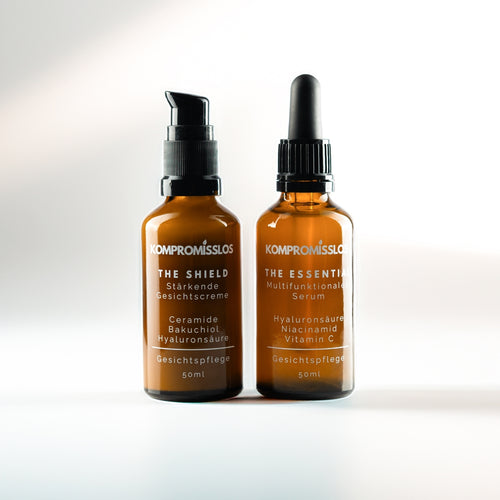
The same questions help elsewhere too, for instance when you want to know what to look for when buying natural skincare in Switzerland or what the term clean beauty really promises. To be honest about our own product: The Duo contains neither CBD nor hemp seed oil. The lipid and skincare role that hemp cosmetics promise is covered there by disclosed ingredients: ceramide NP, squalane and jojoba oil in The Shield, panthenol and 5% niacinamide in the Duo, and aloe vera as the base of both products. If a declared concentration matters more to you than a trendy ingredient, you will find the details directly on The Duo with serum and cream. In her review on Judge.me, Barbara describes how two products can be enough: ‘I think it’s lovely to achieve that with just 2 little bottles’ (review translated from German).
You will not find hemp on The Duo’s INCI list, and I am not going to pretend otherwise. With trendy ingredients, one question matters more to me than any other: how much is actually in it? That is why our main active ingredients are listed with a number – 5% niacinamide, 2% vitamin C as 3-O-Ethyl Ascorbic Acid and 1% zinc PCA, calculated for The Duo as a whole. For other ingredients such as ceramides, bakuchiol or squalane, I do not give percentages, and I say so openly. For me, two products instead of eight means not putting an ingredient on the label just because people happen to be searching for it. And no cream replaces having your skin assessed by a professional. You can find all active ingredients with their disclosed concentrations in one place.
Frequently asked questions
Can a CBD cream get you high or show up on a drug test?
A CBD cream will not get you high, because according to the FSVO, CBD has no intoxicating effect. Drug tests look for THC, not CBD. Since CBD cosmetics in Switzerland are allowed to contain THC as long as the content stays below 1.0 per cent, a residual risk cannot be ruled out entirely. If you are tested, ask the seller for a lab analysis of the THC content, or give it a miss to be on the safe side.
How much CBD should a face cream contain?
There is no scientifically proven ideal amount, because good efficacy studies are lacking. As a safety benchmark, the EU committee SCCS, on which the FSVO bases its position, gives concentrations of up to 0.19%. Products with higher amounts are not automatically banned, but they have to justify their safety. More important than a high figure is that an amount is declared at all.
Is hemp seed oil comedogenic?
Hemp seed oil is generally considered a light oil that rarely clogs pores, but that is no guarantee. Whether an oil encourages breakouts for you depends on the finished formulation, the amount and your skin. Test a new oil on its own for a few weeks before changing any other products – that way, you can clearly identify the trigger.
Does CBD cream help with acne, rosacea or atopic eczema?
That has not been proven. Lab experiments and early studies are interesting, but a review found only a small effect on itching. Acne, rosacea and atopic eczema are skin conditions, and diagnosis and treatment belong with a dermatologist. What skincare can do alongside that is explained in the article on rosacea skincare and when to see a dermatologist.
Can CBD skincare be advertised as soothing or anti-inflammatory?
In Switzerland, cosmetics may not be advertised as having a therapeutic effect, and that applies to CBD products too. According to the enforcement guidance from Swissmedic, the FOPH and the FSVO, any reference to healing, alleviating or preventing diseases is prohibited. Statements such as ‘nourishes’ or ‘skin feels calmer’, on the other hand, describe how the skin feels. The more medical the advertising sounds, the more sceptical you are entitled to be.
Can I put CBD oil meant for oral use on my face?
That is not advisable. CBD drops are not formulated as facial skincare, their concentration is often high and the carrier oils do not necessarily suit your skin. Many of these oils are sold in Switzerland as oral care products; the FSVO advises against them and states that many are marketed illegally. For your face, a cosmetic product with a declared amount is the cleaner choice.
Do I need CBD skincare if I use The Duo?
No, you do not need any additional CBD. With its serum and cream, The Duo covers hydration, barrier care and the main active ingredients with disclosed concentrations. If you like hemp seed oil, you can try it on very dry patches. But your foundation remains the Duo of serum and face cream, morning and evening.
Sources
- Bundesamt für Lebensmittelsicherheit und Veterinärwesen BLV. Cannabidiol (CBD) in Kosmetika. blv.admin.ch, abgerufen 2026. Source
- Oláh A, Tóth BI, Borbíró I, Sugawara K, Szöllõsi AG, Czifra G, et al. Cannabidiol exerts sebostatic and antiinflammatory effects on human sebocytes. Journal of Clinical Investigation, 2014. Source
- Sermsaksasithorn P, Nopsopon T, Samuthpongtorn C, Chotirosniramit K, Pongpirul K. Cannabis and cannabinoids in dermatology: a systematic review and meta-analysis of quantitative outcomes. Frontiers in Pharmacology, 2025. Source
- Ali A, Akhtar N. The safety and efficacy of 3% Cannabis seeds extract cream for reduction of human cheek skin sebum and erythema content. Pakistan Journal of Pharmaceutical Sciences, 2015. Source
- Fachgremium für Abgrenzungsfragen (Swissmedic, BAG, BLV, KAV, VKCS). Produkte mit Cannabidiol (CBD) und anderen Cannabinoiden, die nicht dem Betäubungsmittelrecht unterliegen: Überblick und Vollzugshilfe, Version 8.0. blv.admin.ch, 2025. Source