Skincare shelf life after opening: what the jar symbol means and how to tell a cream has gone off
ROUTINE
Skincare shelf life after opening is shown by the open jar symbol on the pack: ‘6M’ or ‘12M’ stands for the number of months you can safely use the product from the day you first open it. For an unopened pack, the printed best-before date applies. Under the Swiss Ordinance on Cosmetic Products, that date may only be left off if the product keeps for longer than 30 months. If a cream smells, looks or feels different, it belongs in the bin, even if the time limit has not yet run out.
How long does skincare last after opening?
After opening, skincare lasts as long as the jar symbol on the packaging says, counted from the day you first open the product. There is no single time limit for all creams, because the manufacturer sets it separately for each formula. Three things come together here: how well the preservative system keeps germs at bay, how sensitive the active ingredients are to air and light, and how well the packaging shields the contents. Opening adds two factors that do not exist in a sealed pack: oxygen and your fingers. Both come into play from day one. Whether it says 6, 12 or 24 months, the number only tells you how long the product stays safe under normal conditions, not how long it will take you to use it up.
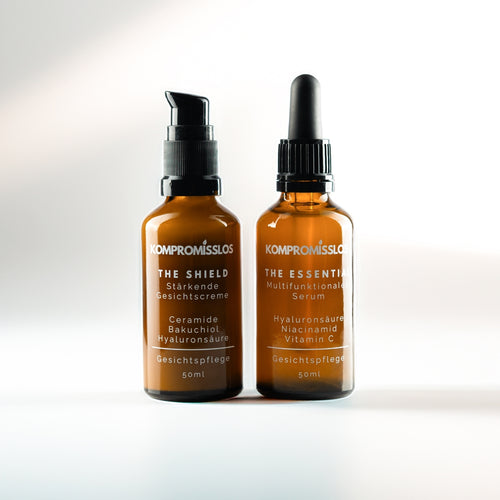
That is why it is worth comparing this with how long a pack actually lasts you. A pack you finish in three months never comes anywhere near a twelve-month limit, whereas a cream you only bring out on special occasions may well do. How to work out usage for your own dosage is explained in the article on how long 50 ml of face cream lasts. The Duo of serum and face cream lasts 2 to 4 months depending on use, or around 2 months if you use both products twice a day. The period after opening itself is shown by the jar symbol on the pack.
What does the jar symbol with ‘6M’ or ‘12M’ mean?
The jar symbol with ‘6M’ or ‘12M’ means that you can safely use the product for 6 or 12 months respectively after first opening it. The technical term is PAO, short for period after opening. In Switzerland, the Ordinance on Cosmetic Products issued by the Federal Department of Home Affairs sets out when it is required: if the minimum shelf life is more than 30 months, no date has to appear on the pack. Instead, the manufacturer uses the jar symbol to state how long the product remains safe after opening and can be used without causing harm. If a product has a shorter shelf life, it carries a best-before date with an hourglass symbol or the words ‘best before’. The two details therefore answer different questions: the date tells you how long the product will do its job if stored properly, the jar symbol how long it stays safe once opened. Since hardly anyone remembers when they opened something, a simple trick helps: when you first open a product, write the month and year on the bottom of the pack with a waterproof marker.
| Symbol or label | Meaning | What to look out for |
|---|---|---|
| Open jar with ‘6M’, ‘12M’ or ‘24M’ | Shelf life after opening, in months | The time limit starts when you first open the product |
| Hourglass with a date, or ‘best before’ | Best-before date | Applies if stored properly, including to unopened packs |
| Open book with a hand | Further information is enclosed with or attached to the product | Read the leaflet or tag |
| Storage instruction, such as ‘store in a cool place’ | Condition under which the shelf life applies | Without this storage, the time limit no longer applies |
Can you still use a cream past its expiry date?
You should not use a cream past its expiry date, even if it still looks normal. Once the time limit has passed, the manufacturer no longer guarantees that the preservative system will reliably keep everyday germs in check or that the active ingredients will still do what they are there for. A study in the Journal of Applied Microbiology shows that germs in opened cosmetics are not a theoretical risk: around 79 to 90 per cent of used lipsticks, lip glosses, eyeliners, mascaras and make-up sponges were contaminated with bacteria, including Staphylococcus aureus and Escherichia coli. The authors therefore call for shelf-life information to be clearly visible and for consumers to recognise the symbols on the packaging. A survey in the International Journal of Cosmetic Science shows how common it is to carry on using products regardless: 43 of the 44 female students surveyed, or 97.9 per cent, said they had used make-up after it had expired. Both studies concern make-up, not face cream. But the principle is the same: every time you take some out, something gets carried in, and once the time limit has run out, there is no guarantee that the formula can cope with it.
The time limit is not a cut-off date after which everything goes bad, but a period the manufacturer stands behind. If a product changes before then, trust what you smell and see, not the symbol.
How can you tell that a cream has gone off?
You can tell that a cream has gone off by its smell, colour and texture, and by how your skin reacts to it. One clear sign is enough reason to throw the product away. With fragrance-free skincare, smell is particularly telling, because there is no scent to mask any change. What matters is not whether you like the natural smell of the raw ingredients, but whether it changes within the same pack.
- Smell: sour, rancid or musty, or noticeably different from when you opened it.
- Colour: yellowish or brownish discolouration, or dark edges around the opening.
- Texture: water and oil separate, or the cream turns grainy, lumpy or suddenly runny.
- Anything visible: spots, patches or a film on the surface. In that case, throw it out straight away.
- Skin reaction: burning, itching or redness from a product your skin has tolerated well until now.
With pure oils, a rancid smell is usually the first sign, because the fats react with oxygen. How long pure jojoba oil keeps after opening is covered in the article on jojoba oil for your face.
Does natural skincare have a shorter shelf life?
Natural skincare does not automatically have a shorter shelf life; what matters is the preservative system and whether the product contains water. Any formula with water in it needs a system that keeps germs in check after opening, whether or not the label says natural. The same applies to a homemade face cream. It is mainly water-free products such as pure oils or balms that can do without added preservatives. With these, the problem is less about germs and more about the fats going rancid. On top of that, natural skincare is not a protected term. What this means when you shop is explained in the article on natural skincare in Switzerland. The article on preservatives in natural skincare explains which preservatives are used and how well tolerated they are. And the article on parabens in cosmetics explains why paraben-free simply means preserved differently, not automatically safer. So the question of how long natural skincare lasts has the same answer as for any other skincare: what counts is the jar symbol and the date on the pack, not the label.
Does skincare last longer in the fridge?
Keeping skincare in the fridge does not automatically make it last longer, and for most creams it is unnecessary. The stated time limit applies to normal storage. If a product has to be kept cool for its shelf life to hold, the Swiss Ordinance on Cosmetic Products requires this to be stated on the pack. If there is no such instruction, you do not need a fridge. Cold can slow down chemical changes, but it does not extend the time limit on the jar symbol, because germs still get into a cold cream. Some emulsions also turn firmer in the cold and are harder to spread. And if you carry a product back and forth between the fridge and a warm bathroom every day, you expose it to swings in temperature that can cause condensation to form inside the container. What matters more than cold is a stable spot: out of direct sunlight, away from radiators, with the lid closed after every use. The fridge only makes sense where the manufacturer explicitly recommends it. Which products tolerate the cold, what the cooling effect does and whether a beauty fridge is worth it is covered in the article on storing skincare in the fridge.
Jar, dropper or pump: which packaging protects active ingredients better?
The packaging that protects best is one where neither fingers nor air regularly reach the contents. This is well documented for germ contamination, much less so for the oxidation of individual active ingredients. The evidence on germs comes from an older study in Applied and Environmental Microbiology: a skin lotion without preservatives was filled into containers with three types of closure and used by volunteers in their everyday lives for two weeks. Afterwards, 71 per cent of the packs with a screw cap were contaminated with germs, compared with 39 per cent of those with a flip-top lid and 10 per cent of those with a pump. The authors conclude that the closure mainly protects weakly preserved products. Open jars and droppers were not tested. With a jar, you dip straight into the contents every time you use it. A dropper stays in the bottle, and whatever clings to it as you apply the product goes back into the bottle with it. Airless dispensers are designed so that no air flows back in when you pump. It is plausible that they measurably protect oxidation-sensitive active ingredients for longer in everyday use, but this has been studied less thoroughly than protection against germs. Packaging is also no substitute for an effective preservative system or a stable form of the active ingredient. In everyday use, what helps most is keeping the dropper off your skin, taking cream out of a jar with a clean spatula and closing bottles again straight away.
For the vitamin C in the serum, I chose 3-O-Ethyl Ascorbic Acid rather than pure ascorbic acid. The reason fits this topic: pure ascorbic acid is unstable in water-based formulas and reacts with oxygen, and every time you open the bottle, fresh oxygen reaches the liquid. The 3-O-Ethyl form is more stable, and The Duo contains 2% of it. What this decision cannot do is turn the serum into a product without a period after opening. The jar symbol on the pack applies to The Duo too, and here too, the dropper should not touch your skin. A stable form of an active ingredient is no substitute for care when you use it. You can see which active ingredients are in it, and in what concentrations, on the page with all the active ingredients and concentrations in The Duo.
Frequently asked questions
How long does unopened skincare last?
Unopened skincare lasts until the date next to the hourglass or after ‘best before’. If there is no such date, the Swiss Ordinance on Cosmetic Products requires the minimum shelf life to be over 30 months. This assumes proper storage, meaning not in full sun and not next to a radiator.
Does the period after opening also apply to serums with a dropper?
Yes, the period after opening applies to every product with a jar symbol, regardless of the packaging, and it starts the first time you unscrew the cap. With dropper bottles, a little care pays off: put the drops into the palm of your hand without the dropper touching your skin, and close the bottle again straight afterwards.
Does vitamin C lose its effect after opening?
Pure ascorbic acid can lose its effectiveness after opening, because it reacts with oxygen. A review in the Journal of Cosmetic Dermatology describes the instability of this water-soluble vitamin as a formulation problem. More stable forms such as 3-O-Ethyl Ascorbic Acid are less susceptible. How to recognise an oxidised product is explained in the article on vitamin C serum and how to spot a stable formula.
What do the hourglass and the open book on the packaging mean?
The hourglass comes before the best-before date, meaning the date until which the product will do its job if stored correctly. The open book with a hand indicates that further information can be found on a leaflet or on a tag attached to the product. Both pictograms are defined in the Swiss Ordinance on Cosmetic Products.
Can I keep skincare in the bathroom?
You can, but it is not ideal if your bathroom is often warm and humid. Heat speeds up changes in oils and active ingredients, and open containers are exposed to moisture. A closed cabinet out of direct sunlight is fine for most products. What matters more than the room is putting the lid back on after every use.
Can expired skincare cause spots?
Expired skincare can encourage skin reactions such as redness, burning or small inflamed spots if it is contaminated with germs or its ingredients have changed. In individual cases, this is hard to prove. If new blemishes appear after you start using an old product again, leaving it out is the simplest test. If the problems persist, see a dermatologist.
Will I use up The Duo within its period after opening?
That depends on how often you use it and on the time limit on the pack. Depending on use, The Duo lasts 2 to 4 months, or around 2 months if you use both products twice a day. The period after opening is shown by the jar symbol on the pack. Compare the two especially if you use The Duo less often or leave a pack standing for a long time.
Sources
- Eidgenössisches Departement des Innern. Verordnung des EDI über kosmetische Mittel (VKos), SR 817.023.31, Art. 9 und Anhänge 2 bis 4. Stand 1. Januar 2026. Source
- Brannan DK, Dille JC. Type of closure prevents microbial contamination of cosmetics during consumer use. Applied and Environmental Microbiology, 1990. Source
- Bashir A, Lambert P. Microbiological study of used cosmetic products: highlighting possible impact on consumer health. Journal of Applied Microbiology, 2020. Source
- Giacomel CB, Dartora G, Dienfethaeler HS, Haas SE. Investigation on the use of expired make-up and microbiological contamination of mascaras. International Journal of Cosmetic Science, 2013. Source
- Stamford NP. Stability, transdermal penetration, and cutaneous effects of ascorbic acid and its derivatives. Journal of Cosmetic Dermatology, 2012. Source