Storing skincare in the fridge: what the cold does, which products can’t take it and whether a beauty fridge is worth it
ROUTINE
You only need to keep skincare in the fridge if the manufacturer says so on the packaging. For every other product, cold is a comfort, not a requirement. Water-based gels, sheet masks and eye pads feel pleasantly fresh when chilled. Creams, oils and balms, on the other hand, gain nothing from it: they firm up, turn cloudy or become harder to spread. More important than cold is a calm spot away from sunlight, away from radiators and free from constant changes in temperature.
Which skincare belongs in the fridge and which doesn’t?
The fridge is the place for products with a refrigeration instruction on the packaging and, as a comfort, for light water-based products whose freshness you want to feel. Everything else can be stored at room temperature. The distinction comes down to texture. A gel consists mostly of water and thickener, so it stays supple even when chilled. A cream is an emulsion of water and oil that firms up in the cold. Pure oils and balms contain fats that can turn cloudy or form small crystals at low temperatures. That is usually not harmful, but it is impractical. Whether a product lasts longer in the fridge is a separate question: the time limit on the packaging applies to normal storage, and cold does not automatically extend it. Why that is, and what a refrigeration instruction on the packaging means, is explained in our guide to skincare shelf life after opening.
| Product type | Fridge? | Why |
|---|---|---|
| Products with a refrigeration instruction on the packaging | Yes | The manufacturer has set the shelf life under these conditions |
| Water-based gels, sheet masks, eye pads | Optional, as a comfort | They stay supple and feel fresh when chilled |
| Creams and lotions (emulsions) | Unnecessary | They firm up and are harder to spread |
| Facial oils, balms, products with shea butter | No | They can turn cloudy, crystallise or go grainy |
| Sunscreen | Not necessary | Follow the packaging and, above all, avoid heat and direct sun |
| Nail polish, lipstick | Not necessary | Nail polish thickens, lipstick hardens |
What does a cold cream or a chilled eye pad do for your skin?
Chilled skincare mainly delivers a sensation: it feels fresh, invigorating and pleasant, especially on hot days or after a short night. Behind it is a simple mechanism. A review in the Journal of Applied Physiology describes how local cooling constricts the small blood vessels in the skin and how temperature changes directly at the skin can have a strong influence on blood flow. As a result, the skin may briefly look paler and feel cooler. That is an effect of the temperature, not of the product. As soon as the cream has reached skin temperature, it behaves exactly like the same cream from the bathroom cabinet. A chilled eye pad is therefore a nice morning ritual, but not an extra skincare step with an effect of its own. A gel from the fridge, such as a pure aloe gel, feels particularly cool because it consists almost entirely of water. What a gel like this does beyond that is covered in our article on what aloe vera gel can and cannot do for your face.
Many people reach for eye cream first when it comes to this topic, because lists online put it right at the top. Before you buy one to chill, it is worth asking whether you really need an eye cream at all. A cold spoon or a chilled, damp flannel gives you the same feeling of freshness.
Which products don’t cope well with the cold?
The products that cope worst with the cold are mainly those with a high fat content: facial oils, balms, firm creams with shea butter or cocoa butter, and rich emulsions. Plant oils are made up of different fat fractions, some of which solidify even at fridge temperature. An oil then turns cloudy, a balm grainy, a cream stiff. This usually reverses at room temperature, but the product feels different from before. With emulsions there is a second risk: sharp and repeated changes in temperature can upset the balance between the water phase and the oil phase. If a cream visibly separates, that is a sign its structure has suffered. One underrated point is condensation. If you take a cold product into a warm bathroom every morning and then put it back, moisture can form on the inside of the lid and the jar. Water in places where it does not belong is bad news for any product. Cold does nothing for nail polish and lipstick either – both are simply harder to apply afterwards.
Homemade masks made from quark, yoghurt or honey are a different story. These ingredients belong in the fridge anyway, because they are food. What they actually do for your skin is covered in our article on home remedies for dry facial skin.
Do vitamin C serums and retinol belong in the fridge?
Vitamin C serums and retinol only belong in the fridge if the manufacturer recommends it on the packaging. The popular rule “always keep vitamin C in the fridge” is too sweeping. A refrigeration instruction is most likely to apply to serums with pure ascorbic acid, because this form really is sensitive. A review in the Journal of Cosmetic Dermatology describes the instability of this water-soluble vitamin as a central problem for formulation. That is why many manufacturers work with derivatives that are more stable. One of them is 3-O-Ethyl Ascorbic Acid. A study in the International Journal of Pharmaceutics: X explains that the chemical modification of the molecule protects the vulnerable site at which pure ascorbic acid oxidises. In all but two of the solvents tested, the researchers still recovered 90.23 to 101.51 per cent of the active ingredient after 120 hours at 32 °C. That was a laboratory test with pure solvents, not a finished serum, but it points in a clear direction: for forms like this, a fridge is generally not a must, as long as the packaging does not say otherwise. What discolouration means and how to make a good choice on the shelf is explained in our article on how to spot a stable vitamin C formula.
The same principle applies to retinol. Whether it needs refrigerating depends on the formulation, and the answer is on the packaging. With light-sensitive active ingredients, opaque, tightly sealing packaging and a spot out of the sun also matter. The same goes for probiotic skincare: only refrigerate it if the manufacturer says so.
Is a beauty fridge worth it?
For most routines, a beauty fridge is not worth it, because hardly any product needs refrigerating and the rest will fit in your normal fridge. These little appliances are a lifestyle object. They look good on a chest of drawers, but they do not solve a skincare problem. If you want to chill two or three products, put them in a closed box in one of the compartments in the fridge door so that they are not sitting next to open food. Other arguments against an extra appliance are the electricity it uses, the space it takes up and the risk that the fridge becomes a reason to buy more products than you need. In the end, a beauty fridge is often a sign that a routine involves a great many products.
It can make sense in a few cases:
- You regularly use products with an explicit refrigeration instruction.
- Your bathroom or bedroom stays very warm throughout the summer.
- You enjoy chilled gels and eye pads as a ritual and want to keep them separate from food.
- You simply have no room in your normal fridge.
Incidentally, natural skincare without conventional preservatives does not automatically need to be kept in the fridge. Here too, the instruction on the packaging is what counts. How products like these are kept stable is explained in our article on preservatives in natural skincare.
Where is the best place to store skincare day to day, if not the fridge?
The best place to store skincare is a calm, shady spot where the room temperature stays as even as possible – with the lid closed. The bathroom is not ideal for this, but it is usually good enough, as long as the products are not right next to the shower, on the radiator or on a sunny windowsill. A cupboard or a drawer is better than an open shelf. The three enemies are heat, light and air, not a lack of cold. That is why you should close jars and bottles after every use and not leave droppers lying around uncapped. In summer, heat is the bigger risk, for example in the car or in a beach bag in blazing sun. For sunscreen, the US Food and Drug Administration (FDA) advises not exposing the containers to direct sun and, when spending long periods outside in the heat, wrapping them in a towel or keeping them in the shade.
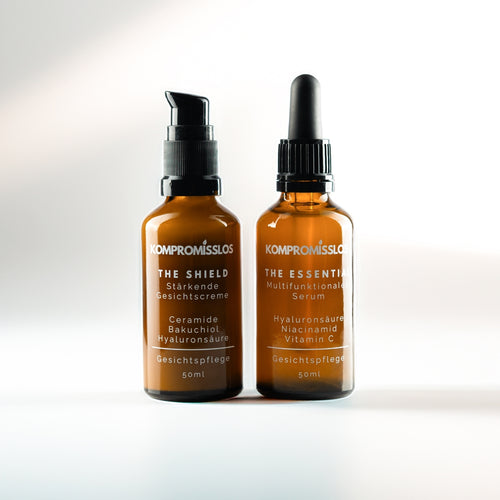
The Duo of serum and face cream does not need a fridge. The vitamin C in the Duo is the more stable 3-O-Ethyl Ascorbic Acid, and the cream with squalane and jojoba oil is an emulsion that would only firm up in the cold. A spot away from sun and radiators is enough. As with any product, the information on the packaging is what counts. In her review on Judge.me, Sabine B. writes: “Especially now in the heat, it feels very fresh and light on the skin, but still richly nourished” (review translated from German).
If you take your skincare with you when travelling, pack it in your hand luggage or in the middle of your suitcase rather than in an outside pocket. There it is exposed to smaller swings in temperature.
For the vitamin C, I deliberately chose 3-O-Ethyl Ascorbic Acid, 2% in the Duo, rather than pure ascorbic acid. Pure ascorbic acid is sensitive, and I did not want skincare that only works in the fridge and becomes a problem in the bathroom. To be honest, though, even a stable form is no substitute for sensible storage: sun, radiators and an open lid harm any product. And the time limit after opening shown by the jar symbol still applies. For me, two products instead of eight also means you do not need a beauty fridge to make room for your routine. Which active ingredients are in the Duo, and at what concentrations, is set out on the page listing all active ingredients and their concentrations.
Frequently asked questions
Can you put face cream in the fridge?
Yes, face cream can go in the fridge, but it does not have to. It usually comes to no harm there; it just firms up and becomes harder to spread. Problems arise if you carry it back and forth between the fridge and a warm bathroom every day, because condensation can form. Without a refrigeration instruction on the packaging, a shady spot is enough.
Can I keep sunscreen in the fridge?
You can, but it is not necessary. For sunscreen, heat is a bigger problem than a lack of cold. The US FDA, too, mainly recommends protecting the tube from direct sun, not chilling it. Follow the instructions on the packaging and do not leave sunscreen in a hot car.
Does natural skincare without preservatives need to go in the fridge?
Only if the manufacturer says so on the packaging. Most natural skincare products are formulated with approved preservatives or other systems so that they keep at room temperature. Freshly made products without any preservation at all are the exception; for these, the refrigeration instruction is usually stated explicitly, together with a short use-by period.
Is a cream ruined if it has separated after being in the fridge?
You should no longer use a cream that has visibly separated into oil and water. The separation shows that the emulsion has lost its structure, which also means the ingredients are no longer evenly distributed. Becoming slightly firmer or stiffer, on the other hand, is normal and usually reverses at room temperature.
What is the ideal temperature for skincare?
For most products, normal room temperature without large fluctuations is ideal. There is no single figure in degrees that applies to everything, because every formulation reacts differently. What matters is avoiding extreme heat, direct sun and frequent switches between cold and warm. If the manufacturer specifies a temperature or a refrigeration instruction, that is what applies.
Can skincare be left in a hot car in summer?
No, a hot car is one of the worst places for skincare. In summer the interior heats up considerably: emulsions can separate, balms melt and sensitive active ingredients suffer. Take your skincare and sunscreen with you rather than leaving them in the glovebox or on the dashboard, and keep them in the shade when you are out and about.
Do I need to keep The Duo in the fridge?
No, The Duo does not need a fridge. The vitamin C in the serum is the more stable 3-O-Ethyl Ascorbic Acid, and the cream would only firm up in the cold. Keep both products somewhere away from sun and radiators, close them after use and check the jar symbol on the packaging for how long they keep once opened.
Sources
- Johnson JM, Kellogg DL Jr. Local thermal control of the human cutaneous circulation. Journal of Applied Physiology, 2010. Source
- Stamford NP. Stability, transdermal penetration, and cutaneous effects of ascorbic acid and its derivatives. Journal of Cosmetic Dermatology, 2012. Source
- Iliopoulos F, Sil BC, Moore DJ, Lucas RA, Lane ME. 3-O-ethyl-l-ascorbic acid: Characterisation and investigation of single solvent systems for delivery to the skin. International Journal of Pharmaceutics: X, 2019. Source
- U.S. Food and Drug Administration. Sunscreen: How to Help Protect Your Skin from the Sun. FDA, as of 2026. Source