Vitamin C serum: which skin it’s worth it for and how to spot a stable formula
ACTIVE INGREDIENTS
A vitamin C serum is worth it above all for a dull, uneven complexion and the first dark spots. What matters is not the percentage but the form used: pure L-ascorbic acid oxidises quickly and needs a very acidic pH, while stable derivatives such as 3-O-ethyl ascorbic acid stay effective for longer and are usually better tolerated by sensitive skin.
Which skin condition is a vitamin C serum worth it for?
A vitamin C serum is most clearly worth it for dull, uneven skin with the first dark spots. The ingredient is an antioxidant and works where the complexion looks uneven and tired, not where it lacks moisture or lipids. Dry skin needs lipids first and foremost, dehydrated skin needs humectants, and an irritated barrier needs, above all, some peace. Vitamin C can play a supporting role in all of these cases, but it is never the first step. That is why it is worth taking your current skin condition rather than your skin type as the starting point: the same person can be dry in winter and oily in summer, and the question of whether a vitamin C serum makes sense right now has a new answer each time. If all you feel is tightness and roughness, you are better served by barrier-strengthening skincare than by yet another active ingredient. The overview below puts the most common skin conditions into context.
| Skin condition | Is a vitamin C serum worth it? | What to look out for |
|---|---|---|
| Mature skin | Yes, especially with a dull complexion | Always combine with moisture and lipids. |
| Dry skin | To a degree | Build up the lipid supply first, vitamin C afterwards. |
| Dehydrated skin | To a degree | Hyaluronic acid takes priority; vitamin C only adds to it. |
| Combination skin | Yes | Choose a light, watery texture rather than an oily base. |
| Blemish-prone skin | Yes, for a more even complexion | Start with a low dose and leave out acid treatments. |
| Reddened skin | Only with caution | Use stable derivatives rather than pure L-ascorbic acid. |
| Over-treated skin | No, pause first | Cut back your routine and then build it up again. |
Why does vitamin C oxidise in so many serums?
Vitamin C oxidises in many serums because pure L-ascorbic acid is chemically unstable and breaks down quickly on contact with air. In a characterisation study in the International Journal of Pharmaceutics X, a research team led by Fotis Iliopoulos described the molecule as readily oxidising as soon as it is exposed to oxygen. In the process, the active ingredient turns into dehydroascorbic acid, which in turn forms further breakdown products that no longer deliver the original effect. Heat, light and traces of metal in the formula speed this up – conditions found in any ordinary bathroom. You can see the breakdown in the colour: a serum that starts out clear or pale yellow and turns orange to brownish after a few weeks has already lost a considerable part of its active ingredient. That is exactly why a high percentage on the packaging says little about how much active ingredient is actually left after two months in an open bottle. We have summed up what vitamin C can do at all in our article on what vitamin C does for your skin.
How can you recognise a stable vitamin C formulation?
You can recognise a stable vitamin C formulation by three things: the form of the active ingredient, the packaging and the colour over time. According to an absorption study by Sheldon Pinnell and colleagues in Dermatologic Surgery, pure L-ascorbic acid has to be formulated at a pH below 3.5 to get into the skin at all. For sensitive skin, this acidic range is often the real source of irritation, not the vitamin C itself. Stable derivatives avoid this problem because they work at more skin-friendly pH levels. Then there is the packaging: an opaque container with a pump or airless system protects far better than a transparent dropper bottle that lets air in every time you open it. And finally, the simplest check of all: note the date you opened it and look after eight weeks to see whether the colour has changed. How the stable vitamin C form 3-O-ethyl ascorbic acid behaves in detail, and where its limits lie, is covered in a separate article. We explain which criteria comparison tests actually check in our piece on the criteria behind top-rated vitamin C serums.
Is a vitamin C serum suitable for sensitive skin?
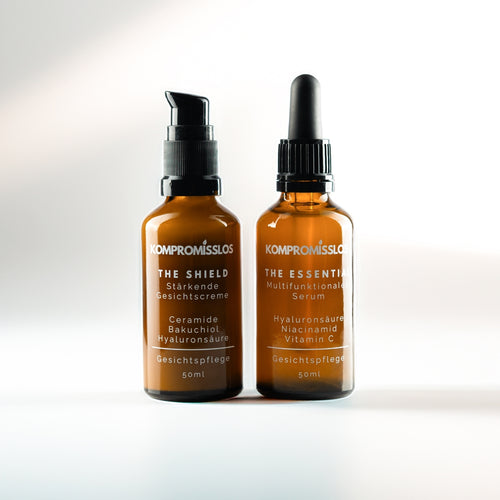
A vitamin C serum is suitable for sensitive skin if it is based on a stable derivative rather than high-strength pure L-ascorbic acid. The classic reactions – burning, stinging and widespread redness – usually come from the low pH and high concentrations, not from vitamin C as such. Our Duo of serum and cream contains 2% 3-O-ethyl ascorbic acid, a deliberately restrained dose intended to work for thin and reactive skin too. Context matters as well: an active ingredient on an already disrupted barrier almost always leads to irritation, however gently it is formulated. If your skin currently feels tight, flakes or reacts to several products at once, the barrier needs stabilising first, and only then should an active ingredient be added. What sensitive skin really needs differs considerably from what advertising usually recommends for it.
How often should you use a vitamin C serum?
You can use a vitamin C serum every day, morning and evening, as long as your skin tolerates it well. As an antioxidant, it makes particular sense in the morning, because the ingredient then works against free radicals during the day. That is not a must, though: if you are more consistent in the evening, you will achieve more with your evening routine than with a morning routine you regularly skip. With our products, that means 3 to 6 drops of Essential serum, followed by 3 to 6 pumps of Shield cream, morning and evening. If you are new to vitamin C and prone to redness, start every other day and build up over two to three weeks. This gradual introduction saves you from the most common mistake: giving up because too much happened at once in the first week. Whether you need a cream alongside the serum at all is covered in the article comparing serum and cream, and you will find all concentrations under ingredients.
When a new serum isn’t the answer
A vitamin C serum is not a solution for skin changes that need a medical assessment. Skincare cares for the skin and improves its appearance; it does not treat diseases. If a dark spot changes in colour, shape or size, if redness persists and comes with pustules or burning, or if your skin suddenly reacts to products you have used without any problems for years, that belongs in the hands of a dermatologist, not in a new skincare routine. The same applies to heavily flaking or weeping patches and to itching that won’t stop at night. A professional can clarify in a single appointment what you won’t find out through months of trial and error. There is no defeat in setting a product aside and making an appointment instead. In many cases, it is simply the quicker route to skin that feels calm again.
I deliberately decided against a high-strength vitamin C serum. The maths with 15 or 20 per cent pure L-ascorbic acid looks impressive on the label, but it needs a pH that many of my customers don’t tolerate, and after a few weeks in the bathroom it is a good deal weaker than on the day it was filled. Instead, I chose 2% 3-O-ethyl ascorbic acid, because the molecule stays stable and lets me deliver what it says on the packaging through the whole bottle. A lower percentage on the label, but more reliable over two to four months.
Frequently asked questions
At what concentration does a vitamin C serum work?
There is no fixed threshold, because it depends on the form of the ingredient. For pure L-ascorbic acid, an absorption study showed that uptake into the skin does not increase further above 20 per cent. For stable derivatives, sensible levels are much lower; in our Duo, it is 2% 3-O-ethyl ascorbic acid.
How can you tell that your vitamin C serum has oxidised?
Most reliably by the colour. A serum that was clear or pale yellow at first and turns orange to brownish over time has already lost part of its active ingredient. A metallic smell can also be a sign. An oxidised product no longer works as intended and should be replaced.
Can you use a vitamin C serum morning and evening?
Yes, twice a day is no problem if your skin tolerates it well. In the morning, the antioxidant effect works alongside you during the day; in the evening, the serum fits into your skincare routine. Regular use matters more than timing. With sensitive skin, you are better off starting with one application a day.
Does a vitamin C serum make sense for reddened skin?
Only with caution and in the right form. High-strength L-ascorbic acid with a low pH often makes redness worse; stable derivatives are the better-tolerated choice here. If redness persists or pustules appear, having it checked by a dermatologist is a more sensible step than another product.
What should you do if you don’t tolerate vitamin C?
Stop using the product for two to three weeks and cut your routine back to cleansing and barrier-strengthening skincare. After that, you can start again with a stable derivative at a low dose, every other day. If the reaction persists, vitamin C is not the right active ingredient for your skin at the moment.
Do you need a cream as well as a vitamin C serum?
In most cases, yes. A serum delivers active ingredients in a water-based formula, but it does not replace the lipids a cream provides. Without that final layer, moisture evaporates faster and the barrier remains vulnerable. Only very oily skin can sometimes manage without an extra cream in the warmer months.
Does a vitamin C serum make sense for over-treated skin?
No, leaving things out is the better step here. Over-treated skin shows irritation, tightness and reactions to products that used to be fine. An additional active ingredient makes that worse. For two to four weeks, cut back to cleansing and simple skincare, and only reintroduce vitamin C after that.
Sources
- Iliopoulos F, Sil BC, Moore DJ, Lucas RA, Lane ME. 3-O-ethyl-l-ascorbic acid: Characterisation and investigation of single solvent systems for delivery to the skin. International Journal of Pharmaceutics X, 2019. Source
- Pinnell SR, Yang H, Omar M, et al. Topical L-ascorbic acid: percutaneous absorption studies. Dermatologic Surgery, 2001. Source