Vitamin C for skin: what it does and what it can realistically achieve
SINGLE INGREDIENT
What vitamin C does for skin comes down to two functions: it neutralises free radicals, and it is an essential co-factor in collagen formation. You see both as a more even complexion and a finer texture – in studies, usually after around twelve weeks of regular use. Vitamin C is no substitute for sun protection.
What does vitamin C do for your skin?
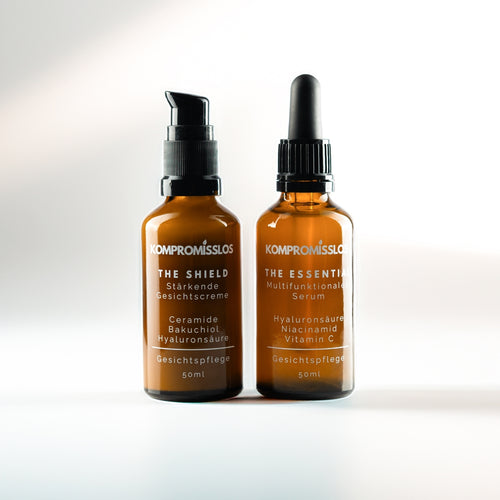
In the skin, vitamin C has two clearly distinct jobs. First, it neutralises free radicals generated by UV radiation, ozone or smoke. Second, it is an essential co-factor in the hydroxylation of collagen – precisely the step that makes newly formed collagen stable in the first place. Healthy skin naturally contains vitamin C, far more in the epidermis than in the dermis. According to a review in the journal Nutrients, the difference between the two layers is consistently two- to fivefold. With age, this store falls in both layers, and heavy UV exposure or air pollutants lower it further, especially in the epidermis. That is where skincare comes in. It doesn’t heal anything; it supports a store that shrinks over the years. The Duo contains 2% vitamin C for this purpose, as 3-O-Ethyl Ascorbic Acid, combined with other antioxidants.
How long does vitamin C take to work?
Allow around twelve weeks before you see a change in the mirror. The Micronutrient Information Center of the Linus Pauling Institute summarises the human studies as follows: topical vitamin C at concentrations of 3 to 10% showed fewer fine lines, less visible roughness and increased collagen formation after at least twelve weeks. Shorter periods of use generally don’t produce robust results. That fits the biology: collagen is formed slowly and remodelled slowly, and a week of skincare cannot shorten that cycle. What you notice sooner is the surface. Moisture, smoothness and a more even skin tone often appear after two to four weeks, because they depend mainly on humectants and lipids, not on collagen building. If you give up disappointed after ten days, you are measuring something that cannot yet be measured at that point. This pattern comes up regularly in our customer reviews.
Which form of vitamin C belongs in a serum?
There is no best form, only a trade-off between the evidence, stability and tolerability. Pure L-ascorbic acid is the best-studied variant and, at the same time, the least stable in solution. It needs a pH below 4 to get through the stratum corneum in its uncharged form at all, and this acidic pH is the most common reason for stinging and redness in sensitive skin. Derivatives solve this problem with varying success. 3-O-Ethyl Ascorbic Acid is a stable derivative whose skin uptake has been demonstrated in diffusion-cell experiments on pig skin. Ascorbyl phosphates are also stable, but are considered to penetrate the skin less well. Ascorbyl palmitate is fat-soluble and only absorbed to a limited extent. Which form a product contains is always stated in the INCI list, not on the front of the pack. If the list just says vitamin C, with no INCI name, you can judge neither its stability nor how well it is likely to be tolerated. That is why a look at the full ingredients list tells you more than any number on the front of the packaging.
| Form | Stability | pH required | Key point |
|---|---|---|---|
| L-ascorbic acid | Low, oxidises in solution | Below 4 | The best-studied form. |
| 3-O-Ethyl Ascorbic Acid | High | No strongly acidic pH needed | Skin uptake demonstrated experimentally. |
| Sodium and magnesium ascorbyl phosphate | High | Close to skin-neutral | Considered to have limited skin penetration. |
| Ascorbyl palmitate | Medium | Not relevant | Fat-soluble, limited uptake. |
What concentration of vitamin C makes sense?
Beyond a certain point, a higher percentage does not mean a greater effect. In the absorption experiments cited by the Linus Pauling Institute, maximum uptake was reached with a 20% vitamin C solution; higher concentrations were absorbed less well. The human studies showing a visible effect used 3 to 10%. These figures don’t translate one-to-one to derivatives, because they have a different molecular weight and a different conversion rate. A high percentage on the pack is therefore not proof of quality – at first, it is just a number. Three things matter: the form, the pH and whether the formulation stays stable until you have used it up. A 20% serum that has turned brown after six weeks delivers less than a lower-dosed one that keeps its colour. We have written in more detail about how to spread active ingredients across the day in vitamin C or niacinamide.
Does vitamin C replace sunscreen?
No – vitamin C is not a sunscreen and does not replace one. The reason is physical: vitamin C absorbs neither UVA nor UVB radiation, so it filters nothing out. What it does is intercept the follow-on damage that occurs when UV radiation triggers free radicals in the skin. That is a useful addition to a filter, but not a substitute for one. Several studies also suggest that combining vitamin C with vitamin E improves protection against UV-related damage more than either substance on its own. In practice, that means antioxidants go under your sunscreen in the morning, not instead of it. The same principle applies to plant antioxidants such as gentian root extract, which also neutralises free radicals and still doesn’t replace a filter. If you are outdoors every day in summer and take dark spots seriously, there is no way around sun protection. Anything else is a convenient calculation that your skin pays for later.
When you don’t need vitamin C
Vitamin C is not the right choice for every skin, or at every stage. If your skin barrier is currently irritated – tight, flaking, or suddenly stinging with products you normally use – adding another active ingredient is the wrong move. Calm the barrier first, then bring vitamin C back in. And if you are already working with several actives at once, you rarely gain anything by adding another acid on top. If you are dealing with a diagnosed skin condition such as rosacea, eczema (atopic dermatitis) or acne, treatment belongs in the hands of a dermatologist, not in a cosmetic routine. Cosmetics care for the look of your skin; they don’t treat a condition. With persistent redness, weeping patches, severe itching or changes to moles, the right answer is an appointment with a specialist, not a new serum. If your skin is unsettled, our article on blemish-prone skin will help you get your bearings, and what a calm routine looks like in practice is set out in the how-to-use guide.
For the Kompromisslos two-product set, I deliberately chose 2% 3-O-Ethyl Ascorbic Acid rather than 15% pure L-ascorbic acid, even though the higher number looks better on the label. Two reasons. Pure L-ascorbic acid needs a pH below 4, and I make skincare for skin that reacts to that kind of thing. And I didn’t want to sell a product that turns orange in your bathroom after eight weeks and then no longer contains what it says on the bottle. A formulation you can use down to the last drop matters more to me than a percentage that is easy to advertise. If you tolerate pure L-ascorbic acid well, that is a legitimate alternative route. Just not mine.
Frequently asked questions
When is the best time to apply vitamin C?
In the morning, because antioxidant protection is needed during the day, when UV radiation and air pollutants reach your skin. Using it in the evening is also possible and does no harm. With The Duo, the routine is the same morning and evening: 3 to 6 drops of serum, followed by 3 to 6 pumps of cream.
Why is my vitamin C serum turning yellow or orange?
The discolouration shows that the vitamin C is oxidising. Pure L-ascorbic acid is not very stable in solution and reacts with air, heat and light. A discoloured serum contains less active vitamin C than it did on day one. Stable derivatives such as 3-O-Ethyl Ascorbic Acid do this far less often.
Can you use vitamin C with niacinamide?
Yes, the two can be combined in one routine. The widespread warning goes back to laboratory conditions that don’t carry over to a finished skincare formulation. The Duo formulates 2% vitamin C and 5% niacinamide together. If your skin is very sensitive, you can split the two between morning and evening.
What percentage of vitamin C should a product contain?
Studies showing a visible effect used 3 to 10% pure ascorbic acid. Maximum uptake was measured at 20%; above that, it falls again. These values don’t apply directly to derivatives, because they are absorbed and converted differently. Form, pH and stability matter more than the percentage alone.
Is vitamin C suitable for sensitive skin?
Often yes, if the form is right. The most common problem is not vitamin C itself but the low pH that pure L-ascorbic acid requires. Stable derivatives don’t need a strongly acidic pH and are therefore usually better tolerated. Still, patch test first on a small area along your jaw.
Does vitamin C from your diet work the same way as on your skin?
No – the two routes complement each other but don’t replace each other. From your diet, vitamin C reaches the skin via the blood, but skin levels stop rising once blood levels are saturated. Vitamin C applied topically reaches the upper layers of the skin more directly.
Can vitamin C remove dark spots?
Remove them, no. Vitamin C can soften the look of darker areas and help create a more even skin tone, because it intervenes in melanin production. The effect is gradual and takes weeks. Without consistent sun protection, the effort comes to nothing, because UV radiation keeps driving pigmentation again.
Sources
- Pullar JM, Carr AC, Vissers MCM. The Roles of Vitamin C in Skin Health. Nutrients, 2017. Source
- Linus Pauling Institute, Oregon State University. Vitamin C and Skin Health, Micronutrient Information Center. Source
- Iliopoulos F et al. 3-O-ethyl-l-ascorbic acid: Characterisation and investigation of single solvent systems for delivery to the skin. International Journal of Pharmaceutics: X, 2019. Source