Homemade face cream: what DIY can do and where shelf life and efficacy run out
NATURAL SKINCARE
Homemade face cream is perfectly possible, but once it contains water, it is only safe for a short time in a home kitchen. As soon as water is involved, the cream needs an emulsifier, effective preservation and clean working practices – otherwise microbes multiply long before you can smell anything. Vitamin E and tea tree oil are no substitute for a preservative. Active ingredients such as vitamin C or niacinamide can hardly be dosed reliably without precision scales and a pH meter. The more honest DIY option is water-free skincare made from oils and wax.
Is it worth making your own face cream?
Making your own face cream is worth it if you enjoy mixing and want something for the next few days, but not if you expect a long-lasting cream with active ingredients that keeps for months. DIY has real advantages: you know exactly what is in the jar, you can leave out fragrance and react to individual oils your skin does not like. And if you like to understand how cosmetics are put together, stirring up your own cream is a good education. The limits lie elsewhere. A kitchen lacks a clean room, sterilised equipment, tested raw materials and the safety report a company needs before it can sell a product. And for a single cream, you quickly end up buying an emulsifier, a preservative, several oils, precision scales and test strips, half of which you will never use up. That is why DIY rarely works out cheaper than a finished product. If what you are really after is a short ingredient list, the question of natural vs conventional skincare is often a better shortcut than a home lab.
What is a cream made of, and why does it need an emulsifier?
A cream consists of a water phase, an oil phase and an emulsifier that holds the two together permanently. Water and oil do not mix of their own accord. If you stir them vigorously, fine droplets form for a moment, but after minutes or hours they separate again. An emulsifier settles at the boundary between oil and water and stops the droplets from merging. Besides water, the water phase often contains humectants such as glycerin, while the oil phase contains plant oils, fatty alcohols or waxes. Thickeners are added to stabilise the texture. When you make a cream at home, a lot depends on the details: both phases usually have to be brought to a similar temperature, the ratio has to suit the emulsifier you have chosen, and even small deviations can make the cream split or weep water after a few days. How these building blocks are declared on finished products, and which of them form the base and which are extras, becomes clear once you know how to read an ingredient list.
Why does homemade cream with water go off so quickly?
Homemade cream with water goes off quickly because water, combined with oils, sugars and plant substances, makes an excellent breeding ground for bacteria, yeasts and moulds. A review in the journal Molecules notes that water is the main constituent of most cosmetics and, at the same time, an ideal growth factor for microorganisms. Another review, in Contact Dermatitis, describes cosmetics with a high water content as particularly prone to contamination and reports that Staphylococcus aureus and Pseudomonas aeruginosa are frequently found in contaminated products. The tricky part is that you often only see or smell contamination once it is well advanced. Microbes get in via your hands, tap water, non-sterile raw materials such as aloe gel or plant powders, and every finger dipped into the jar. How long shop-bought products last once opened is a separate topic, covered in the article on skincare shelf life after opening. With a homemade cream, this information is missing altogether, because nobody has tested your batch.
If you still want to make a cream that contains water, a few habits reduce the risk:
- Use boiled or distilled water rather than water straight from the tap.
- Clean equipment, jars and spatulas thoroughly beforehand and disinfect them with alcohol.
- Only make small batches that you will use up within a few days.
- Take the cream out with a clean spatula rather than your fingers – or, better still, use a pump dispenser.
- Write the date you made it on the container and, if in doubt, throw it away.
Does vitamin E or tea tree oil preserve homemade cream?
No, neither vitamin E nor tea tree oil can replace a preservative in a cream that contains water. Vitamin E is an antioxidant. It can help plant oils stay fresh for longer before they go rancid, but it does nothing against bacteria or mould. The review in Molecules draws exactly this distinction between two groups: antimicrobial preservatives, which act on microorganisms, and antioxidant additives, which slow down oxidation. Tea tree oil is more complicated. In the lab, essential oils do act against microbes, but the same review notes that their use as preservatives is often discouraged: they lose activity when diluted, depend on pH, evaporate and are fat-soluble. In a cream, they therefore tend to stay in the oil phase, while microbes grow mainly in the water phase. On top of that, essential oils are among the more common triggers of irritation. There is more on this in the article on essential oils in skincare and why they can irritate sensitive skin. Whether a preservative system actually works only becomes clear in a stress test known as a challenge test. The product is deliberately inoculated with bacteria, yeasts and moulds and monitored for 28 days. Which preservatives are permitted in certified natural cosmetics is explained in the article on preservatives in natural skincare.
Which active ingredients can you sensibly add at home, and which can’t you?
Robust ingredients such as plant oils, glycerin or panthenol are a sensible choice at home, whereas delicate active ingredients that need a specific pH, a precise dose or protection from oxygen range from difficult to impossible. Vitamin C is the best example. According to a study in Dermatologic Surgery, pure ascorbic acid has to be formulated at a pH below 3.5 to get into the skin at all in tests on pig skin. At the same time, it oxidises quickly in water and changes colour. Without a pH meter and airtight packaging, you are mixing something without knowing whether it will work or irritate. Dosing is another hurdle: for 50 grams of cream with 5 per cent niacinamide, you need 2.5 grams of powder, which is hard to measure accurately on kitchen scales that only show whole grams. For active ingredients used at a fraction of a per cent, it is hopeless. This is exactly where a finished formula makes the difference – such as The Duo with disclosed concentrations, which uses a stable form of vitamin C and is dermatologically tested.
| Ingredient | Feasible at home | Reason |
|---|---|---|
| Plant oils, shea butter, waxes | Yes | Robust and water-free; just keep an eye on oxidation |
| Glycerin, panthenol | Yes, with caution | Stable, but only useful in a preserved water phase |
| Niacinamide | To a limited extent | Needs precise dosing with precision scales |
| Vitamin C as pure ascorbic acid | Hardly | Needs a very low pH, oxidises quickly |
| Retinol and other light-sensitive substances | No | Break down in light and air, need very low dosing |
When is water-free skincare the more honest DIY option?
Water-free skincare is the more honest DIY option as soon as you want to work without a preservative and without a lab, because without water, microbes lose the thing they need most to grow. A balm made from plant oils and a little wax, or a pure facial oil, needs no emulsifier, and the risk of microbial contamination is considerably lower as long as no water gets in, for example from wet fingers. The problem then shifts to oxidation: oils can go rancid. This is where vitamin E genuinely earns its place, because it protects oils from oxidation. The limit deserves an honest mention too: a balm does not add moisture, it only holds it in and makes the skin’s surface feel supple. For very dry skin, it works well as the last step in the evening, but it is no substitute for a hydrating moisturiser. Which oils from the kitchen cupboard are suitable for this, and which are not, is covered in the article on home remedies for dry facial skin.
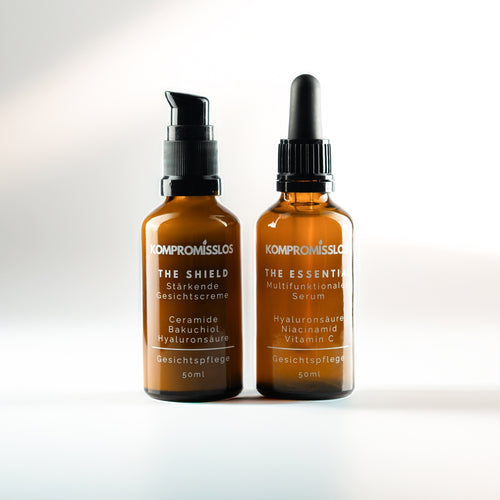
I decided to name our preservatives openly rather than put ‘naturally preserved’ on the packaging. In The Duo, they are Sodium Benzoate, which we classify as synthetic on our own website, and Sodium Levulinate, supported by Pentylene Glycol and Glycerin. No phenoxyethanol, no parabens, no essential oils and no fragrance. I could not sell you a cream that contains water but no preservation – after everything above, that simply would not be honest. In the same spirit, I disclose the concentrations: 5% niacinamide, 2% vitamin C as the stable 3-O-Ethyl Ascorbic Acid and 1% zinc PCA, applying to The Duo as a whole. You can see exactly what is in it in our full list of ingredients.
Frequently asked questions
How long does homemade face cream last?
Homemade face cream made with water and no preservative only keeps for a very short time – think days rather than weeks. There is no reliable figure, because it depends on hygiene, raw materials and storage, and nobody has tested your batch. With a suitable preservative, it lasts longer, but without a challenge test that is still only an estimate. Water-free balms keep considerably longer.
Can I make a cream without an emulsifier?
A true cream of water and oil will not stay mixed without an emulsifier; the phases separate again. What gets described as an emulsifier-free cream is usually a water-free balm, a gel with very little oil or a mixture you have to shake before every use. Without an emulsifier, the water-free route is therefore the most sensible one.
Does homemade cream last longer in the fridge?
Yes, a little, but not as long as people often assume. Cold slows the growth of many microbes but does not stop it, and every time you take some cream out, you introduce new ones. So the fridge extends the time a homemade cream stays usable, but it is no substitute for preservation. Small batches and clean handling remain essential.
Can I give away or sell homemade cosmetics?
For your own use, you can mix whatever you like. Selling cosmetics means placing them on the market, and in Switzerland that brings them under food and consumer goods legislation. According to the Federal Food Safety and Veterinary Office (BLV), cosmetic products may only contain safe substances, and a product information file with a safety report is required in every case. If you are unsure whether a gift counts too, check with your cantonal laboratory. This is a general overview, not legal advice.
Is homemade cream better for sensitive skin?
Not automatically. A short ingredient list does make triggers easier to pin down, but essential oils, plant extracts, the wrong pH or microbial contamination can irritate sensitive skin just as easily. If your skin is quick to sting or redden, a tested, fragrance-free product is usually the calmer choice than an experiment. If redness or burning persists, have it checked by a dermatologist.
How can I tell if my homemade cream has gone off?
Warning signs are a sour or rancid smell, spots, discolouration, water on the surface or a change in texture. If you notice any of these, throw the cream out immediately. The reverse matters just as much: a cream can be contaminated without you noticing anything. That is why, with homemade cosmetics, the date you made it counts for more than the smell test.
Do I need a homemade cream if I use The Duo?
No. With its serum and cream, The Duo covers the skincare part of your routine, with disclosed concentrations and openly declared preservatives. Adding a homemade water-based cream mainly brings an extra risk of contamination. If you enjoy making your own, a small water-free balm for very dry patches is the simpler addition to The Duo of serum and cream.
Sources
- Halla N, Fernandes IP, Heleno SA, Costa P, Boucherit-Otmani Z, Boucherit K et al. Cosmetics Preservation: A Review on Present Strategies. Molecules, 2018. Source
- Lundov MD, Moesby L, Zachariae C, Johansen JD. Contamination versus preservation of cosmetics: a review on legislation, usage, infections, and contact allergy. Contact Dermatitis, 2009. Source
- Pinnell SR, Yang H, Omar M, Monteiro-Riviere N, DeBuys HV, Walker LC et al. Topical L-ascorbic acid: percutaneous absorption studies. Dermatologic Surgery, 2001. Source
- Bundesamt für Lebensmittelsicherheit und Veterinärwesen (BLV). Kosmetika. BLV, 2025. Source