Parabens in cosmetics: what’s allowed, what’s banned and what paraben-free really means
INGREDIENTS AND TRUST
Parabens in cosmetics are preservatives, and only some of them are still permitted in Switzerland. Methylparaben and ethylparaben are assessed as safe up to 0.4% per ester, butylparaben and propylparaben up to 0.14% combined. Five long-chain parabens have been banned since 2014. Paraben-free does not mean preservative-free – it simply means preserved differently.
What are parabens and why are they in cosmetics at all?
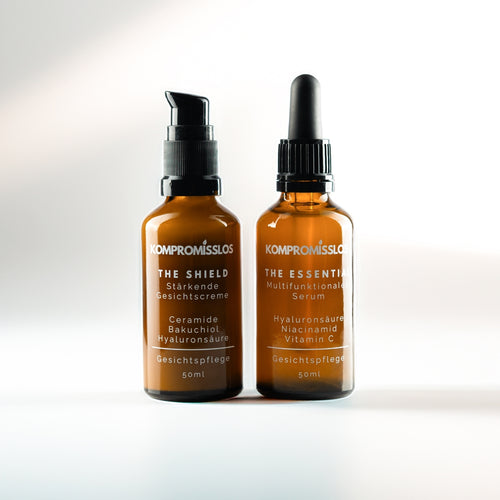
Parabens are esters of 4-hydroxybenzoic acid, used to stop water-based products from becoming contaminated with microbes. Every cream and serum that contains water offers bacteria, yeasts and moulds an ideal breeding ground. Without preservation, a product like that would no longer be safe to use after a few weeks in a warm bathroom. The biggest source of germs is you: every time you dip a finger in, microorganisms get into the product. Parabens became widespread because they are odourless, work in very small amounts, cover a broad range of microbes and are compatible with almost any formula. So a product being preserved is not a flaw but a safety requirement. That applies to The Duo, our serum and cream too: a water-based product without effective protection against microorganisms would not be a better product, just a riskier one. The real question is therefore not whether a product is preserved, but with what and in what amount.
Which parabens are allowed in Switzerland and which are banned?
Switzerland applies the same limits to parabens as the EU. Article 54(4) of the Swiss Ordinance on Foodstuffs and Utility Articles refers directly to Annex V of the EU Cosmetics Regulation for permitted preservatives. From that list, methylparaben and ethylparaben are allowed at a maximum of 0.4% per individual ester. Butylparaben and propylparaben may make up no more than 0.14% combined. For all the parabens in a product together, the upper limit is 0.8%. Five long-chain parabens have been banned outright since 2014: isopropylparaben, isobutylparaben, phenylparaben, benzylparaben and pentylparaben. Anything you find on a Swiss shelf complies with these limits – otherwise it could not be sold at all. If you buy natural skincare in Switzerland, you are already operating within a tightly regulated framework, whether or not a brand makes a point of it. The table summarises what is still permitted today and how to spot it in the ingredient list.
| Paraben | Status in Switzerland | Maximum concentration | Name in the INCI list |
|---|---|---|---|
| Methylparaben, ethylparaben | Permitted | 0.4% per ester, 0.8% for all parabens combined | Methylparaben, Ethylparaben |
| Propylparaben, butylparaben | Permitted with restrictions | No more than 0.14% combined | Propylparaben, Butylparaben and their sodium and potassium salts |
| Isopropyl-, isobutyl-, phenyl-, benzyl- and pentylparaben | Banned since 2014 | Not permitted | Must no longer appear in any list |
Why do parabens still have such a bad reputation?
The bad reputation comes from a debate about possible hormonal effects, which centred mainly on the long-chain parabens. In 2011, Denmark unilaterally banned propylparaben and butylparaben in products for children under three, citing possible endocrine activity. The European Commission’s Scientific Committee on Consumer Safety (SCCS) then reviewed the evidence several times. The outcome was neither an all-clear nor a confirmation of the ban, but a tiered response: methylparaben and ethylparaben were classed as safe at the permitted maximum concentrations, the limit for butylparaben and propylparaben was lowered significantly, and for five other parabens there simply wasn’t enough data for an assessment. Those five are the ones banned today. So the reputation clings to a group of substances whose problematic members have since left the market, while the remaining ones are among the most thoroughly tested preservatives there are.
Does paraben-free automatically mean safer?
No. Paraben-free only tells you what isn’t in a product, not what is in it instead. A product without parabens still needs protection against microbes, which means a different preservative system. Whether that system suits your skin better depends on the individual ingredient and on your skin, not on a word on the front of the pack. Some alternatives have been studied less than methylparaben; others are considered more common triggers of contact allergies. “Free-from” claims are also a sales argument rather than proof of quality, much like the promises around cosmetics without additives. If you want to know whether a product is any good, the full ingredient list tells you more than any claim on the front. And if independent assessment matters to you, certified natural skincare labels are a more reliable guide than a negative claim that any brand can print on its packaging without external checks.
How are paraben-free products preserved?
In paraben-free products, other approved preservatives do the job. The ones you will see most often in the ingredient list are phenoxyethanol, benzyl alcohol, sodium benzoate, potassium sorbate, benzoic acid and dehydroacetic acid. There are also substances that preserve only as a side effect and therefore don’t count as preservatives: high levels of alcohol, certain glycols such as pentylene glycol, or essential oils. So a product can technically do without a declared preservative and still be preserved. For sensitive skin, this distinction matters more than the word paraben-free, because fragrances and essential oils are considered common triggers of skin reactions. That is why it pays to read the whole list from bottom to top, not just the front of the pack. You can see which system protects the Kompromisslos serum and cream in our full ingredient overview. Our Duo contains NO parabens.
When a specialist is a better bet than the next product
If your skin repeatedly reacts to skincare products, seeing a dermatologist is a quicker route than buying the next product. Cosmetics may neither diagnose nor treat skin conditions, and no label can tell you exactly what you are reacting to. A specialist can use a patch test to check whether you have a contact allergy to a particular preservative, fragrance or emulsifier. The result is something you can actually use: afterwards you know which single INCI name to avoid, rather than ruling out entire groups of ingredients across the board. Persistent redness, weeping, flaking or itching that won’t settle also needs to be looked at, not covered with yet another cream. If, on the other hand, the main issue is tightness and your skin barrier is mostly just stressed, a calm, short routine is often the more sensible first step. Questions about pregnancy, breastfeeding or caring for young children’s skin are also for a doctor to answer, not the packaging.
I deliberately decided not to advertise “paraben-free”, even though the word sells. It would have fitted on any pack and no one would have asked questions. But a negative claim says nothing about what is actually inside – and that is exactly what I wanted to turn around at Kompromisslos. That’s why our list is out in the open, with percentages for the active ingredients that count: 5% niacinamide, 2% vitamin C as 3-O-ethyl ascorbic acid, 2% hyaluronic acid and 0.3% bakuchiol, each relative to the Duo as a whole. It is also what comes up most often in feedback from our customers. If you want to know what’s in a product, you should be able to read it, rather than having to rely on a word that only describes what is missing.
Frequently asked questions
Are parabens in cosmetics banned in Switzerland?
No, only five of them are banned. Isopropylparaben, isobutylparaben, phenylparaben, benzylparaben and pentylparaben have not been permitted since 2014. Methylparaben and ethylparaben remain approved; butylparaben and propylparaben are now only allowed within strict limits. Switzerland adopts the list from the EU Cosmetics Regulation and enforces it through its food control authorities.
How do I spot parabens in an ingredient list?
By the ending “paraben” in the INCI name. You will find them as methylparaben, ethylparaben, propylparaben or butylparaben, sometimes also as a salt such as sodium propylparaben. Because preservatives are used at low levels, they usually appear towards the end of the list, just before fragrances and colourants.
How much paraben is allowed in a face cream?
No more than 0.4% per individual ester and 0.8% for all parabens in a product combined. A tighter limit applies to butylparaben and propylparaben: together they must not exceed 0.14%. These values apply equally in Switzerland and the EU and refer to the ready-to-use product.
Is paraben-free skincare better for sensitive skin?
Not automatically. Paraben-free only describes a gap, not the actual formula. Substitutes such as fragrances or essential oils are considered more common triggers of skin reactions than the approved parabens. For sensitive skin, the full ingredient list therefore matters more than a single word on the front of the pack.
Are parabens allowed in natural skincare?
Legally yes; under most natural skincare standards, no. Swiss regulations make no distinction between conventional and natural cosmetics. Private labels, on the other hand, work with their own positive lists of preservatives, which generally exclude parabens. On this question, a label tells you more than the law does.
Can a product manage without any preservative at all?
Only if it contains no water or is packed airtight. Pure oils, balms and anhydrous sticks don’t need protection against microbes. As soon as water is involved, the product needs a preservative – otherwise it would no longer be safe to use after a few weeks in the bathroom.
What should I do if my skin reacts to a preserved product?
Stop using the product and don’t switch straight to the next one. Make a note of which products you were using at the same time. If the reaction persists or keeps coming back, a patch test with a dermatologist will show which individual substance is actually the trigger.