Jojoba oil for your face: what it does, who it suits and when to skip it
SINGLE INGREDIENT
Chemically, jojoba oil for the face is not an oil at all but a liquid wax ester from the seeds of Simmondsia chinensis. It absorbs without leaving a heavy film, smooths the surface of the skin and slows down moisture loss. It makes sense for dry, sensitive and mature skin. For very oily skin it usually brings no additional benefit.
What is jojoba oil chemically, and why is it not a true oil?
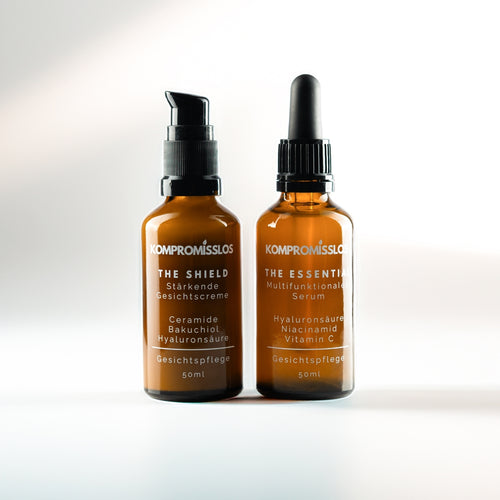
Jojoba oil is a liquid wax ester, which makes it chemically different from olive, almond or argan oil. Those consist of triglycerides – three fatty acids attached to a glycerol backbone. Jojoba oil, by contrast, is around 98 per cent waxes, mostly wax esters: in each case a long-chain fatty acid bonded to a long-chain fatty alcohol. This is shown in a review in the journal Polymers. On ingredient lists it still appears as Simmondsia Chinensis Seed Oil, because the trade name has stuck. This structure explains two properties that matter in skincare. First, the substance stays liquid at room temperature, even though it is a wax. Second, it is considerably more resistant to oxidation than polyunsaturated plant oils, so it goes rancid more slowly. For skincare, that means less of its own smell and a product that stays fresh in the jar for longer. That is exactly why jojoba oil is also part of The Duo, our serum and cream, where it forms the oil phase together with squalane.
Why is jojoba oil similar to the skin’s own sebum?
Jojoba oil resembles sebum because both contain wax esters. According to a review in the Journal of Medicinal Food, around a quarter of human sebum consists of wax esters, alongside triglycerides, free fatty acids, squalene and cholesterol. Jojoba oil supplies precisely the fraction that is structurally closest to sebum. In practice, that means it spreads thinly and evenly, absorbs quickly and leaves less shine than a pure triglyceride oil. What does not follow from this: your skin does not recognise jojoba oil as its own oil, and so it does not cut back its sebum production either. That claim appears in a great deal of product copy, but there is no evidence for it. Jojoba oil resembles sebum in its structure, not in how it is regulated. If you want less shine, you get there through cleansing and the texture of your skincare, not through an oil that supposedly regulates sebum. The distinction matters, because it determines what you can realistically expect from jojoba oil.
Is jojoba oil comedogenic?
Jojoba oil is considered to have low comedogenic potential, but the scale behind that is less useful than its reputation suggests. The familiar ratings from zero to five come from the rabbit-ear test of the 1950s to 1970s. A clinical review in JAAD Reviews notes that this model is oversensitive and cannot be reliably transferred to human skin. On top of that, individual raw materials were tested neat, not finished formulas, and the term non-comedogenic is still not regulated today. In practice, three things follow. First, the concentration in the product matters, not the ingredient as such. Second, the overall formula matters. Third, your own skin matters. If you are prone to clogged pores or blemish-prone skin, test a new product on a small area for two to four weeks rather than relying on a number from a table.
Which skin types benefit from jojoba oil on the face?
Jojoba oil is worthwhile above all for dry, sensitive and mature skin. On dry skin, it lays a thin film over the stratum corneum and slows down water loss. For sensitive skin, its advantage is that it brings hardly any fragrance compounds or reactive fatty acids with it, so it offers little that could trigger irritation. For mature skin, it makes up for the fact that sebum production declines over the years and the surface looks rougher. It makes less sense if your skin is very oily anyway: then it is not oil that is lacking but moisture, and an extra oil tends to make your complexion shinier rather than better. Nor is an oil the first step for acutely irritated or weeping skin; then the priority is calming your routine and using fewer products rather than more. If the question is more fundamental, the comparison serum or face oil will help. The table below looks at the most common starting points.
| Starting point | What jojoba oil does | Assessment |
|---|---|---|
| Dry, tight skin | Slows down water loss and smooths the surface. | Makes sense, ideally as part of a cream rather than neat. |
| Sensitive skin that is quickly irritated | Has little potential for irritation and supports the barrier. | Makes sense, provided the formula is fragrance-free. |
| Mature skin with declining sebum production | Replaces some of the missing surface lipids. | Makes sense, but is not enough as your only skincare. |
| Very oily skin | Adds extra oil to a surface that is already oil-rich. | Usually not necessary; moisture is the better lever. |
How do we use jojoba oil in The Duo?
Jojoba oil is a fixed component of The Duo, declared without a percentage of its own. There it works as part of the oil phase, which carries the active ingredients and determines the skin feel, together with squalane, ceramides and panthenol. The declared concentrations always refer to the Duo as a whole: 5 per cent niacinamide, 2 per cent hyaluronic acid, 2 per cent vitamin C as 3-O-ethyl ascorbic acid, 2 per cent gentian root extract, 2 per cent edelweiss extract, 1 per cent zinc and 0.3 per cent bakuchiol. Jojoba oil is one of the ingredients without its own percentage, because it is intended not as an active but as a base. Everything else the products contain is listed in full in the overview of ingredients. In everyday use, that means three to six drops of serum morning and evening, followed by three to six pumps of cream. As a rule, you do not need an additional face oil alongside it, because the oil phase is already part of the cream.
Not necessary if your skin gets through the day calm, supple and without any feeling of tightness on your current skincare. In that case, another oil does not solve a problem; it just adds a step.
When is skincare no longer enough, and when is a professional the better choice?
Skincare works on the surface of the skin; skin conditions belong in medical hands. Jojoba oil can make dry skin more supple and soften the look of roughness, but it is no substitute for a proper diagnosis. Areas of skin that weep, bleed or become visibly inflamed should be seen by a dermatologist. The same goes for rashes that spread within a few days, itching that disturbs your sleep, and moles that change shape, colour or size. Persistent redness that reacts to every new product is also better checked by a doctor before you try any more products. If there is a diagnosis, your skincare should follow the medical recommendation, not an ingredient list. If, on the other hand, your skin barrier is simply under strain and recovers after a few quiet weeks, that remains a cosmetic question. Skincare can accompany a treatment and make the skin more comfortable along the way. It is not where you start.
I deliberately chose jojoba oil as the base rather than coconut or argan oil. The reason is shelf life. Depending on how often you use it, a bottle lasts two to four months, and throughout that time a product should smell and feel on the last day the way it did on the first. Wax esters oxidise more slowly than polyunsaturated oils. That spares the formula additional stabilisers and spares you the slightly rancid smell that many natural skincare products develop towards the end. To be honest about it: jojoba oil is not an active ingredient. It does not make the formula more effective; it makes it wearable and stable. The real work is done by niacinamide, vitamin C and bakuchiol.
Frequently asked questions
Can I use pure jojoba oil instead of a face cream?
Pure jojoba oil does not replace a cream, because it does not supply any moisture. It only slows down the evaporation of water that is already in the skin. Without a water-based layer underneath, dry skin stays dry. A product that combines both makes more sense: humectants such as hyaluronic acid plus an oil phase that slows down moisture loss.
Does jojoba oil clog pores?
For most skin types, jojoba oil does not clog pores, but there is no guarantee. The widely quoted comedogenic ratings come from an animal model of limited value and refer to neat raw materials. What matters is the concentration in the finished formula and your own skin. If you are prone to clogged pores, test anything new on a small area for two to four weeks.
Does jojoba oil help with wrinkles?
Jojoba oil smooths the surface of the skin and can soften the look of dehydration lines for as long as it is applied. It does nothing to change the underlying skin ageing. For visible effects beyond the surface, you need active ingredients such as bakuchiol, niacinamide or vitamin C. Jojoba oil is the base of these formulas, not the active ingredient in them.
Can you use jojoba oil with retinol or bakuchiol?
Jojoba oil goes well with retinol and bakuchiol, because it keeps the skin supple and cushions the dryness that both active ingredients can cause. It can be used in the same routine, with no waiting time in between. Apply the thinner texture first and the richer one afterwards, so that the order runs from light to rich.
How long does jojoba oil keep?
Jojoba oil keeps considerably longer than most plant oils, because wax esters oxidise more slowly than polyunsaturated fatty acids. Neat and stored somewhere cool, it often stays stable for more than a year. In a finished formula, however, the date on the packaging is what counts, because water, active ingredients and preservatives also determine the shelf life.
Is jojoba oil vegan?
Jojoba oil is plant-based and therefore vegan; it is pressed from the seeds of the Simmondsia chinensis shrub. Historically, it replaced spermaceti from sperm whale oil, which has a very similar wax ester structure. Whether a finished product is vegan, however, depends on all its other ingredients, such as beeswax, lanolin or honey.
Sources
- Gad HA et al., Jojoba Oil: An Updated Comprehensive Review on Chemistry, Pharmaceutical Uses, and Toxicity, Polymers, 2021. Source
- Chakrabarty S et al., Bioactivities of Jojoba Oil Beyond Skincare, Journal of Medicinal Food, 2024. Source
- Comedogenicity in cosmeceuticals: A review of clinical relevance, regulatory gaps, and future directions, JAAD Reviews, 2025. Source