Argan oil for your face: nourishing or overrated?
ACTIVE INGREDIENTS
Argan oil for your face is a solid nourishing oil, but it is not an anti-ageing active. It supplies fatty acids and vitamin E, settles on the skin’s surface and slows water loss, which makes dry and mature skin feel softer and more supple. It does not hydrate the skin by itself, and the well-known studies were carried out on the forearm, not the face. If you like it, it is an optional last step in the evening, not a must-have.
Is argan oil good for your face?
Yes, argan oil is a well-tolerated nourishing oil for many faces, as long as you know what it can and cannot do. It is one of the emollients: lipids that fill the gaps in the outermost layer of the skin, smooth the surface and let less water escape. On dry skin, this feels softer straight away. What an oil cannot do is bring water into the skin. That is the job of humectants such as glycerin or hyaluronic acid, and they are found in serum and cream, not in a pure oil. If your skin feels tight because it lacks moisture, argan oil on its own therefore only solves half the problem. How lipids and moisture work together is explained in the article on the damaged skin barrier and what it really needs.
Marketing likes to sell argan oil as “liquid gold” or “the best anti-ageing oil”. There is no study evidence for these superlatives, but there is evidence for a decent nourishing effect. The fair verdict lies somewhere in between: nourishing, yes, but also overrated as soon as you expect more than suppleness.
What is in argan oil, and what does it do on your skin?
Argan oil consists largely of unsaturated fatty acids, mainly oleic acid and linoleic acid, and contains a comparatively high amount of vitamin E. A 2025 review in the journal Antioxidants gives 45.90 per cent oleic acid and 34.10 per cent linoleic acid, plus palmitic acid at 11.80 per cent and stearic acid at 6.00 per cent as the main saturated fatty acids. These values vary with origin, harvest and pressing method, so treat them as a guide rather than a fixed standard. Oleic acid tends to make an oil rich and supple, while linoleic acid is a fatty acid that also occurs in the skin’s own lipids. With this mix, argan oil sits between very rich and very light oils, and that is usually exactly how it feels: medium-weight, with a light film that largely sinks in after a few minutes.
Then there are the accompanying compounds. According to the same review, argan oil contains roughly twice as much tocopherol as olive oil, mostly in the form of gamma-tocopherol. Tocopherols are fat-soluble antioxidants. In the oil itself, they slow down rancidity; on the skin, they can protect lipids from oxidation. Whether this leads to a visible effect on the face has not been studied for argan oil. You can read more about the active ingredient in the article on what vitamin E does for your skin. You will often come across claims such as “regulates sebum” or “calms inflammation” for argan oil. For cosmetic use on the face, there is no evidence for them.
What do studies on argan oil and skin really show?
The studies show that argan oil reduces water loss from the skin and improves measured elasticity, but only on the forearm and in small groups. The most frequently cited papers come from the same research group led by Boucetta. A 2014 study in the journal Przegląd Menopauzalny included 60 postmenopausal women. Half of them consumed argan oil as a dietary oil, the other half olive oil. In addition, both groups applied around 10 drops of cosmetic argan oil to the inside of their left forearm every evening for two months, with the right forearm left untreated for comparison. On the treated arm, transepidermal water loss fell significantly and the water content of the epidermis rose. A second paper from the same group with the same design, published in 2015 in Clinical Interventions in Aging, found significantly higher skin elasticity on the treated forearm.
These are genuine measurements, but with clear limits. Measurements were taken on the forearm, not the face. The comparison was with untreated skin, not with another oil or a cream. So the studies say nothing about whether argan oil nourishes better than any other nourishing oil. The authors themselves name the short duration of just two months and the lack of any check on whether participants actually applied the oil regularly as weaknesses. Wrinkles were not measured. Put honestly, argan oil does what a good nourishing oil does. Nothing more has been shown so far.
Does argan oil help with wrinkles, or is that just marketing?
Argan oil smooths the skin’s surface in the short term, but there is no evidence that it works against wrinkles on the face. The effect many people see after applying it is an optical one: the lipid film fills in fine dryness lines and makes the skin look plumper and more even. That is pleasant and entirely real, but it only lasts as long as the oil stays on the skin. Elasticity measured on the forearm is a different value from the depth of a wrinkle on the face, and turning that into “anti-ageing” is a big leap. Deeper wrinkles are caused by changes in the dermis, by facial expressions and by UV light over many years. An oil on the surface does little to change that.
If visible skin ageing matters to you, daily sun protection does more than any nourishing oil. Argan oil can still have its place in such a routine, namely as a comfort step for dry, mature skin. The fact that both studies were carried out on postmenopausal women fits this picture: during this phase, skin often becomes drier, and an oil that slows water loss is then an understandable addition. That still does not make it a wrinkle treatment.
Which skin types does argan oil suit – and which does it not?
Argan oil suits dry and mature skin best, while it rarely adds anything for oily or blemish-prone skin. What matters is less the oil itself than whether your skin is still short of lipids after serum and cream. The table shows how you can assess this depending on your skin’s condition.
| Skin condition | Does argan oil suit it? | What to look out for |
|---|---|---|
| Dry | Well suited, as the last step in the evening | The oil does not replace moisture; serum and cream remain the basis |
| Mature | Suitable, especially in winter | Not a wrinkle treatment; during the day, sun protection matters more |
| Normal | Possible, but usually not necessary | If your cream is enough, the oil adds little |
| Combination | Only on dry areas | Leave out a shiny T-zone |
| Blemish-prone | Use with caution | Test on a small area first and watch for two to three weeks |
| Sensitive | Possible, but patch-test first | Choose a pure oil without fragrance or essential oils; contact allergies have been described |
When it comes to blemishes, blanket labels do not help. Whether an oil encourages blackheads on your skin depends on the amount, the formula and your skin, not on a number on a list. Why such lists are of little use is explained in the article on what comedogenic means and which oils really are a problem. Acne, rosacea or eczema should be seen by a dermatologist; a nourishing oil is not the answer.
If argan oil feels too heavy for you, lighter lipids are an option – read about squalane benefits and which skin it suits. And if you are torn between jojoba oil and argan oil for your face: jojoba oil is chemically a liquid wax and behaves differently on the skin. What that means is covered in the article on jojoba oil for your face.
How do you apply argan oil to your face, and when is it better to skip it?
Argan oil goes on in the evening as the last step, and two to three drops are enough for the whole face. More oil does not mean more nourishment – mostly just more of it on your pillow. Here is how to go about it:
- Cleanse your face, then apply serum and cream as usual.
- Warm two to three drops of argan oil between your palms.
- Gently press the oil onto your cheeks, forehead and dry patches rather than rubbing it in, and leave out shiny areas.
- Preferably skip it in the morning if sunscreen or make-up follows. A film of oil can stop both from adhering properly.
- Before using it on your face for the first time, test it on a small area for a few days, for example on the inside of your forearm.
You can leave the oil out if your cream is enough on its own, if blemishes become more frequent after you start using it, or if your skin burns, itches or turns red. In summer, dry skin often needs less anyway. Why the order is serum, cream, oil, and when a face oil makes sense at all, is covered in the article on serum or face oil and what your skin actually needs.
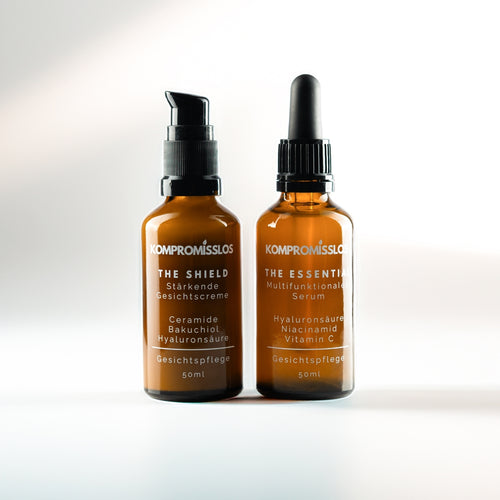
For many people, a cream with well-tolerated lipids is enough. In The Duo of serum and face cream, The Essential provides moisture with hyaluronic acid in three molecular sizes, while The Shield provides the lipids with ceramide NP, squalane and jojoba oil. Argan oil is not included. If you have very dry skin, you can still add a few drops as an optional last step. In her review on Judge.me, Daniela B. writes: “As I have rather dry, mature skin, I would prefer the face cream to be a little richer, so I supplement it with a face oil from another brand” (review translated from German). This is exactly the case where an oil makes a sensible addition.
If your argan oil smells sharp, like old nuts or like paint, it has oxidised and no longer belongs on your face. Stored somewhere cool and dark with the lid tightly closed, it stays fresh for longer.
At Kompromisslos, I deliberately did not plan a face oil as a compulsory step. Two products instead of eight means that the lipids an oil would supply are already in The Shield: jojoba oil, squalane and ceramide NP. Underneath, The Essential takes care of moisture. Argan oil is not in our INCI list. That does not mean it is a bad oil. But an oil does not hydrate, and an extra bottle does not automatically make a routine better. Both products are fragrance-free and contain no essential oils. If your skin still asks for more in winter, a few drops of oil in the evening are a legitimate addition. What neither cream nor oil can replace is getting a skin condition checked by a professional. Everything that goes into our products is in our full list of ingredients.
Frequently asked questions
Does argan oil clog pores?
There is no blanket answer. Online lists often rate argan oil as unlikely to clog pores, but these ratings are unreliable and do not apply to every skin. If you are prone to blemishes, apply it to just one small area for two to three weeks and watch whether more blackheads appear there than usual.
Can I leave argan oil on my face overnight?
Yes, the evening is actually the most sensible time. Overnight, the film of oil interferes with neither sunscreen nor make-up and can stay on the skin undisturbed. Two to three drops over your cream are enough. If your skin burns, itches or is red in the morning, stop using the oil.
Is cosmetic argan oil the same as culinary argan oil?
No. Culinary argan oil is made from roasted kernels and has a distinctly nutty smell and taste. Cosmetic argan oil is pressed without roasting and is intended for skin and hair. For your face, use the cosmetic, unroasted oil, ideally cold-pressed and without added fragrance.
Can I be allergic to argan oil?
Yes, that is possible. Cases of allergic contact dermatitis caused by argan oil have been described in the journal Contact Dermatitis. So test a new oil on a small patch of skin for a few days before putting it on your face. If you notice redness, itching or swelling, stop using it and have the reaction checked by a professional.
Does argan oil go on before or after moisturiser?
After your cream, as the last step. Water-based products such as serum and cream absorb better when there is no film of oil underneath. The oil on top keeps the skincare underneath on the skin and slows water loss. In the morning, sunscreen is the only thing that should go on after it, and less oil is usually better then.
How long does argan oil keep once opened?
That depends on quality and storage; there is no fixed figure. Go by the PAO symbol with the open jar on the bottle, store the oil somewhere cool and dark, and buy small bottles rather than large ones. If it smells sharp or rancid, it has oxidised and no longer belongs on your skin.
Do I need argan oil if I use The Duo?
No, it is not necessary. The Shield already provides lipids with jojoba oil, squalane and ceramide NP, while The Essential takes care of moisture. If your skin is very dry, you can apply two to three drops of argan oil in the evening as the last step over The Duo. It is an optional extra to go by feel, not a requirement.
Sources
- Boucetta KQ, Charrouf Z, Derouiche A, Rahali Y, Bensouda Y. Skin hydration in postmenopausal women: argan oil benefit with oral and/or topical use. Przegląd Menopauzalny, 2014. Source
- Boucetta KQ, Charrouf Z, Aguenaou H, Derouiche A, Bensouda Y. The effect of dietary and/or cosmetic argan oil on postmenopausal skin elasticity. Clinical Interventions in Aging, 2015. Source
- Rabbaa S, Bouchab H, Laaziouez Y, Limami Y, Nasser B, Andreoletti P et al. Argan Oil: A Natural Bioactive Lipid Modulating Oxidative Stress and Inflammation. Antioxidants, 2025. Source
- Foti C, Romita P, Ranieri LD, Bonamonte D. Allergic contact dermatitis caused by argan oil. Contact Dermatitis, 2014. Source