Vitamin E for skin: what it does, how to use it and who it’s worth it for
SINGLE INGREDIENT
Vitamin E is a fat-soluble antioxidant that, in skincare, mainly protects lipids: the fats in the skin barrier and the oils in the formulation itself. On the INCI list, it usually appears as tocopherol. It makes sense as an integral part of well-balanced skincare, not as a separate extra product on top.
What does vitamin E really do in skincare?
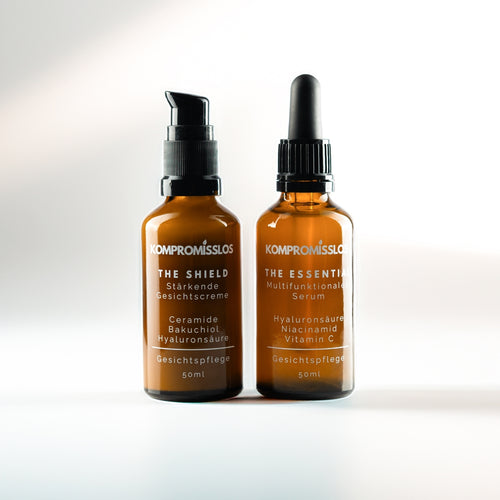
In the skin, vitamin E works as a free-radical scavenger in the fatty component, where it has two jobs. Water-soluble antioxidants barely reach the lipids between the cells of the outer skin layer, whereas vitamin E dissolves precisely there and slows down the chain reaction by which fats oxidise. It is exactly these fats that keep the barrier intact. Your skin supplies itself with it: according to a study in the Journal of Investigative Dermatology, vitamin E reaches the surface via sebum, and in the uppermost layer of the skin the alpha-tocopherol content on the cheek was around twenty times higher than on the upper arm. Where little sebum is produced, correspondingly little of the skin’s own vitamin E arrives. Vitamin E performs its second job before you even apply it: in the jar, it protects a formulation’s plant oils from going rancid, keeping the texture and scent stable. In The Duo of serum and cream, it does both jobs at once, without needing a percentage of its own.
Being honest also means looking at the evidence. A review in the Indian Dermatology Online Journal notes that there is a lack of controlled clinical studies from which clear dosages for vitamin E could be derived. The ingredient is well researched as a molecule and poorly researched as a formulation recommendation.
How can you spot vitamin E on the INCI list?
Vitamin E appears on the INCI list under several names, and the form tells you more than the position. Tocopherol is the free form, which works directly. Tocopheryl acetate is a stabilised ester form that lasts longer in the formulation but first has to be split in the skin. There is also a source without an entry of its own: many plant oils naturally contain vitamin E. If sunflower or wheat germ oil is high up the list, there is vitamin E in the product, even if tocopherol is right at the end or not listed at all. Conversely, an entry at the very end of the list doesn’t automatically mean there is too little: vitamin E is used in small amounts because that is enough to stabilise the oils. You will find the full list for both our products on the Ingredients page.
| Entry on the INCI list | What it is | What it tells you |
|---|---|---|
| Tocopherol | The free form, usually a mixture of several tocopherols. | Works directly, but is sensitive to light and heat. |
| Tocopheryl Acetate | A storage-stable ester form bound to acetic acid. | Stays intact in the tube for longer, but must first be converted in the skin. |
| Tocopheryl Linoleate | Vitamin E coupled to a fatty acid. | Found mainly in rich, oily textures. |
| Plant oils such as Helianthus Annuus Seed Oil | Oils that naturally contain vitamin E. | Provide vitamin E without tocopherol having to be listed separately. |
Can I use vitamin E on sensitive skin?
Yes, vitamin E is one of the calm active ingredients and is generally unproblematic for sensitive skin. It has no acidic pH, it doesn’t speed up cell renewal, and it doesn’t cause stinging or tingling as acids or retinoids do. Nor does it need an adjustment period or a gradually increased dose. That is exactly why it appears so often in formulations intended for irritated, dry or reactive skin. If your skin barrier is weakened, you are more likely to benefit from the surrounding lipids than from vitamin E alone: it protects lipids, but it isn’t a building block that replaces missing ones. That role belongs to ceramides and squalane, both of which are in the Duo. One point still remains open, and most guides skip it: even a gentle active ingredient can trigger a contact allergy. How often that happens is covered in the next section.
What happens if your skin doesn’t tolerate vitamin E?
An intolerance to vitamin E almost always shows up as contact dermatitis: red, itchy, sometimes flaky patches exactly where the product was applied, often with a delay of one to three days. It is not common. In the largest analysis to date by the North American Contact Dermatitis Group, 38 699 people were patch-tested for tocopherol, and 349 of them reacted positively – that is 0.9 per cent. The most common source was personal care products, above all moisturisers. The other side of the same figure is worth noting: 99.1 per cent did not react. So if your skin reacts to a product, vitamin E is rarely the trigger – but it does happen. In that case, stop using the product rather than carrying on, and don’t change three other things at the same time, or you won’t know in the end what the trigger was. Ultimately, only a patch test at a dermatology practice gives you certainty.
Don’t confuse a contact allergy with an adjustment phase. Slight tightness in the first few days usually settles by itself. A rash that gets worse with every application does not.
How often should you apply vitamin E?
Twice a day is the sensible framework, morning and evening, as part of your normal skincare rather than as a separate step. Vitamin E is not an active ingredient you ramp up in courses or pause: it is used up continuously, partly through UV exposure, and so works best when it is constantly present. In most cases, an extra oil on top achieves nothing except more shine and a heavier texture. With the Duo, that means 3 to 6 drops of serum, followed by 3 to 6 pumps of cream, morning and evening. Things get interesting in combination: vitamin C and vitamin E complement each other chemically, because vitamin C returns oxidised vitamin E to its active form. Applying both together in the morning therefore makes more sense than spreading them across two times of day. Which other active ingredients go with it is covered in our article on combining vitamin E.
One caveat belongs here: the well-known figures on enhanced sun protection come from formulas with 15 per cent L-ascorbic acid and 1 per cent alpha-tocopherol – a different formulation from ours. The Duo contains 2 per cent vitamin C as 3-O-ethyl ascorbic acid, based on both products together. These figures can’t be transferred, and vitamin E does not replace sun protection. What the combination looks like in practice is explained in using vitamin C and vitamin E together.
When don’t you need extra vitamin E?
You don’t need extra vitamin E if your skincare already contains plant oils or tocopherol, which is true of most creams. A separate vitamin E oil alongside it then improves nothing; it just makes your routine longer and the texture heavier. For oily skin, too, there is little need for more, because your own sebum brings vitamin E to the surface anyway. And there is a clear line: vitamin E is a cosmetic ingredient. Persistent eczema, weeping or bleeding patches, moles that suddenly change, or redness that lasts for weeks despite gentle skincare belong with a dermatologist, not in a skincare routine. The same applies to anything to do with supplements, capsules or a suspected deficiency: that is a medical question, not a cosmetic one. How the two products work together day to day is shown on the How to use page.
I put vitamin E into the Duo without printing a percentage on it, and that was a deliberate decision. In our products, vitamin E works within the oil system: it keeps the plant oils stable and complements the antioxidants that are already there. A big number on the packaging would have looked good and meant little. Where the dose really matters, I state it: 5 per cent niacinamide, 2 per cent 3-O-ethyl ascorbic acid, 0.3 per cent bakuchiol, each based on the serum and cream together. For vitamin E, a figure like that would have been cosmetics for the sake of cosmetics.
Frequently asked questions
Is vitamin E in skincare the same as a vitamin E capsule?
No. In skincare, vitamin E works locally on the skin and in the formulation, whereas a capsule is swallowed and distributed throughout the body. These are two different uses with different rules. For questions about supplements, dosage or a suspected deficiency, ask a doctor or pharmacist, not a skincare brand.
How often can I use vitamin E?
Twice a day, morning and evening, as part of your normal skincare. Vitamin E doesn’t need breaks or courses, because it is used up continuously. With the Duo, that means 3 to 6 drops of serum followed by 3 to 6 pumps of cream. An extra vitamin E oil on top isn’t necessary.
Does vitamin E clog pores?
Vitamin E itself is considered to have little pore-clogging potential; the carrier oil is what matters. A light texture with squalane behaves differently from a heavy oil with a high oleic acid content. If you get more blemishes after switching products, the base is more often to blame than the vitamin E in it.
Does vitamin E replace sun protection?
No. Vitamin E is an antioxidant, not a UV filter. It scavenges free radicals in the fatty component of the skin, but it doesn’t block UV radiation and has no sun protection factor. A sunscreen remains your actual protection; antioxidants in skincare are an addition, not a substitute.
How can I tell if I don’t tolerate vitamin E?
By red, itchy or flaky patches exactly where you applied the product, often only after one to three days. Stop using the product and see whether it settles. If the rash persists or gets worse, a patch test at a dermatology practice will show which substance is really the trigger.
Do I need a separate vitamin E oil as well as my cream?
In most cases, no. If your cream contains tocopherol or plant oils, vitamin E is already there. A separate oil on top makes your routine longer and the texture heavier, and the difference is rarely visible. Well-formulated skincare makes more sense than another product on the shelf.
Does vitamin E help with scars?
Vitamin E is a cosmetic ingredient, not a scar treatment. The idea that a vitamin E oil makes scars disappear is persistent, but it isn’t backed by clear evidence. For fresh, noticeable or bothersome scars, seeing a dermatologist makes more sense than a cosmetic product.
Sources
- Thiele JJ, Weber SU, Packer L. Sebaceous gland secretion is a major physiologic route of vitamin E delivery to skin. Journal of Investigative Dermatology, 1999. Source
- Keen MA, Hassan I. Vitamin E in dermatology. Indian Dermatology Online Journal, 2016. Source
- Warshaw EM et al. Patch Testing with Tocopherol and Tocopherol Acetate: The North American Contact Dermatitis Group Experience, 2001 to 2016. Dermatitis, 2021. Source