What to mix with vitamin E: which ingredients suit it and which need a gap
INGREDIENT COMBINATION
What can you mix with vitamin E? Vitamin C, niacinamide, hyaluronic acid, ceramides and squalane all work with it without restriction. These ingredients do not interfere with each other, because they work in different layers of the skin. You only need to leave a gap with strong acids and high-strength retinol, and even then the reason is your skin’s tolerance threshold, not vitamin E itself.
Which active ingredients go with vitamin E?
Practically all common skincare ingredients go with vitamin E, because vitamin E is fat-soluble and so works in a different zone from most active ingredients. Vitamin C, niacinamide and hyaluronic acid are water-soluble and sit in the watery phase of a formula. Vitamin E, ceramides and squalane are fat-soluble and settle into the lipid layer of the uppermost layers of the skin. Two ingredients that hardly meet in space can hardly neutralise each other either. That is exactly why tocopherol appears in so many formulas without needing a list of incompatibilities. The classic warnings you find online concern other ingredient pairings, not vitamin E. The basic rules for combining active ingredients still apply, though: what matters is not the ingredient list but how much irritation your skin has to deal with in a day overall. If you layer three active products on top of each other, you don’t have a vitamin E problem; you have a quantity problem.
Can you use hyaluronic acid and vitamin E together?
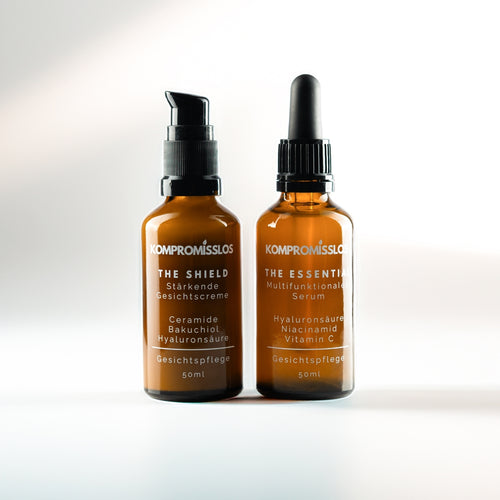
Yes, hyaluronic acid and vitamin E can be used together without restriction, and the combination makes more sense than either ingredient on its own. Hyaluronic acid binds water in the upper layers of the skin but has no way of holding on to that water itself. That job is done by fat-soluble ingredients such as vitamin E, squalane or ceramides, which form a final layer and slow down evaporation. In practice, this means hyaluronic acid goes first, on skin that is still slightly damp, followed by the product containing the lipids. Applied the other way round, the hyaluronic acid gets through less well and some of its effect is lost. You don’t need to wait between the two steps. In the Duo, this order is built in, because the 2% hyaluronic acid works in the watery step and the finishing texture comes afterwards. You will find the routine in detail in our step-by-step guide to using the products.
Vitamin C and vitamin E support each other
Vitamin C and vitamin E are the best-studied antioxidant pair in skincare, because chemically they complement rather than compete with each other. According to a review in the journal Nutrients, the two vitamins work in different parts of the cell and regenerate each other as they interact: vitamin E in the lipid fraction, vitamin C in the water-soluble part. For your routine, this does not mean any complicated calculations, just a simple consequence. A product that contains both makes use of this effect anyway, without you having to do anything. Two separate products work just as well, as long as they end up in the same routine. An honest assessment has to add that most of these data come from studies with pure ascorbic acid, not with every vitamin C derivative. How the two behave in detail is covered in our article on combining vitamin C and vitamin E.
Which combinations with vitamin E need a gap?
With vitamin E, you only need a gap in two cases, and both have to do with your skin’s tolerance threshold rather than with chemistry. First, high-strength retinol: not because vitamin E destroys anything in it, but because skin that is already reacting to retinol experiences every additional layer as a strain. Second, exfoliating acids such as AHAs or BHAs, for the same reason: afterwards, the skin is temporarily more permeable and reacts more sensitively to everything that follows. In both cases, the solution is to separate them in time rather than go without: acid or retinol in one routine, the product containing vitamin E in the other. A third special case is pure, highly concentrated vitamin E oil, because contact reactions to it are described in a dermatological review. At the proportions usual in cosmetics, within a finished formula, this is not an issue. How to assess retinol more generally is covered in our article on retinol and suitable partner ingredients.
| Combination | Can be used together | What to watch |
|---|---|---|
| Vitamin E + vitamin C | Yes | The classic antioxidant pair, most useful in the morning. |
| Vitamin E + niacinamide | Yes | No known incompatibility; both are widely tolerated. |
| Vitamin E + hyaluronic acid | Yes | Hyaluronic acid first, vitamin E afterwards as the final layer. |
| Vitamin E + ceramides | Yes | Both sit in the lipid layer and complement each other there. |
| Vitamin E + squalane | Yes | Squalane spreads fat-soluble ingredients more evenly. |
| Vitamin E + bakuchiol | Yes | Both are considered gentle; no need to separate them. |
| Vitamin E + retinol | With care | Irritation comes from the retinol, not from the combination. |
| Vitamin E + AHA or BHA | At different times | Acid in one routine, vitamin E in the other. |
There is a separate article on the fourth row if you want to go into more depth: how ceramides and vitamin E work together.
In what order should you apply vitamin E?
Vitamin E belongs in the second half of your routine, after the watery products and in the finishing cream. The reason is texture: fat-soluble ingredients form a layer that seals in everything underneath, and whatever is applied on top of this layer gets through less well. In practice, a clean routine looks like this. First: cleanse your face and leave your skin slightly damp. Second: apply the watery serum with hyaluronic acid, niacinamide or vitamin C – with ours, 3 to 6 drops. Third: the cream with the fat-soluble components, which include vitamin E, using 3 to 6 pumps. Fourth, in the morning: sun protection as the final layer. This routine needs no more products, and more layers do not make it better. You can see what role each active ingredient plays in our products in the full overview of active ingredients or directly on the page for The Duo of serum and cream.
When vitamin E achieves little and when a professional is the better choice
Buying extra vitamin E does little for you if your skincare already contains it, and that is the case with most creams. Tocopherol appears on the ingredient lists of countless formulas, sometimes as an active ingredient and sometimes to protect the oils in the product from oxidation. An additional vitamin E oil on top therefore rarely solves a problem and mainly adds to the number of steps. Paying particular attention to vitamin E is more worthwhile if your skin feels tight, looks rough or reacts sensitively to cold and dry central-heating air. Skincare is the wrong route, however, for weeping patches, persistent inflammation, heavy flaking or sudden changes in the skin. These need to be checked by a dermatologist, because cosmetics can neither assess nor treat such conditions. If you are looking for a pared-back routine instead, you will find it in our set of two products.
I deliberately left vitamin E in the Duo without a percentage, and that is a decision, not a gap. In our products, vitamin E is part of the antioxidant system built around the 2% vitamin C as 3-O-ethyl ascorbic acid, not the star of the label. As soon as I put a number on it, I suggest that more of it would be better. With vitamin E, that is not true: whether the molecule stays stable depends on the formula and the packaging, not on the percentage. I give figures where they say something, and I would rather honestly leave the rest unquantified than pretend to a precision that does not exist.
Frequently asked questions
Is tocopherol the same as vitamin E?
Tocopherol is the name for vitamin E on the ingredient list and describes the directly active form. You will also often find tocopheryl acetate, a more stable ester form that the skin first has to convert. Both count as vitamin E but differ in stability and speed. Both often appear far down the list, because the proportions are small.
Can you use vitamin E morning and evening?
Yes, vitamin E is equally suitable for morning and evening and does not make your skin sensitive to light. In the morning, it makes particular sense together with vitamin C, because both work as antioxidants. In the evening, the fat-soluble component mainly supports texture and skin feel. There is no restriction on timing as there is with retinol.
Does vitamin E clog pores?
At the concentrations usual in finished creams and serums, vitamin E is considered unproblematic for pores. Pure vitamin E oils applied neat and thickly are more of a concern, especially on skin prone to blemishes. If your skin reacts to rich textures, the cause is usually the carrier oil, not the tocopherol.
Do you need a separate vitamin E oil?
No, a separate vitamin E oil is unnecessary for most routines. Tocopherol is already in almost every cream, sometimes as an active ingredient and sometimes to protect the oils it contains from oxidation. An additional product mainly increases the number of steps. A product in which vitamin E is properly built in from the start makes more sense.
Can vitamin E irritate the skin?
Yes, that is possible, but it mainly concerns highly concentrated or neat use. Contact reactions to pure vitamin E are described in the dermatological literature. At the proportions usual in cosmetics, within a finished formula, vitamin E is considered well tolerated. If you know your skin is sensitive, it is worth doing a test in the crook of your arm.
How do you recognise vitamin E on the ingredient list?
Look for tocopherol, tocopheryl acetate or the collective term tocopherols. If the entry is right at the end of the list, vitamin E is usually there to protect the oils in the product. Further up suggests it has been chosen deliberately as an active ingredient. The position alone, however, says nothing about how well the formula is put together overall.