Ceramides and vitamin E: do they work together?
INGREDIENT COMBINATION
You can combine ceramides and vitamin E without any restrictions. Both sit in the oil phase of a skincare product, don’t attack each other chemically and work in different places. Ceramides replenish the lipid layer of the skin barrier; vitamin E protects exactly these lipids from oxidation. You need neither an extra product nor to space them out over the day.
Can you use ceramides and vitamin E together?
Yes – in the same layer, at the same time of day, with no waiting time in between. Unlike combinations with strongly acidic or strongly alkaline active ingredients, there is no pH conflict here that you would need to work around. Ceramides are skin-identical lipids; vitamin E is a fat-soluble antioxidant. Both dissolve in the same oil phase of a formulation, and that is exactly where they end up on your skin, too. The question of whether you need to keep them apart usually stems from a misunderstanding: active ingredients only compete if they chemically alter each other or vie for the same route of absorption. That isn’t the case here. In practice, you will rarely find the two apart anyway, because in formulas containing oils, vitamin E also protects the formulation itself from oxidation. With The Duo, we deliberately solved this in one matched formulation rather than in two separate steps.
What ceramides actually do in your skin barrier
By quantity, ceramides are the largest component of the lipids between your uppermost skin cells. According to a review in the Journal of Lipid Research, the lipids of the stratum corneum, the skin’s outermost layer, consist of around 50% ceramides, plus about 25% cholesterol and 15% free fatty acids. This mixture forms the layers that keep water in the skin and irritants out. If the proportion of ceramides falls – through cold, frequent washing with harsh surfactant cleansers, or with age – this orderly structure develops gaps and the barrier becomes more permeable. You notice it as tightness, roughness or skin that suddenly reacts to products it has tolerated for years. Ceramides applied to the skin replenish this lipid layer from the outside and visibly support it. They don’t replace the body’s own production; they back it up. Which lipids our formula includes is openly listed in the complete overview of active ingredients.
What vitamin E does for the skin, and where its limits lie
Vitamin E, usually listed as Tocopherol in the INCI list, is the most important fat-soluble antioxidant in your stratum corneum. It sits exactly where the ceramides sit: in the lipid phase. Its job is to protect lipids from oxidation – the chain reaction that breaks down unsaturated lipids under UV light, ozone and environmental stress. A review in Molecular Aspects of Medicine describes how the alpha-tocopherol content of the stratum corneum drops even with UV doses that don’t yet cause visible redness. That makes vitamin E a useful companion, but not a sunscreen. It doesn’t filter UV radiation and is no substitute for SPF. For wrinkles, scars or dark spots, too, the evidence is considerably weaker than the marketing of pure vitamin E oil would suggest. If you want to know more about antioxidant active ingredients, you’ll find a comparison in our article on vitamin C or niacinamide.
Why ceramides and vitamin E complement each other
The combination is more than peaceful coexistence, because both active ingredients work on the same structure but take on different jobs. Ceramides supply building material for the lipid layer. Vitamin E protects this building material from being broken down by oxidation before it can do its job. It is the same logic by which vitamin E stops the oils in a formula from going rancid – only on the skin. For you, this means you don’t have to choose between building and protecting, because in the Duo’s serum and cream both jobs are already shared out. The combination is particularly useful if your skin is dry, quickly feels tight or reacts sensitively to cold and central heating. It is less useful if your skin is stable and you are getting on well as it is. In that case, a second source of ceramides is no gain – just another product in the bathroom that costs money and makes no visible difference.
| Aspect | Ceramides | Vitamin E (tocopherol) |
|---|---|---|
| Function in the skin | Building block of the lipid layer | Fat-soluble antioxidant |
| Share of stratum corneum lipids | around 50% | Trace amount, but the leading antioxidant |
| Solubility | Oil phase | Oil phase |
| Conflict with the other | None known | None known |
| Useful for | Dryness, tightness | Environmental stress, formulas containing oils |
| No substitute for | SPF | SPF |
How to combine ceramides and vitamin E in your routine
The simplest way is to have both in the same two products you already use. The order follows consistency: first the lighter serum, then the richer cream, which holds the lipids on the skin. Morning and evening, 3 to 6 drops of serum each time, followed by 3 to 6 pumps of cream, applied to slightly damp skin. You don’t need to wait between steps; a few seconds to let each one sink in is quite enough. If your skin is currently irritated, start with the evening application and add the morning after a few days, once the tightness has settled. In the morning, a sunscreen goes on top, which neither ceramides nor vitamin E can replace. You’ll find out what that looks like in practice in the step-by-step guide to using the products. If you would like to know which plant extracts our formula also contains, read our overview of gentian root extract and what it does.
When a professional is the better person to ask
Skincare cares, dermatology treats. That line matters more than it sounds. If your skin weeps, bleeds, flakes over large areas, itches badly or a condition gets worse over weeks, it needs a medical assessment, not a new skincare routine. The same applies to changes in moles and to skin conditions that weigh heavily on you emotionally. With vitamin E, too, a realistic view is worthwhile: in an analysis by the North American Contact Dermatitis Group, around 0.9% of roughly 38,700 people tested reacted positively to tocopherol in a patch test. That is rare, but not zero. If you know you react to tocopherol, avoid it consistently, including in combination products. If a reaction is unclear, a patch test with a dermatologist is the reliable way to find out. You can read how others experienced the switch in the reviews from customers in Switzerland.
With the Duo, I deliberately chose not to split ceramides and vitamin E across two separate steps. It would have sold: more products, more revenue per customer. But it wouldn’t have made any sense from a skincare point of view, because both belong in the same oil phase anyway. What mattered more to me was that you have two products you stick with every day, rather than five that sit in the cupboard after three weeks. Two products, transparent concentrations, no acrobatics over the order. That is the decision behind it, and it deliberately costs us revenue that I don’t want to win back with a third product.
Frequently asked questions
Do I need to wait between applying ceramides and vitamin E?
No, there is no need to wait. Both active ingredients are fat-soluble and don’t interfere with each other, either chemically or in how they are absorbed. You can apply them in the same product or one straight after the other. The only sensible rule is to go by consistency: first the lighter serum, then the richer cream.
Can I use ceramides and vitamin E morning and evening?
Yes, both are suitable for morning and evening. Vitamin E doesn’t make the skin more sensitive to light, and ceramides work regardless of the time of day. In the morning, a sunscreen goes on top as well. If your skin is currently irritated, you can start with the evening application and add the morning after a few days.
Is the vitamin E in skincare a form of sun protection?
No. Vitamin E is an antioxidant and doesn’t filter UV radiation. It can buffer oxidative processes in the lipid layer, but it is no substitute for SPF. So a product containing tocopherol doesn’t replace sunscreen. If you are outdoors during the day, a separate sunscreen belongs on top of your skincare as the final step.
What concentration of vitamin E makes sense?
There is no generally accepted target value. In cosmetic formulas, vitamin E works even in small amounts and often also protects the oils they contain from oxidation. What matters is less the figure than the formula as a whole and which oils need protecting. For the Duo, we list vitamin E without a percentage.
Do I need ceramides if my skin isn’t dry?
Not necessarily. If your skin is stable, doesn’t feel tight and gets on well with what you use, an additional source of ceramides does little. It becomes useful when dryness, roughness or sensitivity come into play – in winter, for example, after frequent washing or with age.
Can vitamin E cause skin reactions?
Rarely, but it does happen. In a large analysis of patch tests, around 0.9% of those tested reacted positively to tocopherol. If you have a known sensitivity, avoid it consistently. If a reaction is unclear, a patch test with a dermatologist will reliably establish the cause.
Does the Duo contain both ceramides and vitamin E?
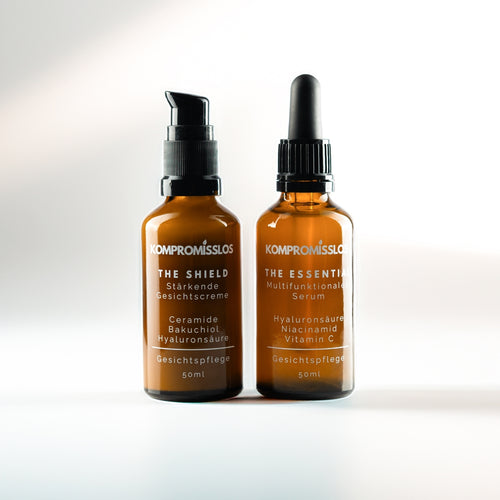
Yes, both are ingredients of The Duo, made up of The Essential serum and The Shield cream. Both are listed without a percentage, whereas we state specific figures for niacinamide, hyaluronic acid, vitamin C, zinc, bakuchiol, edelweiss and gentian root. All figures apply to the Duo as a whole, not to a single product.
Sources
- Feingold KR, Thematic review series: Skin Lipids. The role of epidermal lipids in cutaneous permeability barrier homeostasis, Journal of Lipid Research, 2007. Source
- Thiele JJ, Ekanayake-Mudiyanselage S, Vitamin E in human skin: Organ-specific physiology and considerations for its use in dermatology, Molecular Aspects of Medicine, 2007. Source
- Warshaw EM et al., Patch Testing With Tocopherol and Tocopherol Acetate: The North American Contact Dermatitis Group Experience, 2001 to 2016, Dermatitis, 2021. Source