Combining vitamin C and vitamin E: what the pairing does and doesn’t do
INGREDIENT COMBINATION
Combining vitamin C and vitamin E works well and is one of the most sensible pairings in skincare. Vitamin C is water-soluble and protects the watery parts of the skin; vitamin E is fat-soluble and protects the cell membranes. Together they cover both areas and stabilise each other.
Can you safely use vitamin C and vitamin E together?
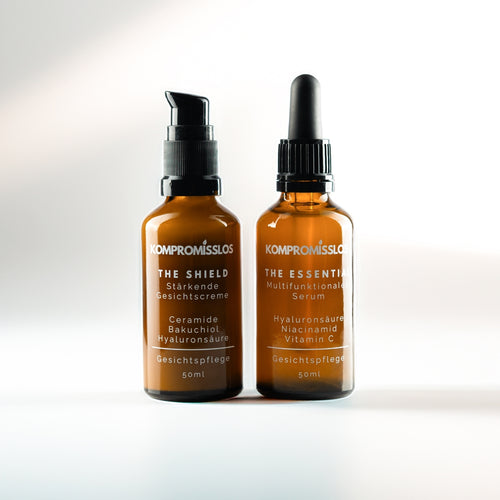
Yes – and unlike some other pairings of active ingredients, there isn’t even a serious dissenting voice here. The reason lies in solubility: vitamin C is water-soluble and therefore active where there is tissue fluid, while vitamin E is fat-soluble and settles into the lipid layers of the skin. So the two don’t compete for the same space; they occupy two different zones of the skin. That is exactly why you find the combination in so many antioxidant formulations, often alongside other plant compounds. In cosmetic development it is regarded as a standard pairing, not an experiment. Extracts such as gentian root extract also contribute antioxidant components. We include both vitamins in the Duo of serum and cream: vitamin C as 3-O-Ethyl Ascorbic Acid at 2%, plus vitamin E. The role each component plays is set out in the overview of our ingredients.
What happens when vitamin C and vitamin E meet?
Vitamin C regenerates vitamin E after it has neutralised a free radical. Antioxidants don’t work indefinitely: when vitamin E neutralises a radical, it becomes a reactive intermediate itself and is used up for the time being. Vitamin C can convert this intermediate back into its active form. Two separate protective substances thus become a cycle in which one keeps restoring the other. That is the real reason why, here, the whole adds up to more than the sum of its parts. The scientific literature describes this as an antioxidant network, and vitamin C plays a central role in it because it can regenerate several other antioxidants. In practical terms, the combination lasts longer than either substance alone, and you don’t need a particularly high dose of any single active ingredient to get an effect.
What does research show about combining vitamin C and vitamin E?
The most frequently cited study comes from Lin and colleagues and was published in 2003 in the Journal of the American Academy of Dermatology. It tested a solution of 15% L-ascorbic acid and 1% alpha-tocopherol on pig skin, which was then exposed to UV radiation. The combination performed better than either active ingredient on its own, with an antioxidant protection factor of roughly four times. A follow-up study by the same group showed in 2005 that adding ferulic acid stabilises the solution and increases the measured protection further. Both studies come from the same research environment, which you should bear in mind when weighing them up. An honest assessment also has to include this: it was animal skin under laboratory conditions, not your face in everyday life, and the concentrations tested are well above what is usual in normal skincare. The direction is established; exactly how it translates to a serum with 2% is not.
In one product or applied one after the other?
It is simplest when both vitamins are already in the same formula, because the manufacturer has then matched stability and pH. If you apply two separate products, the usual rule applies: lighter texture first, richer texture afterwards. So a watery vitamin C serum goes on before an oil-based vitamin E product. You don’t need to wait between layers – that is a stubborn myth from online forums. Your skin isn’t a laboratory dish in which two formulas first have to react before you can carry on. What you should avoid, on the other hand, is stacking three or four active products at the same time, because if your skin reacts, you can no longer tell which one triggered it. Two well-matched products are almost always the calmer solution here than five individual actives. The order and amounts for our two steps are on the how-to-use page.
| Criterion | Both in one product | Two separate products |
|---|---|---|
| Matching | pH and stability are already taken care of. | You have to watch the order yourself. |
| Effort | One step in your routine. | Two steps, morning and evening. |
| Dosage | Fixed by the formula. | Your choice, but harder to judge. |
| Source of error | Low. | Too many actives at once. |
Which concentration and which form make sense?
For vitamin E, levels in the low single-digit percentage range are usual in skincare products; for vitamin C, anything from 1 to 20%, depending on the form. The form matters more than the number itself, and you can identify it from the INCI name. Tocopherol is the directly active form of vitamin E; Tocopheryl Acetate is a more stable precursor that first has to be converted in the skin. Something similar applies to vitamin C: L-ascorbic acid is the direct form and needs an acidic pH, while derivatives are more stable and can be formulated at a pH close to that of the skin. The ingredient list tells you more reliably than the front of the pack which form a product contains. We opted for a combination of a vitamin C derivative and vitamin E, as you can see in the serum and cream of the Duo. Why vitamin C often appears alongside other active ingredients in practice is explained in our article on vitamin C or niacinamide.
When the combination doesn’t help
Antioxidants don’t replace sun protection, and that is the most important point in this entire article. Vitamin C and vitamin E neutralise free radicals generated by UV radiation, but they don’t block the radiation itself. If you use the combination instead of sunscreen, you make your starting point considerably worse, because unchecked UV radiation breaks down exactly what the active ingredients build up over weeks. Secondly, the combination does little if your skin barrier is currently compromised – in other words, if you have irritation, flaking or a feeling of tightness. In that case, soothing and hydrating products come first, and the active ingredient follows two to three weeks later, once your skin has calmed down. And thirdly, there is a clear line where medicine begins: changes to your skin that persist for weeks, change, weep or hurt belong with a dermatologist, not in a skincare routine, however good the combination of active ingredients looks on paper.
I’m often asked why the Duo doesn’t contain any active ingredient at a particularly high concentration when studies work with 15%. My answer: because I build formulas for everyday life, not for a laboratory protocol. A high single dose does nothing for you if you stop using the product after two weeks because your skin doesn’t like it. I chose vitamin C in a better-tolerated form and added vitamin E so that the two support each other. It is deliberately not an attempt to break records, but a combination you apply morning and evening without having to think about it. In my view, consistency over months beats any percentage on the packaging.
Frequently asked questions
Can I apply vitamin C and vitamin E together?
Yes, without restriction. The two vitamins complement each other because one is water-soluble and the other fat-soluble. They don’t compete but protect different areas of the skin. If both are already in one product, you get the combination without an extra step in your routine.
In what order should I apply vitamin C and vitamin E?
By texture, not by active ingredient. The lighter product goes on first and the richer one afterwards – so usually a watery serum before an oil-based cream. You don’t need to wait between layers. If both vitamins are in the same formula, the question doesn’t arise at all.
Does combining vitamin C and E replace sun protection?
No, under no circumstances. Antioxidants neutralise free radicals generated by UV radiation, but they don’t keep out the radiation itself. Sun protection and antioxidants work on two different levels and complement each other. Without protection from light, you lose a large part of what the active ingredients build up over weeks.
What is the difference between Tocopherol and Tocopheryl Acetate?
Tocopherol is the directly active form of vitamin E. Tocopheryl Acetate is a more stable precursor that first has to be split in the skin before it becomes active. Both forms are common, and you can identify them by their INCI name on the back of the packaging.
Does the combination irritate sensitive skin?
Not the combination as such. With vitamin C products, irritation is usually down to the low pH of pure L-ascorbic acid, not to vitamin E. Derivatives can be formulated at a pH close to that of the skin and are therefore generally better tolerated. If you know your skin is sensitive, it is worth testing on the inside of your elbow first.
How long does it take before I notice anything?
Antioxidants work preventively, so what you see is less a quick change than an absence of deterioration. For a more even skin tone, allow eight to twelve weeks of regular use. If you notice nothing at all after three months, check your sun protection first rather than increasing the concentration.
Do I also need ferulic acid?
It isn’t necessary. Ferulic acid stabilises formulations with pure L-ascorbic acid and boosts their protective effect; that is well researched. If a product already uses a stable vitamin C derivative, the main reason for adding it falls away. As an additional antioxidant in a formula, though, ferulic acid does no harm either.
Sources
- Lin J-Y et al., UV photoprotection by combination topical antioxidants vitamin C and vitamin E, Journal of the American Academy of Dermatology, 2003. Source
- Pinnell S. et al., Ferulic acid stabilizes a topical solution containing vitamins C and E and doubles its photoprotection for skin, Journal of the American Academy of Dermatology, 2005. Source