Face cream stinging: harmless tingle or a sign it doesn’t suit you?
SKIN CONCERNS
When your moisturiser or face cream stings, that is a signal, not proof that it is working. A slight tingle that fades after a short while and gets weaker from day to day is usually harmless and often comes from acidic active ingredients or a compromised skin surface. If the cream stings for longer, more strongly each time, or if redness, swelling or itching appear as well, it does not suit you right now. In that case, rinse it off, stop using it and leave your skin in peace.
Why does my moisturiser sting?
A face cream or moisturiser stings when one of its ingredients irritates the nerve endings in your skin, and that happens all the more easily the more permeable your skin’s surface is at that moment. So there are almost always two sides to it: the product and the state of your skin. On the product side, the usual culprits are a low pH, evaporating alcohol, fragrance or active ingredients that cause a prickling sensation in their own right. On the skin side, it is usually a damaged skin barrier: after over-thorough cleansing, exfoliation, wind, cold or sun, the outermost layer of the skin is thinner and lets irritants reach the nerves more quickly. That is why the same cream you have been using for months can suddenly sting on a winter’s day. What you cannot see matters too: stinging is a sensation and does not have to come with visible redness.
Two other situations are worth telling apart. If your skin stings and feels tight even without any freshly applied product, the problem is more likely to be dryness, and the article on tight skin will help you further. If suddenly almost every cream stings, including ones you used to tolerate, the issue is less about a single product and more about why your skin is suddenly reacting to everything.
Is a brief tingle normal or already a reaction?
A brief tingle straight after applying a cream is usually a harmless sensation, as long as it is gone within a few minutes, your skin looks calm afterwards and it eases from one application to the next. When unpleasant sensations like this occur without any visible damage to the skin, experts call it sensory irritation. An expert group from the International Forum for the Study of Itch describes sensitive skin in exactly these terms in Acta Dermato-Venereologica: as unpleasant sensations such as stinging, burning, pain, itching and tingling in response to stimuli that should not normally provoke such sensations, in skin that may look normal or be reddened. So tingling is not automatically an allergy, but it is not meaningless either. It shows that your skin is responding to an ingredient at that moment.
In her review on Judge.me, Sandra V. describes quite precisely what this looks like in everyday life: “Every now and then the cream stings a little, especially if I have cleansed my face thoroughly beforehand, but it soon stops” (review translated from German). The link with thorough cleansing is typical: skin that has just been stripped of its oils lets more through. What matters is how it develops over time. The following table will help you assess it.
| Feature | More likely a harmless tingle | More likely a sign the cream does not suit you |
|---|---|---|
| Duration | Fades after a short while | Persists or comes back after fading |
| Course over several days | Gets weaker or disappears | Stays the same or gets stronger |
| What you see | Nothing, or brief, slight redness | Redness, swelling, hives, flaking |
| What you feel | Slight prickling | Burning, itching, a feeling of heat |
| Location | Mainly on thin or irritated areas | Spreads beyond the area where you applied the cream |
Which ingredients most often cause stinging?
Acids, pure vitamin C formulations, urea, alcohol and fragrance are the most common causes of stinging, especially on dry or already damaged skin. With acids and classic vitamin C, the low pH is an important part of the explanation. A study on pig skin in Dermatologic Surgery showed that L-ascorbic acid must be formulated at a pH below 3.5 to penetrate the skin. A pH that acidic easily causes prickling on sensitive skin. For urea, there is a direct comparison: in a double-blind study in Acta Dermato-Venereologica involving 197 people with atopic dermatitis, 24 per cent rated the burning, stinging sensation of a cream with 4% urea and 4% sodium chloride as moderate or severe, compared with 10 per cent for a cream with 20% glycerin.
- Acids such as glycolic acid, lactic acid or salicylic acid, especially in toners and exfoliants with a low pH.
- L-ascorbic acid, i.e. pure vitamin C, in acidic serums.
- Urea, especially in higher concentrations and on cracked or very dry skin.
- Alcohol denat. or ethanol near the top of the ingredient list.
- Fragrance and essential oils, which can both irritate the skin and trigger allergies.
- Occasionally niacinamide, when your skin is already irritated.
If the stinging starts after using a niacinamide serum, the article on niacinamide side effects will help you. An allergic reaction to a face cream, incidentally, is something different from irritant stinging: it usually develops with a delay of hours to days, itches intensely and can spread beyond the area where the cream was applied. That is a matter for a dermatologist.
What should you do straight away when a cream stings?
When a cream stings, take it off straight away with lukewarm water, without rubbing, and do not apply anything new afterwards. At this point, many people reach for the next product to calm their skin. That is the most common mistake, because every additional layer brings new irritants onto skin that is particularly vulnerable at that moment. Cooling can ease the stinging as long as it stays gentle: a cloth soaked in cool water, no ice directly on the skin. After that, a short list applies for a few days.
- Rinse off the cream with lukewarm water and pat your skin dry; do not rub.
- Cool your skin with a damp, cool cloth for a few minutes.
- No acids, no exfoliation, no retinol and no vitamin C serum until your skin has calmed down.
- If you need anything at all, use only a product you have tolerated without problems for a long time.
- Take a photo of the stinging cream’s ingredient list so that you can compare later.
This list is no substitute for getting your skin checked if it swells or blisters. More on that below.
When should you stop using the cream?
Stop using a cream if the stinging lasts, comes back with every application or gets stronger, or if you notice redness, itching, flaking or swelling. A single brief tingle on freshly cleansed skin is not yet a reason to stop. Stinging that is still there after three or four applications is. Your skin does not get used to an irritant it does not tolerate; if anything, it becomes more sensitive. Spots that only appear days or weeks after a switch are a different matter. Whether you are dealing with skin purging or a reaction is decided by other criteria.
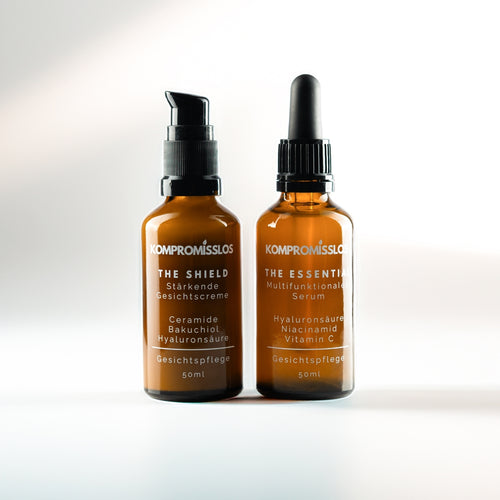
This explicitly applies to our own products too. The Duo is fragrance-free, contains vitamin C in the stable 3-O-ethyl form rather than pure ascorbic acid and contains no alcohol denat. That lowers the risk from some typical triggers. However, it does contain 5% niacinamide, which can occasionally prickle on skin that is already irritated, and there is no such thing as a guarantee for every skin anyway. If it stings on your skin, stop. That is what the 100-day return policy is for, and how returns of cosmetics work in general is covered in the article on your real rights when buying skincare online.
When do you need to see a doctor?
You need to see a doctor if your skin swells, weeps or blisters, if the reaction spreads beyond the area where you applied the cream, or if it does not subside within a few days of stopping. Get help immediately if your eyelids, lips or tongue swell or if you have difficulty breathing, in which case call the emergency number 144. These are not situations for home remedies. If you keep reacting to different products and cannot work out why, it is also worth seeing a dermatologist. They can find out whether a contact allergy is behind it and which substance triggers it – something you cannot reliably work out at home simply by leaving products out. If you have a known skin condition such as rosacea or atopic eczema, persistent stinging should also be assessed by a specialist. Skincare can play a supporting role there, but it cannot replace a diagnosis.
Do not try out a new cream on a day when you have exfoliated or spent a long time in the sun. If it stings then, you will not know whether it is the product or the state of your skin.
I deliberately used vitamin C in the serum as 3-O-Ethyl Ascorbic Acid rather than pure ascorbic acid, and I made both products fragrance-free. The reason is exactly what this article is about: stinging often comes from very acidic vitamin C formulations or from fragrance, and I did not want either in skincare for sensitive skin. You will find all the active ingredients and their concentrations in our overview of active ingredients. Even so, I cannot promise you that your skin will tolerate the Duo. Every skin is different, and a cream without fragrance can still sting. If it stings, stop using it.
Frequently asked questions
Does a cream sting more when your skin is dry?
Yes, a cream often stings noticeably more on dry skin. Dry skin has fewer lipids in its outermost layer and lets irritants through to the nerve endings more quickly. That is why the same cream is more likely to sting in winter, after a hot shower or after thorough cleansing. Cleansing less and taking a break from acids will then help more than switching products.
Can vitamin C sting on your face?
Yes, especially pure L-ascorbic acid in acidic serums. It needs a pH below 3.5 to penetrate the skin, and this acidic range easily causes prickling on sensitive skin. More stable forms such as 3-O-Ethyl Ascorbic Acid, the stable form of vitamin C, are formulated at a more skin-friendly pH and sting less often – but not never.
Why does a cream only sting in certain areas?
A cream often stings only where the skin is thinner or compromised. Typical areas are the sides of the nose, the skin around the mouth and eyes, the cheeks and any areas you touch often or that take a beating when you blow your nose. The barrier is weaker there, and irritants get through more quickly. With creams containing acids or vitamin C, it is best to avoid the eye area.
Can I use the cream again after a break?
Yes, if the stinging was brief and probably down to irritated skin, you can try again after a break of a few days. Start with a small amount, and not straight after exfoliating. If it stings again, you have your answer. If you had swelling, blisters or severe itching, do not use the product again without getting it checked first.
Does cooling help with stinging skin?
Yes, gentle cooling often eases the stinging quickly. A cloth soaked in cool water and laid on the skin for a few minutes works best. Ice or cold packs directly on the skin are too harsh for irritated skin. Cooling does nothing about the cause, though: if the cream stings every time, the only thing that helps is to stop using it.
Is stinging a sign that the cream is working?
No, stinging is not a sign that a cream is working. It only shows that an ingredient is irritating the nerve endings in your skin. Many effective products do not sting at all, and some products that do sting achieve very little. If you get used to strong stinging, you risk permanently irritated skin rather than a better complexion.
What should I do if The Duo stings on my skin?
Rinse it off and stop using it, just as you would with any other skincare. The Duo is fragrance-free and contains vitamin C in the stable 3-O-ethyl form, but that is no guarantee for every skin. Stinging that keeps coming back is a clear sign that it does not suit you right now. That is what the 100-day return policy is for.
Sources
- Misery L, Ständer S, Szepietowski JC, Reich A, Wallengren J, Evers AW, et al. Definition of Sensitive Skin: An Expert Position Paper from the Special Interest Group on Sensitive Skin of the International Forum for the Study of Itch. Acta Dermato-Venereologica, 2017. Source
- Pinnell SR, Yang H, Omar M, Monteiro-Riviere N, DeBuys HV, Walker LC, et al. Topical L-ascorbic acid: percutaneous absorption studies. Dermatologic Surgery, 2001. Source
- Lodén M, Andersson AC, Anderson C, Bergbrant IM, Frödin T, Ohman H, et al. A double-blind study comparing the effect of glycerin and urea on dry, eczematous skin in atopic patients. Acta Dermato-Venereologica, 2002. Source