Allergic reaction to face cream: how to recognise it, what causes it and what to do now
SKIN CONCERNS
You can recognise an allergic reaction to face cream by the fact that your skin does not react straight away but with a delay, often only the next day or the day after: it itches, turns red and swells, frequently around the eyelids, and the rash spreads beyond the area where you applied the cream. If that happens, stop using the cream immediately, rinse it off with water and don’t apply anything new. If your lips or tongue swell or you find it hard to breathe, call 144. Only an allergy test at a dermatologist’s can tell you which ingredient is behind it.
How do you recognise an allergic reaction to face cream?
An allergic reaction to face cream typically shows up as itchy, reddened eczema that appears after a delay and gets worse every time you use the product again. The skin may swell, flake, form small blisters or weep. The eyelids are affected particularly often, along with the cheeks, chin and neck. The edges tend to look blurred, and the rash does not stay within the area where the cream was applied. What lies behind this is a contact allergy, a delayed type IV reaction of the immune system. Your immune system has stored a particular substance as foreign and reacts to it as soon as it touches your skin again. That is why the main symptom is itching rather than burning. And it is not rare: according to a review in Current Allergy and Asthma Reports, cosmetics have been described as the trigger in around 30 per cent of people with facial eczema. Swollen, itchy eyelids the morning after starting a new cream are therefore a typical warning sign.
Allergy or irritation: how do you tell them apart?
Irritation comes on quickly and stays where the product was applied, whereas an allergy comes later, itches and spreads. Irritation is by far the more common of the two. In a paper in the journal Dermatology Practical & Conceptual, the authors attribute around 80 per cent of cases of contact dermatitis to the irritant form and the remaining 20 per cent to the allergic form. In their measurements, the irritant reaction peaked after 24 hours, while the allergic reaction only peaked after 72 hours. Irritation can affect anyone’s skin if a substance is too strong, applied too often or applied to a damaged barrier. An allergy only affects people who are sensitised to that exact substance – and then even small amounts are enough. The overview below is no substitute for a diagnosis, but it will help you make a first assessment.
| Feature | Irritation | Allergy |
|---|---|---|
| Timing | Immediately or within a few hours of applying | Delayed, often only after one to three days |
| Sensation | Burning, stinging, tightness | Mainly itching |
| Spread | Stays on the contact area, sharply defined | Spreads beyond the contact area, including to the eyelids and neck |
| Repeat exposure | Often gets weaker as the skin recovers | Gets stronger with every new contact |
| What helps | Fewer products, protecting the barrier | Finding the trigger and avoiding it for good |
A brief tingle right after applying usually belongs in the first column. What causes it and when it is harmless is explained in the article on face cream stinging.
Why are you suddenly reacting to a cream you’ve used for years?
You react suddenly because a contact allergy develops in two stages: first, your immune system becomes sensitised without you noticing, and only after that does every further contact trigger the eczema. The first stage can take months or years of repeated use without you feeling a thing. That is why the cream you have been using the longest is not automatically above suspicion. There are three other common reasons. First, manufacturers change their formulas without any visible change to the name or packaging. Second, the sensitisation may have happened through a completely different product, such as a shampoo, a shower gel or a perfume containing the same substance. Third, a stressed skin barrier – in winter, for example, or after too many active ingredients – lets more of a substance into the skin, which can encourage sensitisation. If, on the other hand, your skin reacts with redness to almost every product and no single trigger can be identified, an overloaded barrier is often the more likely cause. What helps in that case is covered in the article on skin suddenly reacting to everything.
Which ingredients most often cause a contact allergy?
The most common triggers of a contact allergy to cosmetics are fragrances. Preservatives used to cause a lot of allergies, but have become less common since stricter rules came in. Both points are made in the review in Current Allergy and Asthma Reports mentioned above. To track down the trigger, it is enough to know the main groups:
- Fragrances: perfume, fragrance allergens and essential oils top the list. How much a label actually tells you and what fragrance-free really guarantees is covered in a separate article.
- Preservatives: isothiazolinones such as methylisothiazolinone triggered a wave of allergies in the 2010s and are now banned in the EU in products that stay on the skin. More on this in preservatives in natural skincare.
- Plant extracts from the daisy family (Compositae), such as arnica, chamomile or calendula, which can cause a reaction if you already have a daisy-family allergy.
- Lanolin, or wool wax, a well-known natural trigger.
- Propolis, a resin produced by bees, which mainly causes allergies through lip care products and, according to the review, is becoming a more frequent trigger.
The list also shows that “natural” does not protect you from an allergy. The review explicitly names lanolin and propolis as established natural contact allergens.
What should you do now if your face is having an allergic reaction?
Stop using the suspect cream immediately and give your skin as little as possible until the reaction subsides. At this stage, every new substance makes it harder to find the trigger and can put further strain on your irritated skin. In practice, that means:
- Stop: leave out the suspect cream, along with any products you have started using in the past two weeks.
- Rinse: wash off any residue with lukewarm water, without rubbing.
- Apply nothing new: no home remedies, no oils, no aloe gel from the cupboard, no new cream to try out.
- Cool: a clean cloth dampened with cool water can ease the itching. Don’t scratch.
- Document: photograph the product and its full INCI list, and keep the packaging.
- Keep a record: take a photo of your skin every day and note when the reaction started.
Whether a cortisone cream or an antihistamine makes sense is for a professional to decide – depending on the situation, a pharmacist or a doctor. If your skin improves after a few days without the trigger, that points to an allergy, but it is not yet proof.
Take every product you have used on your face, hair and nails in recent weeks with you to the appointment. Photos showing how the reaction developed often help the dermatologist more than any description.
When do you need to see a doctor straight away, and when is a dermatologist appointment enough?
You need help immediately if your lips, tongue or throat swell, you are struggling to breathe, you feel dizzy or wheals like those of hives spread across your whole body. In that case, call the emergency number 144 and don’t wait. According to the review in Current Allergy and Asthma Reports, severe immediate reactions like these to cosmetics are rare, but when they do occur, they are an emergency. You need an appointment with your GP or a dermatologist if the eczema has not clearly improved after about a week despite stopping the product, if it weeps or spreads, if your eyes swell up badly or if the reaction keeps coming back without you knowing the trigger. This usually involves a clinical patch test (epicutaneous test): possible allergens are taped to your back and read after a few days. How this test differs from patch testing skincare at home is explained in the linked article. If the test identifies an allergy, you will be given an allergy passport, and from then on it is your most important tool.
How do you find a cream you can tolerate after a diagnosis?
After a diagnosis, you are not looking for a cream with the right promise, but for one whose full ingredient list contains none of the substances in your allergy passport. The passport does not always name allergens the way they appear on the packaging: “wool wax alcohols” in the passport, for example, becomes “Lanolin Alcohol” in the INCI list. So ask your dermatologist to note down the INCI names and common synonyms of your allergens. The article on how to read an ingredient list shows you how to do this. Terms like “hypoallergenic” or “dermatologically tested” are no substitute for this check. It also helps to keep the number of products small, because every additional product brings in new substances you need to check.
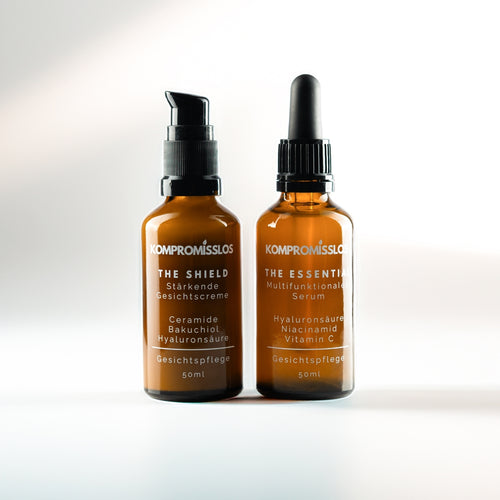
For The Duo of serum and cream, this means in concrete terms: both products are fragrance-free, and the Duo’s INCI list contains no essential oils, phenoxyethanol or parabens. The Duo does, however, contain plant extracts – aloe vera, edelweiss, gentian root, bakuchiol and tamarind seed – as well as plant oils such as jojoba oil and, as preservatives, Sodium Benzoate and Sodium Levulinate. Botanically, edelweiss belongs to the daisy family. So if your allergy passport lists the daisy family or any of these substances, The Duo is not the right choice for you. If none of them applies, starting a new product is still a trial, not a guarantee. That is what the 100-day return policy is for.
For me, two products instead of eight also means this: if your skin reacts, there are fewer substances to suspect. That is why I made The Duo fragrance-free and without essential oils. But I won’t pretend otherwise. Even fragrance-free skincare can trigger an allergy. The Duo contains plant extracts such as edelweiss and gentian root, along with bakuchiol and Sodium Benzoate, a preservative that I classify as synthetic on our own website. Anyone who is allergic to one of these specific substances should not use the Duo. That is why the Duo’s full INCI list is openly available, ingredient by ingredient. Check it against your allergy passport before you order. I cannot guarantee that no one will react – and, to be honest, no brand can.
Frequently asked questions
How long does an allergic reaction to cosmetics last?
An allergic reaction to cosmetics usually starts with a delay and, once you stop using the product, settles within a few days to a few weeks. As long as you keep using the trigger, it will keep coming back. If the eczema has not clearly improved after about a week without the product, get it checked by a doctor.
Why does the allergy show up on my eyelids when I don’t put cream there?
The skin on your eyelids is very thin and therefore often reacts first, including to substances that get there via your hands, your hair or your pillow. In an analysis of 228 people with eyelid eczema at a Brazilian referral centre, published in Anais Brasileiros de Dermatologia, a contact allergy was the cause in 61 per cent – most often from nail varnish, followed by topical medications and cosmetics.
Can you be allergic to natural skincare or plant extracts?
Yes, natural skincare and plant extracts can trigger a contact allergy just like any other product. Well-known examples are plants from the daisy family such as arnica or chamomile, propolis and lanolin. A natural origin says nothing about whether your immune system will tolerate a substance. The only thing that matters is whether a substance from your allergy passport appears in the INCI list.
Does “hypoallergenic” protect you from an allergy?
No, “hypoallergenic” does not protect you from an allergy. The term only means that a manufacturer has tried to avoid known allergens. If you are allergic to a specific substance and it is in the product, you will still react. The only reliable approach is to check the INCI list against your allergy passport.
Can I wear make-up or use another cream during the reaction?
Better not, as long as your skin is visibly reacting. Make-up and new creams add more substances to skin that is already inflamed and make it harder to find the trigger. If your skin feels very tight, ask a pharmacist or doctor which skincare suits this phase.
Can I try the cream again later?
Not if the allergy has been confirmed, because a contact allergy usually persists and the reaction returns with the next contact. You shouldn’t try it again without getting checked either. If the allergy test finds no allergy to the ingredients, discuss with your dermatologist whether and how another attempt makes sense.
What should I do if I think I’m allergic to The Duo?
Stop using both products straight away, rinse your skin with water and don’t apply anything new. If your lips or tongue swell or you are struggling to breathe, call 144. If there is severe swelling or weeping eczema, get it checked by a doctor. Take the INCI list of The Duo with you to the appointment so that the dermatologist can test specifically for its ingredients.
Sources
- Sukakul T, Svedman C. What is New in Contact Allergy To Cosmetics for Physicians, Cosmetologists, and Cosmetic Users? Current Allergy and Asthma Reports, 2025. Source
- Gkagkari P, Tagka A, Stratigos A, Karalis V, Kyritsi A, Vitsos A, et al. Differential Diagnosis of Irritant Versus Allergic Contact Dermatitis Based on Noninvasive Methods. Dermatology Practical & Conceptual, 2024. Source
- de Figueiredo Silva Hafner M, Cerqueira Elia V, Lazzarini R, Duarte I. Demographic and clinical characteristics of patients with eyelid eczema attended at a referral service from 2004 to 2018. Anais Brasileiros de Dermatologia, 2023. Source