Tight skin: where the feeling comes from and what your skin really needs
SKIN CONDITION
Tight skin happens when the outermost layer of the skin holds too little water and has lost lipids from the barrier. The most common triggers are harsh cleansing, dry, centrally heated air and too many active ingredients at once. What helps is gentle cleansing, moisture-binding ingredients such as hyaluronic acid, and a lipid-containing cream straight afterwards.
Why does your skin feel tight?
A feeling of tightness develops when the outer layer of the skin can no longer hold on to its water content and loses flexibility as a result. This outer layer consists of keratinised cells embedded in a mass of lipids. If those lipids are missing, or water is, the tissue becomes stiffer, and it is precisely this stiffness that you perceive as tightness. Three factors explain most cases: a cleanser that strips away too much oil, surroundings with very low humidity, and skincare that adds moisture but doesn’t seal it in. Age plays a part, because lipid production declines, but it is rarely the only reason. The distinction is important: tightness is a skin condition, not a skin type. It occurs in oily skin just as much as in dry skin, and it disappears once the trigger is removed. That is why it pays to look for the trigger first rather than immediately buying another product. How to recognise a damaged skin barrier is the most important clue here.
| Trigger | How to recognise it | What to change |
|---|---|---|
| Harsh cleansing | Tightness sets in within a few minutes of washing. | Gentle cleansing, lukewarm rather than hot water. |
| Dry indoor air | Tightness mainly occurs during the heating season and in the morning. | Increase the humidity, apply a richer layer in the evening. |
| Too many active ingredients | Tightness started after a new exfoliant or serum. | Cut back your routine, pause acids and retinoids. |
| Missing lipids | Skin feels tight all day despite a moisturising product. | Add a cream with ceramides and squalane. |
Why does your skin feel tight straight after washing?
Your skin feels tight straight after washing because surfactants remove not only dirt and sebum but also some of the skin’s own lipids and water-binding substances. According to a review in Dermatologic Therapy, this very tightness after cleansing is regarded as a typical consequence of surfactants reacting with skin proteins and skin lipids. As a rule, the more foaming and alkaline a cleanser is, the stronger the effect. Traditional bar soaps sit well above the slightly acidic pH of the skin’s surface and intensify the feeling further. Hot water works in the same direction, because it dissolves oils more quickly. In practice, if your skin feels tight after every cleanse, the problem is not the cream afterwards but the product before it. A well-tolerated cleanser leaves your skin feeling clean, but not taut. If the tightness persists, it is a signal that sensitive skin takes seriously.
Why does your skin feel tight even with moisturiser?
If your skin feels tight despite using a cream, it is usually not moisture that is missing, but the layer that holds it in. Moisture-binding ingredients such as hyaluronic acid, glycerin or panthenol attract water, but without a lipid-containing top layer they release it back into the surroundings. In dry indoor air, a purely hydrating product can even make the tightness worse, because the bound water evaporates upwards. The second common reason is quantity: many people apply too little and spread what there is over half their face. The third reason is timing. Applied to completely dry skin, a serum finds hardly any water to bind, and the cream on top then seals in an outer layer that is already empty. So the sensible order is moisture first, lipids on top, and both on skin that is still slightly damp. This is exactly the logic behind the question of whether you really need a serum and a cream, or whether one layer is enough.
Which active ingredients help with tight skin?
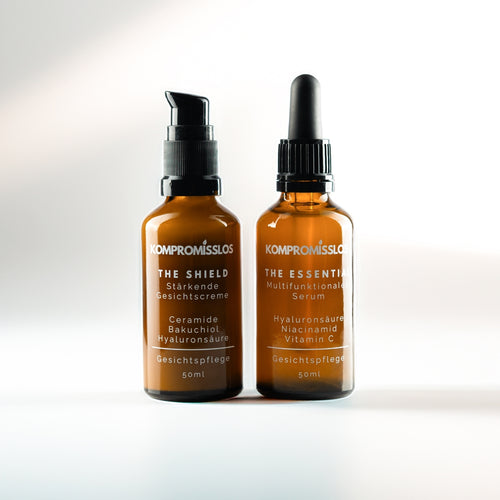
With tight skin, two groups of active ingredients work together: moisture-binding and barrier-supporting ones. The first group includes hyaluronic acid, panthenol and aloe vera, which hold water in the outer layer of the skin. The second group includes ceramides, squalane, jojoba oil and niacinamide, which replenish the lipid layer and support its renewal. The combination of active ingredients in the Duo contains, across both products together, 2% hyaluronic acid, 5% niacinamide and 1% zinc, plus ceramides, squalane, panthenol and jojoba oil without a set percentage. What does little for acute tightness, on the other hand, is acids, retinoids and alcohol-based toners, because they put extra strain on the barrier. A pure face oil also rarely solves the problem on its own, because it seals moisture in but doesn’t bring any with it. It is worth understanding exactly what role ceramides play in skincare before you change your routine. You will find the full list under Ingredients.
What skincare does tight skin need day to day?
A routine for tight skin consists of four steps and doesn’t need eight products. What matters is less what you add than what you leave out and the order in which you work. The following sequence covers both morning and evening and takes under two minutes. Importantly, give your skin two to four weeks before judging whether the change is working, because the outer layer of the skin renews itself slowly. If the tightness eases noticeably during this time, the cause was very probably the cleanser or a missing lipid layer. If it stays the same, it is worth looking at the indoor air, medication and changes in diet. A common mistake in this phase is switching products every week: if you test something new every few days, you can never tell what worked and what didn’t. So keep your routine deliberately boring until the tightness has gone. Exact amounts and the order are on the How to use page.
- Cleanse with lukewarm water, no more than twice a day, without a strongly foaming product.
- Apply serum to skin that is still slightly damp, 3 to 6 drops.
- Cream straight on top, 3 to 6 pumps, while the serum hasn’t quite been absorbed.
- Pause acids, exfoliants and retinoids until the tightness has gone.
If you follow this routine morning and evening, The Duo of serum and cream lasts 2 to 4 months, depending on how often you use it.
When should you see a professional about tight skin?
Tightness is a matter for a professional if it persists for several weeks despite gentle cleansing and lipid-containing skincare, or if it comes with other symptoms. Specific reasons include cracks in the skin, weeping patches, severe itching, sharply defined redness, or tightness that started suddenly after beginning a medication. Tightness that affects the whole body rather than just the face should also be checked by a dermatologist, as should tightness accompanied by noticeably dry eyes or a dry mouth. Cosmetics work on the surface: binding moisture, replenishing lipids, visibly calming the complexion. Diagnosis is not part of that, and skincare is no substitute for treating skin conditions. This line is not caution for the sake of it, but a practical matter. If you spend months trying out creams when there is a different cause behind it, you lose time and money alike. How the picture shifts over the years is described in our article on dry skin with age.
For The Shield cream, I deliberately chose ceramides and squalane rather than a heavy occlusive. The reason is simple: a dense film takes the tightness away immediately, but solves nothing once you stop using it. Lipids that match your own barrier take longer, but the effect lasts. And to be honest: if your skin only feels tight in winter and only in the morning, you don’t need a new routine. Higher humidity in your bedroom is enough. I would rather sell one Duo fewer than talk you into a problem your central heating is causing.
Frequently asked questions
Is tight skin the same as dry skin?
No. Tightness is a sensation; dry skin is a condition with visible signs such as flaking and roughness. The two often occur together, but oily skin can also feel tight, for example after harsh cleansing. That is why it helps to look for the trigger rather than assign your skin to a type.
Why does my skin only feel tight in winter?
Cold outdoor air and centrally heated air contain little water vapour. As a result, more water evaporates from the surface of the skin and the water content of its outer layer drops. According to a review in the Journal of the European Academy of Dermatology and Venereology, ambient humidity measurably affects the water content of the skin’s outer layer. Higher indoor humidity often helps more than a new product.
Which active ingredients are suitable for tight skin?
Moisture-binding ingredients such as hyaluronic acid, panthenol and aloe vera, combined with barrier-supporting lipids such as ceramides, squalane and jojoba oil. Niacinamide also supports the barrier; the Duo contains 5%. Acids, retinoids and alcohol-based toners should be paused while your skin feels tight, because they put extra strain on its outer layer.
Does drinking more water help with tight skin?
Drinking enough makes sense, but it rarely solves tightness on its own. The water content of the skin’s outer layer depends mainly on how well the barrier retains water, not on how much you drink, provided your intake is normal. Gentle cleansing, a lipid-containing cream and more humid indoor air are more effective.
How long does it take for the tightness to ease?
When you change your cleansing and skincare, the feeling often improves within a few days, but the barrier itself takes longer. Allow two to four weeks before judging whether the new routine is working. If the tightness is unchanged after that, it is worth looking at the indoor air, medication or getting it checked.
Can a face oil solve tightness?
A face oil seals the surface and eases the feeling in the short term, but it doesn’t bring any water of its own. Applied to dry skin, there is no moisture for it to hold. It makes more sense to apply moisture first with a lipid-containing layer on top, rather than relying on oil alone.
Is it normal for skin to feel tight after applying serum?
A brief tightening feeling as a serum dries is harmless and disappears once a cream goes on top. Persistent tightness with burning or redness, on the other hand, suggests an ingredient that is too demanding. In that case, stop using the product and see whether the feeling goes within a few days.
Sources
- Ananthapadmanabhan KP, Moore DJ, Subramanyan K, Misra M, Meyer F. Cleansing without compromise: the impact of cleansers on the skin barrier and the technology of mild cleansing. Dermatologic Therapy, 2004. Source
- Goad N, Gawkrodger DJ. Ambient humidity and the skin: the impact of air humidity in healthy and diseased states. Journal of the European Academy of Dermatology and Venereology, 2016. Source