Ceramide benefits: what they do, how to use them and which skin needs them
ACTIVE INGREDIENTS
The main benefit of ceramides is structural: they are lipids your skin makes itself, and they account for around half of the lipid mass in its outermost layer. In skincare, they replace what the skin loses through age, cleansing or cold, and slow down moisture loss. They make most sense for dry, sensitive or over-treated skin. If your barrier is intact and working well, they add little extra benefit.
What do ceramides do in skincare?
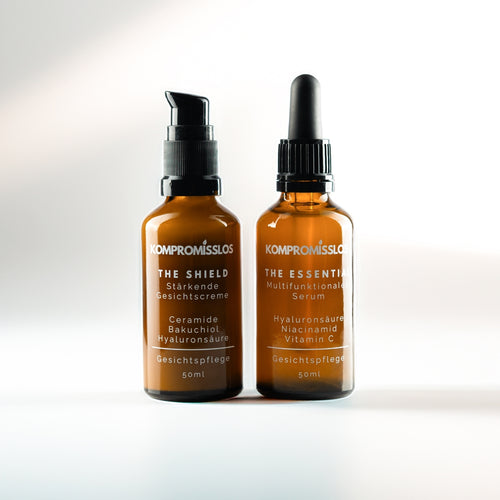
Ceramides are lipids your skin produces itself, and in skincare they top up the lipids that the outermost layer of the skin, the stratum corneum, is missing. They do not bind water the way hyaluronic acid does, and they do not interfere with pigment processes the way niacinamide does. Wrinkles, dark spots and oil production are not what they address. Their job is less spectacular but more fundamental: they fill the spaces between the skin cells in that outer layer and make sure water evaporates more slowly. Without this mortar, your skin loses more moisture over the day than it can replace. You notice it as tightness after washing, as rough patches or as a sudden stinging from products you have used for years. That is exactly why ceramides are in The Duo of serum and cream, together with squalane and panthenol. Ceramides will not give you a visible result within a week. They make your skin more resilient, and you usually notice that through what stops happening: the tightness, the redness, the reaction to cold air.
Ceramides and the skin barrier: what is behind it?
Around half of the lipid mass of the skin barrier is made up of ceramides. According to a review in the Journal of Lipid Research, the lipid matrix of the stratum corneum consists of roughly 50 per cent ceramides, 25 per cent cholesterol and 15 per cent free fatty acids. Together, these three groups form a layered mass between the skin cells that keeps water in the tissue and irritants out. When the proportion of ceramides falls, the layering becomes disordered and the barrier becomes more permeable in both directions. There are plenty of causes: frequent washing with harsh, stripping cleansers, dry central-heating air in winter, aggressive exfoliants and, quite simply, age, because the skin’s own lipid production slows down. We have explained separately how this feels day to day and how to recognise a damaged skin barrier. Ceramides applied to the skin do not replace its own production; they bridge the shortfall until the skin catches up again.
That is why the effect does not rise in step with the amount. A barrier that is already replenished simply takes on extra ceramides without doing more with them. What a weakened barrier costs you day to day is a better yardstick than any percentage.
Which skin conditions benefit from ceramides?
Ceramides are worth it whenever the stratum corneum has lost lipids, not when your skin simply needs water. This is the crucial distinction that many routines miss: dry skin lacks oil, dehydrated skin lacks water, and the two feel similar. For dry, mature or sensitive skin, ceramides are almost always the right answer. For skin that is purely dehydrated with an intact barrier, they are a supporting act; hyaluronic acid does more there. For blemish-prone skin, they are neither the problem nor the solution, but they do stabilise skin that has been put under strain by drying active ingredients. With combination skin, it helps to look at the individual zones rather than the face as a whole: cheeks and jawline benefit, while the T-zone usually needs less. How your needs shift over the years shows particularly clearly with dry skin as you get older.
| Skin condition | What ceramides do there | What else to watch |
|---|---|---|
| Dry skin | Replace missing lipids and ease the feeling of tightness | Check your cleanser – often the real cause |
| Dehydrated skin | Keep the water you apply in the stratum corneum for longer | Hyaluronic acid is the more important building block here |
| Sensitive skin | Reduce the surface that irritants from outside can attack | Leave out fragrance and avoid frequent product changes |
| Skin prone to redness | Visibly calm the skin when the redness comes from dryness | Have persistent redness checked |
| Combination skin | Stabilise dry zones without weighing down the T-zone | Dose zone by zone rather than applying all over |
| Mature skin | Make up for the skin’s declining lipid production | Consistency over months beats any concentration |
How much ceramide should a product contain?
There is no sensible percentage for ceramides that anyone can seriously quote, because what matters is the ratio to the other barrier lipids, not a single figure. In the study by Man and colleagues in the Journal of Investigative Dermatology, a mixture of ceramides, cholesterol and free fatty acids in equal parts allowed the barrier to recover normally, and a threefold increase in any one of these three components speeded up recovery further. So the composition is what counts, not the headline on the front of the pack. On top of that, ceramides are expensive and difficult to formulate in a stable way, which is why many brands name them on the packaging but list them right at the end of the INCI list. Their position tells you more than any advertising claim. In our full ingredient list, you can see where ceramides sit in our formula and what they are combined with.
At Kompromisslos, we deliberately do not give a percentage for ceramides. The figures we state apply to the Duo as a whole: 5% niacinamide, 2% vitamin C as 3-O-ethyl ascorbic acid, 2% hyaluronic acid, 1% zinc and 0.3% bakuchiol. Ceramides, squalane and panthenol work as a trio in the Kompromisslos serum and cream, and a single isolated figure would promise more than it could deliver.
What can you combine ceramides with?
Ceramides are among the least problematic active ingredients there are, because they are chemically inert and are not sensitive to pH. You can combine them with shea butter and aloe vera without restriction: shea butter adds to the occlusive effect, aloe vera provides moisture, and neither gets in the way of the ceramides. Peptides and coenzyme Q10 also get on well with them, as they work on different levels and do not compete for the same mechanism. Niacinamide and hyaluronic acid are equally unproblematic, and in our products they are in the same formula anyway. Things get more interesting with exfoliating acids. Salicylic acid, other BHAs and AHAs loosen bonds in the stratum corneum and strip it of lipids in the process. Applying ceramides afterwards is not only fine, it is the obvious order, because they give back exactly what the exfoliant has taken away. For a broader picture, see our overview of which active ingredients work together.
Two combinations come up particularly often: vitamin C alongside ceramides and ceramides together with vitamin E. Both work, but each has its own logic for the order. As a rule of thumb: light textures first, lipid-rich ones last.
When ceramides are not enough and a professional is the better choice
Ceramides are a purely cosmetic ingredient, and their limit lies exactly where a skin condition needs medical assessment. If redness persists for weeks, if weeping or scaly patches appear, if your skin reacts severely with no obvious trigger or if itching keeps you awake at night, that is a matter for a dermatologist, not for a skincare routine. The same applies if you suspect a contact allergy or if you already have a skin condition under medical care. In such cases, skincare can be a useful accompaniment, but it does not replace a diagnosis or treatment. It is only fair to say the reverse as well: if your skin does not feel tight after washing, is not rough and takes new products in its stride, you do not need extra ceramide care. A barrier that works well does not improve because you offer it more lipids than it can use.
When we were developing the formula, I spent a long time thinking about whether to state a percentage for ceramides. I decided against it, because in this group of ingredients such a figure says little and easily turns into a marketing argument I could not defend. What I can defend is the combination: ceramides, squalane and panthenol as a trio that supports the barrier from three sides, rather than a single figure printed in large type. In any case, the feedback we receive most often is not about percentages but about tightness after washing. To me, that was the more honest yardstick.
Frequently asked questions
What happens if your skin doesn’t tolerate ceramides?
Genuine intolerance to ceramides is rare, because they are substances the skin makes itself. If your skin reacts to a product containing ceramides, the cause is usually one of the other ingredients, such as fragrance, preservatives or emulsifiers. Stop using the product, watch your skin for two weeks and then test the products one at a time. If the reaction persists, have it checked by a dermatologist.
How often should you use ceramides?
Twice a day, morning and evening, is the usual rhythm. Ceramides do not build up like an ingredient your skin gets used to; they continually replace what the skin loses. With the Duo, that means 3 to 6 drops of serum and 3 to 6 pumps of cream per application. Depending on how often you use it, a bottle lasts 2 to 4 months.
Are ceramides suitable for over-treated skin?
Yes, over-treated skin is one of the most sensible uses for them. Too many active ingredients, too much exfoliating and constant product changes strip lipids from the stratum corneum. Ceramides give exactly these back. Just as important is leaving things out: for a few weeks, cut back to cleansing, a ceramide product and sun protection before you add active ingredients again.
Can you use ceramides and aloe vera together?
Yes, ceramides and aloe vera complement each other well and do not interfere. Aloe vera binds moisture in the stratum corneum, and ceramides slow down its evaporation. Apply the watery aloe component first and the richer ceramide product afterwards, otherwise the lighter texture can no longer get through. In the Duo, the two are already combined.
Can you use ceramides and peptides together?
Yes, peptides and ceramides can be combined without restriction. They work in different places: peptides target signalling pathways in deeper layers, ceramides the lipid matrix of the stratum corneum. There is no known interaction that would require you to separate them. Apply the peptide product first if it has the lighter texture.
Can you use ceramides with AHAs or BHAs?
Yes, and the order is clear: first the acid, then the ceramides. AHAs and BHAs such as salicylic acid loosen bonds in the stratum corneum and strip it of lipids in the process. Ceramides applied afterwards give exactly these back. Applied at the same time, the ceramide layer would dilute the acid and weaken its effect.
Can you use ceramides and shea butter together?
Yes, shea butter and ceramides work in the same direction. Shea butter forms an occlusive film on the skin, while ceramides work within the stratum corneum. For very dry skin, the two complement each other well. For combination or blemish-prone skin, shea butter can be too heavy; there, the ceramide product on its own is usually enough.
Sources
- Feingold KR, Thematic review series: Skin Lipids. The role of epidermal lipids in cutaneous permeability barrier homeostasis, Journal of Lipid Research, 2007. Source
- Man MQ, Feingold KR, Thornfeldt CR, Elias PM, Optimization of Physiological Lipid Mixtures for Barrier Repair, Journal of Investigative Dermatology, 1996. Source