Vitamin C and ceramides: what works together and in which order
INGREDIENT COMBINATIONS
You can combine vitamin C and ceramides without any restrictions. The two do not compete, either chemically or for the same place in your skin: vitamin C is a water-soluble antioxidant, ceramides are barrier lipids. Apply the vitamin C serum first, then the cream containing ceramides. For sensitive skin, this order is actually the more obvious choice.
Why vitamin C and ceramides don’t get in each other’s way
Vitamin C and ceramides do not get in each other’s way because they work in completely different places. Vitamin C is a water-soluble antioxidant that neutralises free radicals and is involved in pigment formation. Ceramides are lipids – fats the skin makes itself – that sit in the spaces within the outermost layer of the skin and seal the barrier there. The two meet in the stratum corneum but have separate jobs there: one works on keeping the barrier tight, the other on oxidative protection. There is no reaction that makes either substance ineffective. The only point at which such a combination tips over in practice is pH: pure L-ascorbic acid needs a strongly acidic environment, and that puts additional strain on a barrier that is already irritated. If a pH-stable form of vitamin C is used instead – like the one in The Duo, with 2% 3-O-ethyl ascorbic acid – this conflict disappears entirely.
An example from my inbox: a customer wrote to tell me that her previous vitamin C serum stung when she applied it, so she had stopped using her cream, because she thought the combination was the problem. It was the other way round. The stinging came from the acidic serum, and the cream would have been the only thing to calm her barrier afterwards.
In what order should you apply vitamin C and ceramides?
Apply the vitamin C serum first, then the cream with ceramides. The rule behind this is simple: light, water-based textures first, oil-based textures last. A cream with lipids forms a film over your skin and slows down anything that comes after it. A watery serum, on the other hand, absorbs quickly and lets the cream work on top without hindrance. If you reverse the order, the vitamin C is not lost, but it reaches the stratum corneum more slowly and in smaller amounts. You do not need to wait between the two steps. As soon as the serum no longer feels damp – usually after about thirty seconds – you can apply the cream. The amount plays a part too: too little serum spreads unevenly, too much sits on the surface and makes the cream harder to apply. Three to six drops reliably cover a face.
- Cleanse your skin and pat it dry.
- Spread 3 to 6 drops of serum over your face and neck.
- Wait around thirty seconds, until your skin no longer looks damp.
- Apply 3 to 6 pumps of cream on top.
- In the morning, finish with your sun protection.
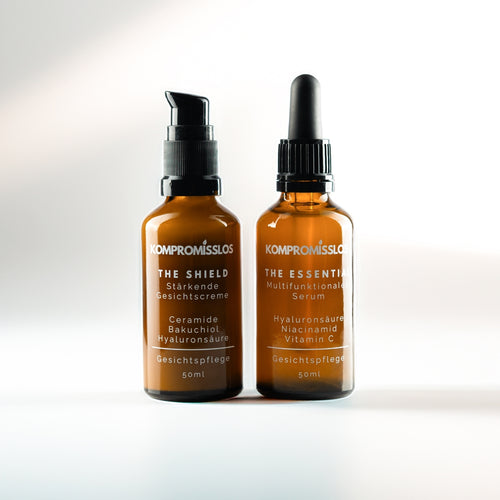
This sequence applies morning and evening alike and is described in more detail on our page on how to use the serum and cream. Both are available, designed to work together, as the Duo of The Essential serum and The Shield cream.
What ceramides do in the skin barrier
Ceramides make up around half of the lipids in the outermost layer of the skin and hold its barrier together. According to a review in the International Journal of Cosmetic Science, the lipids of the stratum corneum consist of about 50% ceramides, around 25% cholesterol and 10 to 20% free fatty acids. This mixture forms the layers between the skin cells and is often compared to the mortar between bricks. When ceramides are lacking, the skin loses water more quickly, feels tight and reacts more sensitively to everything that comes from outside. The same review describes thirteen classes of ceramide with more than three hundred individual types, which shows how finely tuned this system is. Ceramides applied from outside do not replace the skin’s own, but they fill gaps and visibly support the skin barrier in its function. In winter and with age, this top-up becomes noticeably more important for many people.
Ceramides are on the Duo’s list of active ingredients. You can find the INCI name of the ceramide we use in the overview of all ingredients.
Why the form of vitamin C decides how well your skin tolerates it
The form of vitamin C determines how acidic a formulation has to be – and therefore how well it is tolerated. Pure L-ascorbic acid has a pKa of 4.2 and, in water-based formulations, needs a pH below 3.5 so that it stays uncharged and can get through the stratum corneum at all. The skin’s pH, by contrast, is around 5.5, and formulations below 3.5 can irritate it. 3-O-ethyl ascorbic acid tackles this at the root: the ethyl group protects the part of the molecule that would otherwise oxidise quickly and shifts the pKa to 7.72. At a pH of 5.5 – close to the skin’s own value – the molecule therefore stays uncharged and stable. For combining with ceramides, that is exactly the point: there is no need for an acidic environment that puts extra strain on the barrier. The same percentage on two labels can therefore feel completely different, depending on which form is behind it.
A side finding from the research fits the picture: in a study on pig skin, around 80% of the 3-O-ethyl ascorbic acid applied stayed in the skin when it came from a lipid-based carrier system, compared with about 44% from a plain water solution. This cannot be transferred to a finished skincare product, but it does show that lipids and vitamin C are not mutually exclusive.
Which combinations are trickier than vitamin C and ceramides
Combinations that are trickier than vitamin C and ceramides are those in which two irritating steps meet. Ceramides are nourishing lipids with no irritation potential of their own, so they practically never cause a conflict. It is a different story if you combine a strongly acidic vitamin C product with a fruit acid peel or with retinol in the same routine. Not because the ingredients destroy each other chemically, but because your skin gets too much in total. Typical signs are tightness, stinging on application and redness that does not go away after a few days. The solution is rarely to give something up, but to spread things out: one active ingredient in the morning, one in the evening, or an exfoliant just twice a week. In this picture, ceramides are the balancing element, never an additional irritant. If you are also using acids for blemish-prone skin, it is worth taking a particularly close look here.
| Combined with vitamin C | Can be used together | What to watch out for |
|---|---|---|
| Ceramides | Yes | Serum first, cream afterwards. |
| Niacinamide | Yes | Both fit into the same routine. |
| Hyaluronic acid | Yes | Apply a cream on top. |
| Bakuchiol | Yes | Bakuchiol is considered a gentler alternative to retinol. |
| AHA or BHA | With caution | Two acidic steps can overwhelm sensitive skin. |
| Retinol | With caution | If irritation occurs, split them between morning and evening. |
To weigh up the two most discussed active ingredients, the comparison vitamin C or niacinamide will help.
When skincare is no longer enough
Skincare reaches its limit when a change in your skin persists, spreads or hurts. Skincare looks after the outermost layer of the skin and can improve its appearance; it is no substitute for a medical assessment. If redness lasts for weeks, if weeping or heavily flaking patches appear, if a mole changes, or if your skin reacts badly to several products in a row, that belongs in the hands of a dermatologist. The same applies if you have a known skin condition and are unsure whether an active ingredient is suitable. No serum and no cream – including one with ceramides – is meant to replace a diagnosis or treatment. Until your appointment: fewer products, gentle cleansing and no additional acids. A gentle skincare routine does no harm during this time, but it does not replace a medical assessment either.
For the Duo, I deliberately chose 3-O-ethyl ascorbic acid rather than classic L-ascorbic acid in double-digit concentrations. The reason is exactly the question this article is about: a product meant to support the barrier and a second one that strains it with a pH below 3.5 work against each other. With 2% 3-O-ethyl ascorbic acid, I get a stable form of vitamin C that does not need a strongly acidic environment. That costs me the big percentages on the packaging. In return, the routine stays sustainable even for sensitive skin, and that is what counts after a few weeks. You can read what customers tell us in their reviews.
Frequently asked questions
Can you use vitamin C and ceramides on the same day?
Yes, vitamin C and ceramides can be used on the same day and straight after each other without any problem. They do not interfere with each other: vitamin C acts as an antioxidant, ceramides as barrier lipids. Apply the serum first, then the cream. There is no need to split them between morning and evening.
Does the vitamin C serum or the ceramide cream go on first?
The vitamin C serum first, then the cream with ceramides. Watery textures always go before oil-based ones, because a lipid layer slows the penetration of the products that follow. Doing it the other way round does not break anything, but the vitamin C reaches the stratum corneum more slowly. You do not need a long wait – around thirty seconds is enough.
Morning or evening: when does the combination work best?
Both work, and using it at both times is the norm. In the morning, vitamin C provides antioxidant protection against environmental stressors; in the evening, the ceramides support overnight regeneration. If you have to choose one time, use the serum in the morning and the richer care in the evening.
Does vitamin C destroy the ceramides in the cream?
No. Vitamin C oxidises itself, but it does not break down ceramides. Ceramides are chemically stable lipids and do not react with ascorbic acid or its derivatives. What can actually happen is that a very acidic vitamin C product irritates the skin. That is down to the pH of the formulation, not the ceramides.
Does the combination make sense for sensitive skin?
The combination makes particular sense for sensitive skin, provided the form of vitamin C is pH-stable. The ceramides support the barrier while the vitamin C works as an antioxidant. It only becomes critical with strongly acidic formulations below pH 3.5. Start with one application a day and only increase after one to two weeks.
Do you need other active ingredients besides vitamin C and ceramides?
In most cases, no. Vitamin C, ceramides, a moisturising component and sun protection in the morning cover the essentials. Other active ingredients only help if you have a specific additional goal. More products mean more variables and make it harder to see what is actually working.
Sources
- Moore, D.J. and Rawlings, A.V., The chemistry, function and (patho)physiology of stratum corneum barrier ceramides, International Journal of Cosmetic Science, 2017. Source
- Iliopoulos, F. et al., 3-O-ethyl-l-ascorbic acid: Characterisation and investigation of single solvent systems for delivery to the skin, International Journal of Pharmaceutics: X, 2019. Source
- Loza-Rodríguez, N. et al., Lipid-Based Gels for Delivery of 3-O-Ethyl L-Ascorbic acid in Topical Applications, Pharmaceutics, 2024. Source