Swiss cosmetics: how to tell where a product really comes from
SWISS COSMETICS
Swiss cosmetics may only be called Swiss if at least 60% of the manufacturing costs are incurred in Switzerland and the defining manufacturing step takes place here. The raw materials themselves can come from abroad. If you want to check where a product comes from, read the company address on the packaging and the ingredient list – not the cross in the advertising.
What makes a product a Swiss cosmetic product?
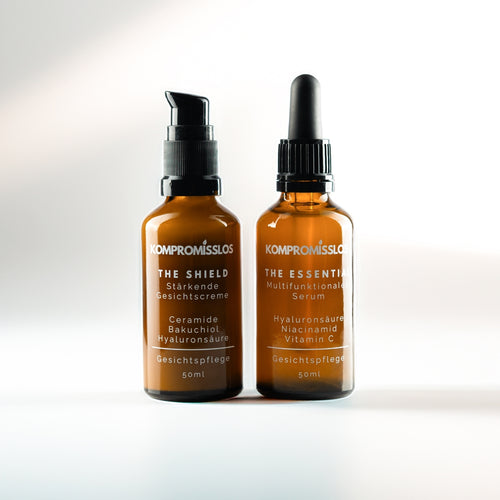
What counts is not the company logo but a cost calculation. In law, cosmetics are industrial products, and for this category the Swissness legislation sets two conditions: at least 60% of the manufacturing costs must be incurred in Switzerland, and the activity that gives the product its essential characteristics must also take place here. Costs that count towards this include manufacturing, research and development, and quality assurance. Marketing, distribution and the transport of packaging do not. That explains why a brand with a Swiss address is not automatically selling a Swiss product. Phrases such as “developed in Switzerland” or “Swiss design” mean something quite different in law and are not tied to any such threshold. Conversely, a product remains Swiss even when individual raw materials are imported, which in cosmetics is almost always the case. If you want to know what goes into our Duo of serum and cream, the ingredient list tells you more honestly than any statement of origin.
How are cosmetics actually made in Switzerland?
It starts with the formula, not the machine. A formulation defines which active ingredient, at which concentration, stays stable with which emulsifier, preservative system and pH. Next, the raw materials are bought in, usually from specialist suppliers who ship their extracts with data sheets and certificates of analysis. Swiss plant ingredients such as edelweiss or gentian root extract come through the same route. Only then does production begin: weighing, heating, emulsifying, cooling, testing, filling. Before release come stability and compatibility tests with the packaging, because a formula ages differently in its container than in a laboratory beaker. At most Swiss brands, none of this happens in-house but at a contract manufacturer that produces for several clients. That is industry standard and no flaw, because these facilities have equipment, hygiene standards and laboratory capacity that a small brand could never support on its own. The brand is responsible for the formula, the choice of raw materials and the release of every single batch.
Which rules apply to manufacturing and safety in Switzerland?
Cosmetics in Switzerland are not unregulated, even though there is no approval process like the one for medicines. Before it goes on sale, every product needs a safety assessment by a qualified expert and a product information file that brings together the formula, raw material data, stability and the safety report. Manufacturing itself is subject to a standard of good manufacturing practice which, according to the Federal Food Safety and Veterinary Office (FSVO), corresponds to ISO 22716. Certification is not mandatory, but the requirements for hygiene and cleanliness still apply. On top of that, there is a ban on misleading claims: advertising must not mislead and must not promise medical or therapeutic properties. Checks happen after products are on the market, carried out by the cantonal enforcement authorities, which can take samples and request documentation. For you, this means a product on sale in Switzerland has cleared these hurdles before you see it. It does not mean it is the right one for your skin.
How can you tell from the packaging who is behind a product?
Packaging reveals more than most people expect. Among other things, it must state the name and address of the manufacturer, importer, distributor or responsible person. If that is a Swiss address, there is at least someone here who can be held accountable for the product. Then there are the ingredients, listed in descending order of quantity using INCI nomenclature, a batch number for traceability, and either a best-before date or the open-jar symbol showing how long the product can be used after opening. The order of the ingredients is the most useful part: anything near the end is present only in small amounts, however large it is advertised on the front. That is exactly why we state our concentrations openly instead of letting them disappear in a long list. You will find all the figures on the ingredients page.
A country on the packaging tells you nothing about the dose inside. A product of Swiss origin can contain 0.5% niacinamide, an imported one 5%. Check the concentration first, then the origin.
Swiss origin, natural skincare, vegan: what does each term mean?
These three terms often sit side by side on the shelf and mean entirely different things. Origin is a geographical statement about costs and manufacturing steps. Natural skincare is not a legally protected term; it is defined by private standards and labels, which vary in strictness from one provider to the next and in some cases only require a minimum share of natural raw materials. Vegan means that no animal-derived raw materials have been used – no beeswax, no lanolin, no silk. None of the three terms, on its own, says anything about tolerability or effectiveness, and none replaces a look at the concentration of an active ingredient. That is why it pays to check them separately rather than buying them as a package. The overview below shows what each term covers and what it does not. If you are unsure which active ingredients to prioritise for your skin, the comparison vitamin C or niacinamide will help.
| Term | What it stands for | What it does not mean |
|---|---|---|
| Swiss origin | A legally regulated cost threshold and the defining manufacturing step in Switzerland. | That all raw materials come from Switzerland. |
| Natural skincare | Private standards and labels with criteria of varying strictness. | A legally protected, uniform term. |
| Vegan | No animal-derived raw materials in the formula. | Automatically better tolerability or organic quality. |
| Swiss made | A statement of origin under the same rules as above. | A verdict on the quality of the formula. |
What does all this mean for your buying decision?
Treat origin as one factor among several, not as a shortcut. When you are looking at a product, four questions will get you further than any label. First: which active ingredients does it contain, and at what concentration? Second: is there a reachable address on the packaging? Third: does the texture suit what your skin needs right now? For blemish-prone skin the answer is different from dry skin. Fourth: how many products will you realistically use every day? That last point is often underestimated, because routines fail less often because of the formula than because of the number of steps. That is why we deliberately limited ourselves to two products for CHF 109.90, morning and evening, with 3 to 6 drops of serum and 3 to 6 pumps of cream. You can see how that works day to day on the how-to-use page, and what others have experienced with it in the customer reviews.
I am often asked why there is no big Swiss cross emblazoned on our bottles. I deliberately chose not to make origin our main argument, because it tells you nothing about how much active ingredient you are actually getting. Instead, we put the numbers first: 5% niacinamide, 2% hyaluronic acid, 2% vitamin C as 3-O-Ethyl Ascorbic Acid, each relative to the Duo as a whole. You can compare these figures with other products; you cannot compare a country code. Where exactly production takes place, we will tell you openly if you ask: [OPEN: production site of the serum and the cream]. Origin is part of the answer, but never the whole of it.
Frequently asked questions
What exactly does Swiss made mean for cosmetics?
Swiss made is a statement of origin, not a quality label. For cosmetics, as industrial products, at least 60% of the manufacturing costs must be incurred in Switzerland, and the step that gives the product its essential characteristics must take place here. The term says nothing about the formula itself.
Do the raw materials in Swiss cosmetics have to come from Switzerland?
No. The cost threshold applies to manufacturing costs, not to the origin of every single raw material. Many cosmetic active ingredients are not produced in Switzerland at all. A product can therefore be of Swiss origin and still contain imported extracts, oils and emulsifiers.
Are Swiss cosmetics approved by the authorities?
No, there is no approval process like the one for medicines. What is required is a safety assessment by a qualified expert and a product information file for every product. Checks happen after products are on the market, carried out by the cantonal enforcement authorities, which can take samples and inspect a brand’s documentation.
Are Swiss cosmetics automatically natural skincare?
No, the two terms have nothing to do with each other. Origin is regulated by law; natural skincare is not – the term is defined by private standards and labels. A Swiss product can be formulated entirely from synthetic ingredients, and an imported product can be strictly certified.
How do I know who made a cosmetic product?
The packaging must state the name and address of the manufacturer, importer, distributor or responsible person. That is not necessarily the production facility, but it is the party that stands behind the product. Many brands have their products made by a contract manufacturer, which is common practice in the industry.
Why are Swiss cosmetics often more expensive?
Higher wages, smaller production runs and the effort involved in safety assessments and documentation are reflected in the price. The small home market also limits economies of scale. A higher price is therefore a result of the cost structure and, on its own, no proof of a better formula.
Sources
- Swiss Federal Institute of Intellectual Property, Herkunftskriterien für industrielle Produkte. Source
- Federal Food Safety and Veterinary Office (FSVO), Spezifische gesetzliche Anforderungen für kosmetische Mittel. Source
- FDHA Ordinance on Cosmetic Products (VKos), SR 817.023.31, Art. 8 and 9. Source