Peptides in skincare: what they can do and what they can’t
ACTIVE INGREDIENTS
Peptides in skincare are short chains of amino acids used as signal molecules, carriers, enzyme inhibitors or blockers of chemical messengers. Their mechanisms are well described; the clinical evidence, by contrast, is limited. Studies are small and short, and they often measure proxy markers. Above all, it remains unresolved how much of a peptide actually gets through the outermost layer of the skin.
What are peptides in skincare?
Peptides are short chains of amino acids which, in cosmetics, are intended to mimic the body’s own messenger substances. According to a review in the Indian Journal of Dermatology, Venereology and Leprology, cosmetic peptides fall into four groups: signal peptides, carrier peptides, enzyme inhibitors and peptides that dampen the transmission of chemical messengers. Each group follows a different idea. Signal peptides are meant to stimulate connective-tissue cells, carrier peptides to deliver trace elements such as copper into the skin, and enzyme inhibitors to slow the breakdown of structural proteins, while the fourth group targets expression lines. One point matters for putting all this in context: peptides are a class of substances, not a single active ingredient. Two products that both advertise peptides can contain completely different molecules with completely different evidence behind them. The term on its own says nothing about either the amount or the benefit. That is why a look at a product’s ingredient list and at the exact INCI name tells you far more than the word on the front of the pack.
How well do peptides actually penetrate the skin?
This is the biggest open question about peptides, and the available measurements contradict each other. Peptides are water-loving and, as molecules go, relatively large, whereas the stratum corneum – the outermost layer of the skin – is fat-loving and densely packed. A review in the International Journal of Molecular Sciences summarises two laboratory studies on Acetyl Hexapeptide-8 that came to opposite conclusions. In one, around 30 per cent of the applied amount was found in the receptor fluid after two hours. In the other, only 0.22 per cent had penetrated the stratum corneum after 24 hours, and nothing at all was detectable in the receptor fluid. The authors conclude that penetration as far as the muscles is unlikely when peptides are applied to the skin. Whatever peptides do on the skin therefore seems to happen in the epidermis rather than in the deeper layers. How this filter works in detail is explained in our article on how the skin barrier is built.
How strong is the evidence for peptides?
The evidence for cosmetic peptides is supportive, but weak. A review in the journal Cosmetics rates the clinical evidence for peptides as present but modest, and names three recurring weaknesses: small numbers of participants, short study periods and endpoints that capture biophysical proxy markers rather than validated clinical outcomes. For comparison, the same review rates the evidence for retinoids, vitamin C, AHAs and BHAs as the most robust. That does not mean peptides do nothing. It means advertising credits them with more certainty than the studies support. For you as a buyer, this is the crucial point: a peptide on the pack is a promise about a mechanism, not about a result. Which products offer which active ingredients with what evidence can only be established from the studies. For how to assess claims like these more generally, see our article on what really slows down skin ageing.
Which peptides appear on INCI lists, and what do they promise?
Four peptides turn up particularly often on Swiss shelves and in online shops, and they belong to three different groups with different levels of evidence. Palmitoyl Pentapeptide-4 is the most widely studied signal peptide, Acetyl Hexapeptide-8 the best-known member of the messenger-dampening group, Copper Tripeptide-1 represents the carrier peptides, and Dipeptide-2 stands for the enzyme inhibitors. The fatty acid attached to the palmitoyl versions is no accident: it makes the molecule more fat-soluble and is meant to help it pass through the stratum corneum. The review mentioned above names exactly this chemical modification as one of three strategies, alongside encapsulation in carrier systems and the addition of penetration enhancers. Unlike an active ingredient whose concentration is stated openly, the amount of a peptide can almost never be read off the label. The table below puts the four names in context, so that you can read an INCI list without relying on the advertising claim on the front.
| Peptide (INCI) | Group | What it is marketed for | How to rate the evidence |
|---|---|---|---|
| Palmitoyl Pentapeptide-4 | Signal peptide | Firmness and fine lines | Controlled studies over 4 to 8 weeks, but small groups. |
| Acetyl Hexapeptide-8 | Messenger dampener | Expression lines on the forehead and around the eyes | Effects described; the advertised mechanism remains unconfirmed. |
| Copper Tripeptide-1 | Carrier peptide | Elasticity and a more even tone | Good laboratory data, weaker data from cosmetic use. |
| Dipeptide-2 | Enzyme inhibitor | Puffiness and the eye area | Few independent studies beyond manufacturers’ own data. |
Do you need a peptide serum if your routine is already in place?
In most cases, no – and that is not modesty but a question of priorities. Before a peptide can make a difference, three things have to be right: an intact barrier, enough moisture and consistent sun protection. If one of these is missing, an extra serum is the most expensive and slowest solution. If your skin feels tight after washing or reacts with irritation to new products, sort that out first. And if you are looking for a gentler alternative to retinol, the comparison between bakuchiol and retinol for sensitive skin is the more relevant decision. Peptides are considered well tolerated and can be used alongside niacinamide, hyaluronic acid or ceramides without any problem, as our overview of combining active ingredients shows. They are a sensible extra, but not the foundation of your routine. That is exactly why our skincare consists of two steps rather than seven.
Where skincare stops: peptides, botulinum toxin and the professional
Peptides are cosmetic ingredients and replace neither a diagnosis nor medical treatment. That applies especially to the group marketed as a topical alternative to botulinum toxin. Botulinum toxin is injected into the muscle, a peptide sits on the skin, and the review in the International Journal of Molecular Sciences states explicitly that the evidence for reduced muscle activity after topical application remains thin and largely theoretical. If you expect the same effect, you will be disappointed. Regardless of this, persistent redness, weeping or scaly patches, sudden changes to a mole or itching that keeps you awake at night need to be checked by a dermatologist, not treated with a skincare routine. The same goes if you suspect a contact allergy or have a reaction that does not settle. And if you have a skin condition under medical care, the principle stays the same: skincare can accompany treatment, but the treatment is decided in the doctor’s surgery.
In short: Peptides are not a bad class of ingredients, but they are an oversold one. They make sense as an addition once cleansing, moisture and sun protection are already in place. You can see what a pared-back routine looks like in practice in our guide to using serum and cream.
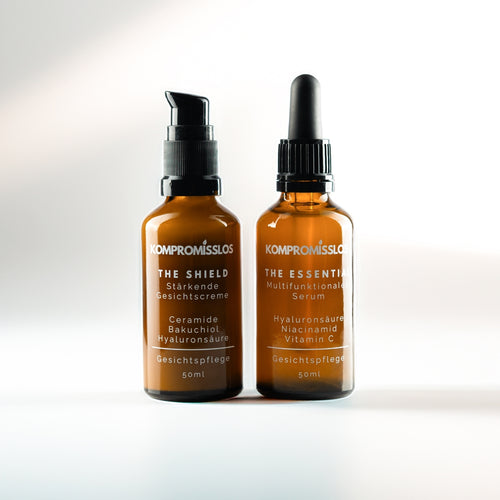
The Duo of serum and cream contains no peptides, and that is a deliberate decision. I looked at this class of ingredients during development and then rejected it, because I could not find an answer I could defend to the crucial question: how much of it, in a formula without an elaborate carrier system, actually reaches the place where it is supposed to work. Instead, I opted for active ingredients whose concentration I can disclose, including 5% niacinamide, 2% hyaluronic acid and 0.3% bakuchiol, each based on the serum and cream together. I would rather have fewer names on the pack than one I cannot justify.
Frequently asked questions
Does The Duo by Kompromisslos contain peptides?
No. The serum and cream contain no peptides. Their ingredients include 5% niacinamide, 2% vitamin C as 3-O-ethyl ascorbic acid, 2% hyaluronic acid, 1% zinc and 0.3% bakuchiol, all figures based on the Duo as a whole. They also contain ceramides, squalane, panthenol and aloe vera, for which no percentage is given.
Are peptides better than retinol or bakuchiol?
Not on the current evidence. The evidence for retinoids is considered the most robust, and for bakuchiol there is a controlled study comparing it with retinol. Reviews rate peptides as promising but with only modest clinical evidence. They are more of an addition than a replacement.
Can I combine peptides with niacinamide or vitamin C?
Yes, peptides are considered easy to combine and do not need to be used at a different time from niacinamide, hyaluronic acid or ceramides. With strongly acidic vitamin C formulas, separate use is sometimes recommended, because very low pH values can break down some peptides. In that case, apply one in the morning and the other in the evening.
How long do peptides take to work?
The available studies on signal peptides use application periods of four to eight weeks, in some cases up to twelve weeks. Shorter periods say little. Allow at least eight weeks of consistent use before you judge a product, and don’t change several other products at the same time during that period.
Are peptides suitable for sensitive skin?
As a rule, yes. Peptides do not exfoliate, do not shift the pH significantly and are considered well tolerated. Reactions are more often caused by fragrance, preservatives or emulsifiers than by the peptide itself. Even so, test a new product on a small area for three days before applying it more widely.
Do peptides make sense in a cleanser?
Hardly. A cleanser stays on the skin for seconds and is then rinsed off, while peptides struggle to get through the stratum corneum in any case. There, the ingredient serves the advertising claim more than the result. Peptides make more sense in products that stay on the skin.
Can peptides replace botulinum toxin treatment?
No. Botulinum toxin is injected into the muscle; a cosmetic peptide stays on the surface. Reviews note that the evidence for reduced muscle activity after topical application remains thin and that penetration as far as the muscles is unlikely. Visible effects tend to take place at the surface.
Sources
- Pai VV, Bhandari P, Shukla P. Topical peptides as cosmeceuticals. Indian Journal of Dermatology, Venereology and Leprology, 2017. Source
- Zdrada-Nowak J, Surgiel-Gemza A, Szatkowska M. Acetyl Hexapeptide-8 in Cosmeceuticals: A Review of Skin Permeability and Efficacy. International Journal of Molecular Sciences, 2025. Source
- Crespi O, Rosset F, Pala V, Sarda C, Accorinti M, Quaglino P, Ribero S. Cosmeceuticals for Anti-Aging: Mechanisms, Clinical Evidence, and Regulatory Insights. Cosmetics, 2025. Source