Peptides and retinol together: do they complement or cancel each other out
COMBINING ACTIVE INGREDIENTS
You can use peptides and retinol together: there is no evidence that the two weaken each other, and some tested products even contain both in a single formula. Whether the combination does more than retinol alone is another matter, because no study has cleanly isolated what the peptides contribute. In practice, both can go on your skin on the same evening, thinner textures before richer ones. What matters more than an extra peptide serum is skincare that sees your skin through the retinol phase.
Can you use peptides and retinol together?
Yes, you can use peptides and retinol together, whether in a combination product, on the same evening or split between morning and evening. Retinol is a vitamin A derivative that the skin converts step by step into active retinoic acid. Peptides are short chains of amino acids, mostly marketed in cosmetics as signalling molecules for the skin. How well they penetrate the skin and how robust the evidence for their effects is are covered in the article on what peptides can and can’t do in skincare. For the question of combining them, one point is enough: the two groups of active ingredients work through different pathways, and the scientific literature contains no study showing that they weaken each other on the skin. That is why manufacturers have been combining them in a single product for years. The real limit lies elsewhere, namely in the total number of products your skin can cope with while it gets used to retinol.
One exception applies regardless of peptides: during pregnancy and breastfeeding, pause retinoids and discuss your skincare with a healthcare professional.
Do peptides and retinol interfere with each other, or is that a myth?
The blanket claim that peptides and retinol interfere with each other is a myth, usually cobbled together from two other rules. The first concerns retinol itself: combined with acid exfoliants on the same night, it quickly becomes too much for many skin types. The second concerns certain types of peptide, where combining them with acids or vitamin C is debated. Neither has anything to do with pairing a peptide with retinol. The studies also argue against the myth. A study in the British Journal of Dermatology tested a skincare regimen in which one product contained niacinamide, the peptides Pal-KT and Pal-KTTKS and 0.3% retinyl propionate, a retinol ester, all together. A smaller study in the Journal of Drugs in Dermatology tested a serum containing 0.1% retinal and peptides in one formula. This does not prove that the peptides contribute anything, but it does show that both groups of ingredients can coexist in one product.
In practice, the combination can still cause trouble, just for other reasons: two serums layered on top of each other pill more easily, and every additional layer is one more potential source of irritation. How to layer multiple serums without that happening is a separate question.
Does the combination do more than retinol alone, and how solid are the studies?
Whether peptides and retinol together do more than retinol alone has not been shown, because no study has yet made exactly this comparison. The best-known study, published in the British Journal of Dermatology in 2010, compared two complete routines in 196 women with fine lines around the eyes: a cosmetic regimen with 5% niacinamide, peptides and 0.3% retinyl propionate versus a prescription routine with 0.02% tretinoin. After 8 weeks, the cosmetic regimen performed significantly better on the appearance of wrinkles; after 24 weeks, the two were comparable in a subgroup, and the regimen was better tolerated on every measure. That sounds like an argument for peptides, but only up to a point. The regimen contained several groups of active ingredients at once, there was no group without peptides, and the study was funded by the manufacturer. The second study, on the retinal and peptide serum, had 32 participants and no control group, and the product tested comes from a co-author’s own brand.
| Study | What was tested | Result | What remains open |
|---|---|---|---|
| British Journal of Dermatology, 2010 | Regimen with niacinamide, peptides and 0.3% retinyl propionate versus 0.02% tretinoin, 196 women | Appearance of wrinkles better after 8 weeks, comparable after 24 weeks, better tolerated | No group without peptides, funded by the manufacturer |
| Journal of Drugs in Dermatology, 2024 | Serum with 0.1% retinal and peptides, 32 women, 3 evenings a week | Visible changes after 8 weeks, no irritation in the patch test | No control group, contribution of the peptides unknown |
Both studies show that combination formulas like these can be well tolerated and that the participants’ skin visibly improved. What they do not show is how much of that is down to the peptides. The retinoid part, on the other hand, is well researched, as the overview of which anti-wrinkle ingredients are actually proven explains.
In what order do you apply a peptide serum and retinol, and do both belong in your evening routine?
Apply the thinner product first and the richer one afterwards, which usually means peptide serum before retinol cream. If both are serums, the more watery one goes on first. There is no study on the order; the rule simply follows texture, so that a richer, oilier layer does not hold back the next product. Retinol belongs in the evening because it is sensitive to light and because your skin needs sun protection during the day anyway. Peptides, by contrast, are not tied to any time of day. That leaves three clean options:
- Both in the evening: cleansing, peptide serum, retinol, then moisturiser if your retinol product does not replace it.
- Split: peptide serum in the morning under your moisturiser and sunscreen, retinol in the evening.
- Alternating: retinol on its set evenings, the peptide serum on the evenings in between.
The split option is the simplest, because each evening involves fewer layers and any reaction is easier to trace. How vitamin C, niacinamide or hyaluronic acid fit into a retinol routine is covered in the overview of what to mix with retinol.
Do peptides make retinol easier to tolerate?
It is often claimed that peptides make retinol easier to tolerate, but there is no evidence for it. The better tolerability in the British Journal of Dermatology study referred to the comparison with tretinoin, a prescription retinoid. A review in Clinical Interventions in Aging describes exactly this difference: irritation such as burning, flaking or dermatitis is mainly a problem with tretinoin and tazarotene, whereas retinal and retinol are considered considerably less irritating. The fact that the cosmetic regimen was better tolerated can therefore already be explained by the milder retinoid and the nourishing creams, with no need for peptides. What actually determines how well you tolerate retinol is well known: concentration, frequency, building up slowly and skincare that supports the skin barrier. If your skin still burns or flakes, the article on retinol side effects will help you work out what is still part of the adjustment phase and what no longer is.
Never start two new products in the same week. Otherwise, if your skin reacts, you will not know whether it is the retinol, the peptide serum or the combination of the two.
When can you skip the peptide product alongside retinol?
You can skip the peptide product if your retinol routine is established, your skin tolerates it and the rest of your skincare covers hydration and the barrier. With retinol, you are already using a well-researched active ingredient. An extra peptide serum adds a layer with thinner evidence, more cost and one more variable on top. Specifically, you do not need one if:
- your skin is still getting used to retinol and every extra layer adds to the strain,
- the skincare you apply after retinol already hydrates and supports the barrier,
- you would only buy the product because the combination is marketed as a booster,
- your budget is better spent on a good sunscreen for the morning.
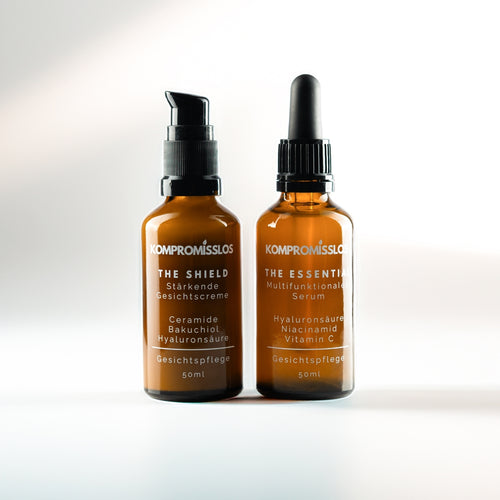
To be honest, with retinol the supporting skincare is the more important part. The Duo, made up of The Essential serum and The Shield cream, contains neither peptides nor retinol, according to its ingredient list. The serum relies on niacinamide and hyaluronic acid in three molecular sizes, the cream on ceramide NP, squalane and bakuchiol instead of retinol. That way, it hydrates and supports the skin barrier without bringing a second retinoid into your routine.
I deliberately left both peptides and retinol out of the Duo. The cream contains bakuchiol instead of retinol, and you use both products the same way, morning and evening. Rather than an ingredient cocktail, I disclose the concentrations: 5% niacinamide, 2% vitamin C as 3-O-Ethyl Ascorbic Acid and 1% zinc PCA, which apply to The Duo as a whole. Two products instead of eight also means that if you want retinol, you add it deliberately. You do not need a peptide serum on top for that. What I cannot promise is that extra retinol alongside the Duo will suit every skin; only your own skin can show you that. What is inside and why is set out on the page with all active ingredients and their concentrations.
Frequently asked questions
Can I use copper peptides and retinol on the same evening?
That is possible if your skin tolerates each product well on its own. There is no study showing that they weaken each other, but there is also hardly any data on this exact combination. If you want to keep things simple, use copper peptides in the morning or on evenings without retinol. That keeps your retinol evenings lean.
Can I use a peptide serum in the morning and retinol in the evening?
Yes, this split is straightforward. The peptide serum goes on in the morning after cleansing, under your moisturiser and sunscreen, and retinol goes on clean skin in the evening. That way, each time of day has fewer layers, and you can see more quickly which product your skin tolerates well and which it does not.
Are there products that already contain peptides and retinol together?
Yes, combination products like these exist, and some have been tested in studies, for example with retinyl propionate or retinal. The advantage is one layer fewer. The downside is that you cannot dose the active ingredients separately, and if the product irritates your skin, you lose both. Check that the retinoid concentration is stated.
Can I combine peptides with retinal instead of retinol?
Yes, the same logic applies to retinal. The study in the Journal of Drugs in Dermatology actually tested a serum with retinal and peptides in one formula, used on three evenings a week. Retinal is a different precursor of retinoic acid from retinol, so introduce it just as carefully and only increase the frequency once your skin stays calm.
Can I start a new peptide product while my skin is getting used to retinol?
Better not. Your skin is most likely to react during the adjustment phase, and every new product makes it harder to tell what is triggering a reaction. Wait until your retinol has been running smoothly for a few weeks, then add the peptide serum as the only new product.
Are peptides and retinol suitable for very sensitive skin?
They can be, but not both at once from day one. Start with retinol at a low frequency and only add peptides later. Whether retinol suits your skin at all is the subject of the comparison bakuchiol or retinol for sensitive skin. If redness persists or you have rosacea, the question belongs with a dermatologist.
Can I use peptides and retinol in addition to The Duo?
Yes. According to its INCI, The Duo contains neither peptides nor retinol, so nothing is doubled up. You do not need a peptide serum on top. You can add retinol deliberately, but it is not essential, as the cream already contains bakuchiol. Keep an eye on how your skin tolerates it and, if in doubt, leave out other extra products on retinol evenings. You can see what is in The Duo’s serum and cream on the product page.
Sources
- Fu JJ, Hillebrand GG, Raleigh P, Li J, Marmor MJ, Bertucci V, et al. A randomized, controlled comparative study of the wrinkle reduction benefits of a cosmetic niacinamide/peptide/retinyl propionate product regimen vs. a prescription 0.02% tretinoin product regimen. British Journal of Dermatology, 2010. Source
- Mukherjee S, Date A, Patravale V, Korting HC, Roeder A, Weindl G. Retinoids in the treatment of skin aging: an overview of clinical efficacy and safety. Clinical Interventions in Aging, 2006. Source
- Konisky H, Bowe WP, Yang P, Kobets K. The Clinical Efficacy and Tolerability of a Novel Retinaldehyde Serum with Firming Peptides to Improve Skin Texture and Signs of Photoaging. Journal of Drugs in Dermatology, 2024. Source